
Attendance and Behaviour Hubs: a DfE initiative

One of the government initiatives that I have just caught up with is the one around attendance and behaviour hubs. The DfE announcement in December when the programme was announced said that:

The regional improvement for standards and excellence (RISE) attendance and behaviour hubs programme is a national initiative designed to support schools in improving pupil attendance and behaviour.

Led by schools with strong practice, it aims to:

  • support school leaders to reflect on current systems
  • share effective practice
  • implement changes

It is aimed at senior leaders with responsibility for attendance and behaviour who are seeking to strengthen their school’s leadership, culture and systems. RISE attendance and behaviour hubs programme – GOV.UK

Yesterday, the DfE updated the list of lead schools, so I took a look at these schools in the South East Region.  Today’s list has five primary and five secondary schools as lead hubs.

The secondary schools are located in:

West Sussex

Milton Keynes

Medway

Slough

Portsmouth

Two of these schools are non-selective schools in a location with selective schools; four schools are under-subscribed, with the fifth school having 1150 pupils against a roll of 1058, and it is a faith school.

The five primary schools are located in

Kent – 2

East Sussex

West Sussex

Medway

All have at rolls of at least 400 pupils, although three of the schools are nowhere near their capacity.

How these schools will spread good practice across the region from Milton Keynes to the Isle of Wight and from Oxfordshire to Bracknell Forest will be an interesting challenge.

One option not open to them will be the device used in the Durham coalfield in the 19th century and recorded on the noticeboard of the school now housed in the Beamish Living Museum.

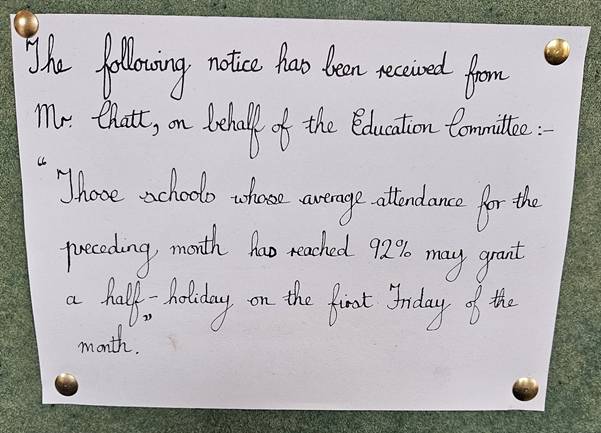
The notice reads

The following notice has been received from Mr Chatt, on behalf of the Education Committee: –

“Those schools whose average attendance for the preceding month has reached 92% may grant a half-holiday on the first Friday of the month.”
Looking at the DfE’s data for Oxfordshire, the average attendance from September 2025 to start of February 2026 was 95.1% for primary schools; 91.5% for secondary schools and 88.8% for special schools.

On the basis of that data some primary schools would have qualified for the half-day in at least one month. Possibly some secondary schools might have done so as well.

However, it is worth remembering that the schools receiving the notice were Elementary Schools, taking pupils from 5 to 13 or 14, depending upon the school leaving age at the time of undated message. Attendance by the older pupils was probably as much of a challenge in the 19th century as it is today; albeit for different reasons.

Challenging schools still find keeping a headteacher challenging

Alongside the White Paper, published today by the DfE, The DfE also released a document entitled Schools, school workforce and pupils statistical analysis 2026 Schools, school workforce and pupils statistical analysis 2026

Within this document, I was interested to see a discussion of headteacher turnover by Pupil Premium Decline. This showed that for both primary and secondary schools, but especially for secondary schools, turnover of headteachers was more likely where Pupil Premium levels were higher. Thus, in Band 1, – most deprived – 8.7% of secondary school headteachers changed between November 2024 and November 2025. This compared with just 2.3% of headteacher vacancies in secondary schools in Band 10. The data was taken from the DfE’s own database of teacher records and the School Workforce census.

Readers of my post of yesterday, won’t be surprised by this piece of research Headteacher: recruitment bonus – good value or not? | John Howson

Interestingly, in September 2002, the then NCSL (National College for School Leadership) published a piece of research on headteacher turnover that I conducted for the College. ‘Staying Power: the relationship between headteachers’ length of service and PANDA grades. (PANDA grades were a measure of a school’s performance and schools were graded from A* to E*).

My research looked at secondary schools with either A* or A grades and compared them with schools with E* or E grades.

The research was based upon an analysis of vacancy advertisements for headteacher posts at these schools.

As with today’s research finding, in 2002, A* schools had the greatest percentage of headteachers with more than six years of service, and E* schools the smallest percentage of headteachers with more than six years f service at that school. There were 785 A*/A schools and 780 E*/E schools in the survey.

There was also an association between the PANDA grade and readvertisement rates. 8% of A* vacancies for a headteacher were re-advertised compared with 14% of E* headteacher vacancies, and 49% of schools rated as E.

As headteachers often move from headship into retirement, the age profile of the teaching profession is a factor affecting turnover. A younger profession means fewer headteachers reaching retirement age.

However, the thesis that the more challenging the school, the shorter the term of office of a headteachers, still seems as credible today as it was half a century ago. Whether the government’s policies as foreshadowed in the White Paper will help to change this pattern of turnover and length of service will be interesting to watch.

Music teacher shortage: the situation worsens

Regular readers will know that I have been pursuing a return of the ITT bursary for postgraduates enrolling to train as a music teacher on courses starting in the autumn of 2026. This is a very small -U- turn for the government, but a necessary one for the subject, and its future in our schools and universities.

Previous posts on this blog have demonstrated that the removal of the bursary has already affected ‘offers’ to music courses, with a reduction of around 20 ‘offers’ in January 2026 compared with January 2025. Traditionally, any reduction in early-bird offers is not recovered later in the annual application cycle. Music ITT will miss its target: my reasoning | John Howson

This post looks at competition for teachers of music. There are three main areas for teachers to seek work as a teacher of music in a school: the state sector- including sixth form colleges; independent schools in England; private schools across the globe that seek to employ teachers trained in England.

Our starting point this year is the 367 trainees in music identified by the DfE’s annual census taken in December 2025. Add in Teach First and any late arrivals, and the overall total might be 380 – being generous.

Take of 10% for non-completes and those not choosing teaching as a career, and the labour market might have a supply of 342 trainees seeking work.

By mid-February, there had been 100 advertised vacancies by state schools for teachers of music without a TLR – i.e. classroom teacher posts. A well-used job board recorded 15 classroom teacher vacancies from independent schools in England on a single day in mid-February.

On the same date, the same job board, recorded 99 vacancies for teachers of music from schools across the world.  This was made up of 40 vacancies in The Gulf, primarily in Dubai and the other Emirates, but there were 13 vacancies from schools in China, and 46 from schools elsewhere in the world.

Now I don’t expect nearly qualified teachers to apply for these vacancies, but to the extent that these posts are not filled by teachers already working overseas, then these vacancies will take teachers away from schools in England, and create new vacancies.

Assuming only a third of these vacancies are filled by teachers leaving schools in England, and the rest filled in other ways that would be an extra 33 vacancies at present.

Adding together the 100 state school vacancies so far in 2026 to the 15 already recorded private schools in England plus the 33 overseas schools currently seeking a new teacher that might recruit from schools in England that produces a total of 148 vacancies by mid-February, or 43% of the available total of trainees. Increase the take by overseas schools to half of their current vacancies, and not far off half the available pool for September and January could have been offered a job.

Now, some of the vacancies in Egland will be filled by existing teachers changing jobs or returners to the profession, but most experienced teachers will probably be looking for a post with a TLR if seeking a move to another school.

With three months to go to the summer resignation date, and six months until terms start, the pool of available teachers already looks stretched, and this is with trainees that have enjoyed the bursary.

If the lack of a bursary shrinks the 2027 pool, because there are fewer trainees, is removing the bursary a sensible move? In my opinion, it is not, and the government should reintroduce the bursary for trainees starting preparation courses in autumn 2026 to be a teacher of music.

 We will continue to monitor the situation and report back through future blogs as the recruitment round unfolds.

Off to University

Here’s a hear warming story about a student from among the group of most disadvantaged pupils in our education system https://www.oxfordmail.co.uk/news/19162077.traveller-milly-teaches-classics-going-oxford-university/

I would say in our schools, but most traveller and Romany children don’t go to school on a regular basis.

When I joined Oxfordshire’s Education Committee in the early 1990s – some readers may have to look up the term Education Committee in the history books – Oxfordshire had a fully fitted mobile classroom serving this community. Now, these children sometimes don’t even appear on the pupil outcomes data as a group as their outcomes are so far adrift from those of other groups in society.

Fairground children are a distinct group within the wider category, and in rural areas they spend part of the year traveling from market own to market town for the annual street fair.  So, congratulations to Milly on winning a place at University, and to Joe for the work that his organisation does to promote Oxford University with state school pupils.

I wonder whether anyone has thought about traveller children during the lockdown and whether they have had access to on-line learning. I will be asking the question as this group could surely benefit from the learning about remote teaching and learning gained during the pandemic.

I recall visiting a secondary school a couple of years ago where they had children from a mobile home community site for travellers on their roll. They worked hard to ensure the children received an education even though it took up time and resources. The National Funding Formula and per pupil funding don’t provide for the needs of groups where special arrangements are required.

I won’t say ‘Good Luck’ Milly, because I don’t believe she needs good luck. But, I do hope that she enjoys her time at university.