Funding SEND – is the current system fair?

The DfE has just published data that sets the context for the expected White Paper, due this autumn. Looking at the data on the High Needs Block that has been the basic building block for the funding of SEND (special needs and disabilities), I can see why there must have been some very intense discussions between the DfE and the Treasury. Section 251: 2025 to 2026 – GOV.UK

The data on individual special school funding only refers to maintained schools where local authorities are responsible for oversight of the budgets. It would be really helpful to see similar ‘cost per place’ data for academy special schools and alternative provision, including Pupil Referral Units, even though they have a different financial year to maintained schools.    

The data for the municipal financial year of 2025-26 for Oxfordshire was set while I was still the cabinet member for Children’s Services, including maintained schools. The data on funding per place for the three maintained special schools in Oxfordshire is illuminating. There is a total of 522 such schools in England listed in the data. The most expensive costs £8.2 million per place, and judging by its website does a great job educating some very challenged young people from the start of their education journey to adulthood.

Now special schools come in many different forms with clearly different funding needs. A school for pupils with hearing loss and no other disability might need less funding per place than a school for non-verbal young people with physical disabilities in addition

The three Oxfordshire maintained schools were placed 74th, 155th and 170th in the list of 522 schools, with funding per place ranging from £840,000 to £1,2 million. Schools with £2,000,000 per place of more were ranked 373 of higher in the list. Does this mean that Oxfordshire is efficient or under-funded compared with some other local areas? I do wonder.

Even allowing for issues such as higher salary costs in London and surrounding areas, the range of cost per place for similar types of school seems worth looking into more closely, and that is where the academy special schools’ data would be useful in order to allow full consideration of cost per place by local government areas.

The current High Needs block distribution formula clearly isn’t working, and I wonder whether equity of funding is an issue for the team putting together the White Paper? How does anyone judge what is fair in funding levels? Wiser heads than mine will know the answer to that question.

Of course, the other key funding issue for SEND, especially outside of the urban areas, is the cost of transport. The Section 251 budget statement for planned expenditure during 2025-26 by Oxfordshire at Line 175092 of the DfE’s spreadsheet suggests expected spending on SEND transport, including for post-16 students of around f£26.4 million. This compares with expected home to school transport costs of just under £21 million for all other pupils entitled to fee transport.

How will the White Paper deal with this cost? Hopefully, it will recognise that such costs should be met by government up to age 18 or even 19 for all such pupils, and not be discretionary beyond age 16. Could a government funded driver scheme for unemployed adults with a driving licence remove the profit element from such expenditure or would the administration costs be more than the saving made by not using private sector firms?

These are not easy issues to grapple with, but starting with some values about the needs of children with SEND would be a good basis for the outcomes in the White Paper. However, as my earlier analysis of Pupil Teacher Ratios demonstrated, funding and values are not common cause in government spending, regardless of the political persuasion of the government in power. Oxford Teacher Services -publications

Special Needs – is nothing new?

Serendipity is defined as a fortunate finding of something unexpected. The origin of the term is credited to Horace Walpole. Earlier this afternoon, while waiting for some data on ITT statistics from the early 1990s that were being brought up from the reserve stacks of a library, I browsed through a bound volume of the TES for March 1991 that happened to be available.

The TES for the 22nd March 1991 contained a report of the annual conference of educational psychologist, the spring being education conference season even then. The report contained the following report

The government confirmed that there has been a widespread increase in the number of children referred for special help to support the claims of educational psychologists who believe that their numbers have increased by 50%. … Anthea Millett HMI for special needs said many local authorities reported an increase in referrals for assessment by educational psychologists.’ (TES 22/3/91 page 3)

One reason suggested was that as schools were becoming liable for their own budgets under local management of schools that had been set out in the 1988 Education Reform Act, schools were more anxious to obtain the statutory help that a statement of special needs brought with it.

Interestingly, in 1990, over 100 MPs had signed an Early Day motion in the House of Commons to the effect that ‘many children in urgent need of help and advice from an educational psychologist are waiting unacceptable lengths of time’.  (TES 22/3/91 P3)

In an editorial in the same edition as the news item referred to above, it was claimed that devolution of funds to schools had exposed the crudeness of existing formula for special needs that had made proper funding for children with special needs a lottery for schools, and that the 1988 Education Reform Act had not paid attention to the needs of children with special needs. The prediction that children with special needs would be a casualty of the Act was now coming true.

All of this seems very reminiscent of the current situation of a growth in demand and concerns over the funding for that growth, as does the analysis in the editorial that devolving funds to schools had allowed schools to identify many children with needs not being met that required extra funding.

As the editorial concluded, ‘The pre-LMS discretionary targeting of resources by LEAs according to putative need was often little more than a system of rationing inadequate funds. Those with the most efficient advocates or most obvious handicaps (sic) got first pickings. The rest got little or nothing – often not even a proper assessment.’ (TES 22/3/91 P21)

Reading this bit of history, reminded me of the present explosion in demand for EHCPs as schools struggled with demand they felt was not funded. This time around, local authorities faced with the 2014 Act opted for running up deficits rather than rationing, except that is by using the NHS favoured outcome of rationing by waiting time for assessments.

One wonders what the government has learnt about special needs funding over the past 35 years, and what the White Paper will do? Will it just tell schools to devote more of their resources to dealing with the issue? Or, will there by more cash – this seems unlikely, but one can but hope.

Headteacher vacancies: even in August

More than 40 years ago, I first started counting heads. That’s actually headteacher vacancies, not actual heads. With some spare time on my hands, I thought that I would go back to my roots and look at what is the current state of play this August?

Of course, August is a quiet month, and there are currently fewer than 60 headteacher vacancies listed on the DfE website that is the main go-to place these days, just as the TES was in the 1980s.   

The DfE vacancy website still contains some of the flaws created when it was established. Anyone trying to use modern methods of’ scraping’ jobs will come across the random duplication outcome that has been a feature of the site ever since its inception. I am not sure whether it was deliberate or a fault in the coding, but it always used to annoy me when I was running TeachVac to see the same job repeated in the listing more than once.

The alternative, pioneered by TeachVac was to ‘scrape’ school websites where schools placed their jobs. However, for obvious reasons, not all schools placed headship vacancies on their website. Presumably not to let staff and parents know of the impending departure of their headteacher.

At least with headteacher posts, there is no problem deciding whether the vacancy is a repeat listing or a re-advertisement. Headteacher posts are unique, and thus easy to track.

Anyway, what did I learn from collecting the first 50 vacancies? Special schools were over-represented, with eight such schools looking for a headteacher this August. As a part of the White Paper on SEND, I hope that the government will consider the staffing and training of staff for the special school sector that has long been a Cinderella, and if not bullied by the bigger primary and secondary sectors, it is certainly still in search of a fairy godmother.

There are only two secondary schools in the list, and one is a 10-14 school, and the other a private school. That doesn’t surprise me, as secondary schools usually sort out headship vacancies well before the start of the school year. If there is an unexpected vacancy, then there is often a deputy head that can ‘act up’ until an appropriate time to advertise the vacancy.

Of the 50 or so primary schools, including one First School, 17 were faith schools: ten Roman Catholic; six Church of England and one other Christian faith. These numbers don’t surprise me in the least; indeed, I would have been surprised if there were fewer Roman Catholic schools in the list. All the years I monitored headteacher vacancies, Roman Catholic schools often featured prominently in any listings. 

The relative absence of schools from London and much of the South East is interesting, but I need more data to say anything else than that.

Almost all schools provide a starting salary, either as a point on the scale or as a cash sum. One academy adds 5% to the quoted salary. The indication of a starting salary is an improvement over the time when schools rarely quoted a starting salary for those interested in becoming their headteacher.

Whether I keep us this task will no doubt depend upon how much else I have to do, but it was interesting retracing my footsteps.

.

One law for parents …

‘School sends children home because of a lack of staff’. The BBC have been running a story about a special school, part of a multi-academy trust that has been sending children home on certain days because of a lack of staff. Oxford pupils miss school amid special needs staff shortage – BBC News

The shortage of staff in the special school sector is nothing new. Indeed, I commented upon the use of unqualified teachers in that sector in a previous post. However, should any school be allowed to send pupils home because of staff shortages?

In 2017, (how time flies) the Supreme Court discussed the responsibilities of parents that contract with the State to provide schooling for their children for free. The case was Isle of Wight Council v Platt and the judgement can be read at Isle of Wight Council (Appellant) v Platt (Respondent) (supremecourt.uk)

The highest court in the land imposed a heavy burden on parents with regard to school attendance – paragraphs 31 onwards set out their reasons for doing so. In reaching their judgement, the court went further than the previous decision made in the 1930s, and placed even more restrictive reasons for parents being allowed not to send a child to school.

The court did not consider the opposite scenario of the responsibility of the State to parents that trust their child to the State to educate.  Lord Denning did discuss this in Meade v Haringey in 1979 at the end of the Winter of Discontent, but that case never came to trial as the strike ended and schools re-opened.  

Lord Denning’s comments in the case can be read at Meade v Haringey London Borough Council – Case Law – VLEX 793965949 The paragraph relevant to the present situation is in paragraph 3.

As I read the statute, it was and is the duty of the Borough Council – not only to provide the school buildings – but also to provide the teachers and other staff to run the schools – and furthermore to keep the schools open at all proper times for the education of the children. If the Borough Council were to order the schools to close for a term – or for a half-term – or even for one week, without just cause or excuse, it would be a breach of their statutory duty. If any of the teachers should refuse to do their work, the Borough Council ought to get others to replace them – and not pay the defaulters. Likewise if the caretakers refuse to open the schools – and keep the keys – the Borough Council ought to demand the return of the keys and open up the schools themselves if need be. For this simple reason: It is the statutory duty of the Borough Council to keep the schools open. If they should fail to do so, without just cause or excuse, it is a breach of their statutory duty.

These days, one must assume that either mutli-academy trust trustees have assumed the responsibilities formerly with local authorities in 1979 or that Regional School Commissioners acting on behalf of the DfE have responsibility for academies under their remit. Whoever is responsible, unless either a court rules otherwise or the law has been changed since 1979, it would seem that there is a statutory duty to open schools, and by implication to staff them during a school term. Of course, fire, plague or pestilence might cause temporary closure, but, as during the covid pandemic, schools were required to stay open for certain children.  

I guess that a parent will need to bring either a judicial review or a case against a school that sent children home. Judicial Review is an expensive process, so perhaps a Council, acting as a corporate parent, could bring the case on behalf of all parents.

It would be interesting to see how the Supreme Court balanced the rights and responsibilities of parents with the duties of the State in providing education. I am reminded that in the late 1940s the then Minister of Education summoned a Council because a school lacking a hall after bomb damage was not offering a daily act of corporate worship. What might that Labour Minister have made of schools sending children home due to staff shortages?

SEND in the spotlight

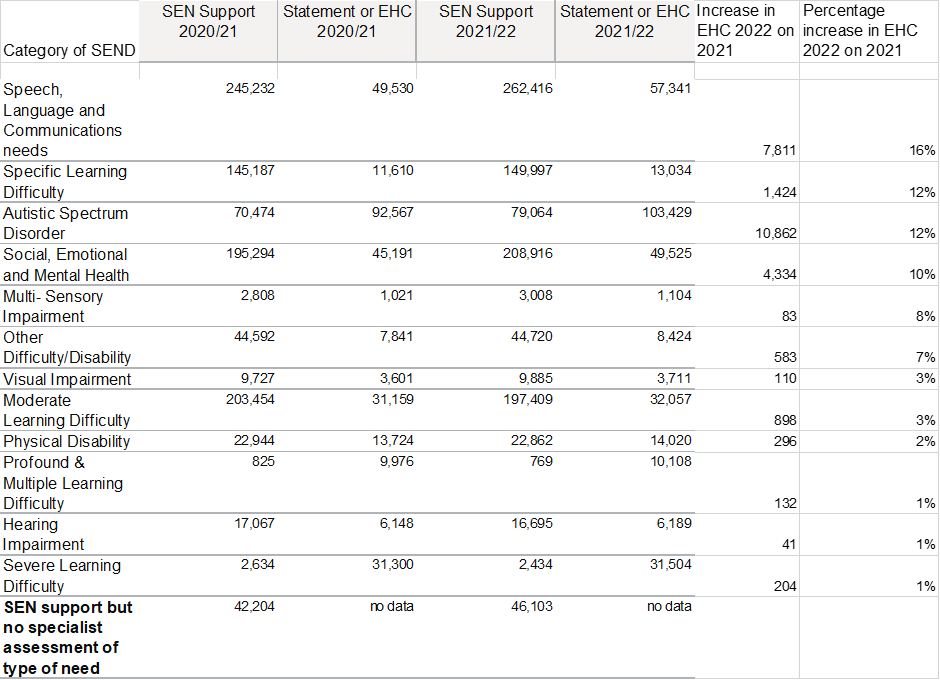
The identification of pupils with Autism or on the Autistic Spectrum at a level where an EHCP (Education and HealthCare plan) is necessary would appear to account for a significant proportion of the unplanned and unfunded growth in spending on SEND, according to the latest DfE data on Special Needs. Special educational needs in England: January 2022 – GOV.UK (www.gov.uk)

The number of EHCPs for young people on the Autistic Spectrum increased from 92,567 in January 2021 to 103,429 in the January 2022 census of pupils. To put this into some context, there are only around 10,000 EHCPs for young people with either a visual or hearing need leading to a requirement for an EHCP. Even, in the category of Social, Emotional and Mental Health, the number of EHCPs in place only increased from 45,191 to 49,525 between 2021 and 2022. However, I suspect this might increase over the coming year if predictions about the mental health of young people following the pandemic come to pass.

Source DfE SEND January 2022 Primary type of need table reordered with additional columns

The growth in EHCPs was even larger for young people with speech, language and communications needs than for those diagnosed as with an autistic spectrum disorder, although this group still only account for half as many EHCPs are for young people on the autistic spectrum disorder group.

Growth in support at this level must mean a radical rethink about how the SEND sector operate. There is no way that this number of young people can be educated in the present Special School sector. Indeed, the staffing of that sector is an issue where a spotlight needs to be shone fairly quickly. There are too many unqualified staff ‘teaching’ these young people, and no visible tracking data for the adequacy of the professional qualifications on top of the basic QTS that such teachers hold. Staying in a mainstream school with an EHCP might be something many parents would need to balance against the journey time to a special school and the more generous staffing of such schools against the qualifications of the staff.

A nine per cent overall increase each year in EHCPs also places a financial burden on more rural local authorities where transport and often that means a driver of a taxi plus another person for each additional EHCP. With fuel costs rising almost by the day, the forward pricing of these contract for next year must already be causing headaches for local authority budget makers.

I don’t have the answers to this issue, but it must be of serious concern that there is sufficient finance for our most vulnerable children to receive as good an education as possible so that they can lead fulfilling lives as adults.  

Out of the shadows

Last evening I went to a truly wonderful concert at Blenheim Palace in Woodstock. Probably best known as the birthplace of Sir Winston Churchill, the Blenheim estate has developed a range of different activities over the past few years including many musical events. Last night’s concert was not staged by some mega-star, in fact none of the musicians, singers and dancers were professionals at all.

In the splendid setting of the Palace’s library, the Oxfordshire County Music Service performed their Buddies at Blenheim concert. Last night’s concert brought a flavour of their show stopping performance delivered in the Royal Albert Hall last November as part of the Schools Prom season.

What make Buddies unique as a concert is the fact that the Buddies Ensemble and heart of the concert features a collaboration between pupils from the special schools across the county and pupils from a range of other schools.

Performing as one choir, the Buddy Ensemble sang three pieces, including one of their own composition. At the Royal Albert Hall there were nearly 600 young singers from Oxfordshire, last night the library could only accommodate some 50 or so to provide a taste of what the experience in London must have been for those lucky enough to witness it.

At the end of the evening the Buddy Ensemble joined many of the other young players, singers and dancers in a finale entitled ‘Love can build a bridge’. Not only was this sung, but it was also signed by the whole choir, and the chorus by the audience as well. A fitting end to a great evening.

Music has been an important part of the cultural life of our education system since at least the end of the Second World War. There have been times when it has been under threat; the early 1990s and during the recent period of austerity and the transfer of funding to schools from local government are just two such periods when it has faced great challenges. Oxfordshire has found a way to navigate these crises, and still flourish as a service under inspiring leadership, as the collaboration between pupils with SEND and others in the Buddy Ensemble so clearly demonstrated.

Apart from the wonderful and ground breaking work of the Buddy Ensemble, there was an excellent rendition of Corelli’s Concerto Grosso op 6 No 2 in F Major that was exactly suited to the setting of the library, especially for those of us fortunate enough to be placed directly in front of the musicians. The Oxfordshire Youth Flute Choir also provided a superb performance of the Overture to the Barber of Seville by Rossini, played on a range of different flutes. But it is invidious to select these examples from a night of wonderful music and ground-breaking originality that show cased the best of the youth of Britain.

On Friday evening, in another wonderful setting of Dorchester Abbey, there will be an end of term concert. But both before then and for long after the bringing of the pupils in our special schools out of the shadows and into the light must be the abiding memory of what education can achieve.


Better identification or more pupils with SEN?

The DfE data on pupils with special education needs in schools at the January 2019 census data confirms what everyone has been saying about the absolute number of such pupils being on the increase, as might be expected when pupil numbers overall are increasing. However, the percentage of pupils with both SEN and the need for an Education and Health Care plan (EHCP) has also increased. https://www.gov.uk/government/statistics/special-educational-needs-in-england-january-2019

As the DfE puts it, across all schools, the number of pupils with special educational needs has risen for the third consecutive year, to 1,318,300 (14.9%) in January 2019. This follows a period of year on year decreases from January 2010 to 2016. Over this period, the overall decrease was driven by decrease in the proportion of pupils with SEN support, while the percentage of pupils with a statement or EHC plan remained stable at 2.8%.

The percentage of pupils with SEN Support, those with identified special educational needs, but no EHC plan, followed a similar pattern rising to 1,047,200 (11.9%).

271,200 school pupils had an EHC plan in place in January 2019. This is an increase of 17,500 since January 2018. The percentage of pupils with an EHC plan has risen to 3.1% of the total pupil population in January 2019, after remaining constant at 2.8% from 2007 to 2017.

These figures show why both the high Needs Block of funding is under such pressure and also why local authority SEN transport budgets are also costing local taxpayers more each year. Moe pupils means more schools and it is to be hoped that in parts of England where there are many small local authorities the forward planning by the ESFA is robust enough to deliver these places at the minimum additional travel costs to taxpayers.

Across all pupils with SEN, Speech, Language and Communications Needs is the most common primary type of need at 22% of pupils. This had previously been Moderate Learning Difficulty, which has decreased to 20%.

Among pupils on SEN support, Speech, Language and Communications Needs is also the most common type of need, at 23%. Of those with an EHC plan, Autistic Spectrum Disorder remains the most common primary type of need with 29% of pupils with an EHC plan having this primary type of need. This has increased from 28% in January 2018.

The number of pupils in state-funded special schools has increased by 6% to over 120,000. This represents 9% of all pupils with SEN. The former trend towards integration now seems to be a feature of the past as numbers of SEN pupils in independent schools has also increased. 7% of all SEN pupils are placed in an independent school.

Special educational needs remain more prevalent in boys than girls, 4.4% of boys and 1.7% of girls had an EHC plan, both small year-on-year increases. Similarly boys were almost twice as likely to be on SEN support – 15% compared to 8% of girls.

SEN is most prevalent among boys at age 9 (23% of all boys), and for girls at age 10 (13% of all girls). SEN support is most prevalent among primary age pupils, before decreasing as age increases through secondary ages.

For EHC plans however, as age increases the percentage of pupils with EHC plans also increases, up to age 16, where nearly 4% of pupils have an EHC plan. However, it is not clear how many pupils with identified needs have been flagged by the NHS before they enter into education. This would save schools both time and resources and ensure early help for some children.

With the new focus on mental health, something schools have always been acutely aware of as an issue, I would not be surprised to see the number of pupils with SEN continue to increase over the next few years. The DfE will also need to consider how to help teachers keep as many of those that can manage their learning in mainstream schools to do so.


SEND on the agenda again

Until recently, the difference between the High Needs Block and remainder of the Dedicated Schools Grant that funds schooling in England was known only to a few officers and civil servants and those headteachers and governors serving on School Forum. The advent of a National Funding Formula for schools outside the special school sector and a growing demand for spending on children with additional needs has brought the issues with the High Needs Block into sharp relief.

The Local Government Association has published the outcomes of the research they commissioned earlier this year. A key paragraph sets out the issues and reflects two of the key issues, the ability of local authorities to ensure all schools act in ‘the common good’ instead of ‘their own good’ and the effects on the school funding of an extension of support to young people up to the age of twenty five from the High Needs budget, not originally designed for that age range.   The report can be found at: https://www.local.gov.uk/have-we-reached-tipping-point-trends-spending-children-and-young-people-send-england

Addressing the points raised in paragraph 17 of the Report would go a long way to creating a sustainable and successful system for young people with SEND.

  1. To create a more sustainable funding settlement going forward there may be merit in considering some key questions around how incentives in the system might be better aligned to support inclusion, meet needs within the local community of schools, and corral partners to use the high needs block to support all young people with SEND as a collective endeavour. These might include
  2. setting much clearer national expectations for mainstream schools;
  3. rethinking how high stakes accountability measures reflect the achievements of schools which make good progress with children and young people with SEND or at risk of exclusion;
  4. correcting the perverse funding incentives that mean that it can be cheaper to pass the cost of an EHCP or a permanent exclusion onto the high needs block than making good quality preventative support available in-school;
  5. looking again at the focus and content of EHCPs to afford greater flexibility to schools in how they arrange and deliver the support needed;
  6. providing ring-fenced investment from government designed explicitly to support new and evidence-based approaches to early intervention and prevention at scale;
  7. providing additional capital investment and flexibility about how that can be deployed by local government;
  8. issuing a national call for evidence in what works for educating children and young people with these needs, backed up by sufficient funding to then take successful approaches to scale and a new focus for teacher training and ongoing professional development;
  9. more specific advice for Tribunals, parents and local authorities on how the test on efficient use of resources can be applied fairly when comparing state and non-state special school placements; and
  10. reaffirming the principle around the equitable sharing of costs between health and education where these are driven by the health needs of the child or young person.

At present, there are perverse incentives for schools to look first to their needs and only then to the needs of children with SEND. The extension of the age range to twenty five brought many more young people into scope without necessarily providing the resource.

The announcement of more cash by the Secretary of State will help, but is almost certainly not enough to solve the problems being faced within many local authorities. At the heart of this is broken system for governance of our schools. In the post Brexit world, whatever it looks like, creating a coherent education system with democratic accountability across the board should be a high priority for the Education Department and its Ministers at Westminster.


High Needs Block

Alongside the consultation on the national funding formula for mainstream schools there is a similar consultation for what is known as the ‘High needs’ group of pupils. This consultation has received far less notice than the mainstream NFF consultation, but is arguably as important for pupils with some of the most challenging of needs.

At the heart of the consultation is the central dilemma facing education in England. Who makes the decisions? The new formula proposes placing a great deal of responsibility with local authorities, as at present. That’s fine, but it ignores the fact that free schools can be established where local authorities might not want them and existing schools can become academies and thus alter their governance structure in relation to the local authority.

The ‘high need’ special education sector has always been a complex area to understand. There are some that think the current proposals out for consultation show that even the government doesn’t fully understand the issues. For example, the government doesn’t seem to have a policy for the use of the often highly expensive independent sector for placements of children where there is a shortage of space or expertise in the state-funded sector. This can be a real burden on some authorities. However, the consultation, in as far as it addresses the issue, seems to opt for the status quo. It might have been helpful to have tried to work out nationally how this expenditure could be reduced without damaging the education of the young people.

The formula has also to grapple with the issue of providing enough places, even if not always filled, and how far to use a methodology where funding follows the pupils, as with pupil unit funding in the mainstream school formula. I am not sure the proposed methodology is going to work as effectively as it might be required to do so. I am concerned that it mustn’t persuade some mainstream academies to ditch existing special provision units leaving the local authority to figure out how to provide a high quality education for these children plus a possible increase in the local transport bill. Local authorities should be able to challenge, if not veto, changes in existing provision not part of a planned and agreed local arrangement, especially where the MAT has its headquarters outside of the authority’s area.

I am worried about the inclusion of IDACI as one of the formula factors. Taken together the total of formula factors seem slanted to special needs caused or exacerbated by deprivation. I understand the concept, but for an authority such as Oxfordshire with limited pockets of urban and rural deprivation, many of our children with high needs don’t live in areas where this factor will be a key determinant. However, those children still need the funding necessary for their education. A review of SEN transport, especially in rural areas and complex non-residential cases, might have raised some issues about planning.

Overall, this looks like a redistribution of the current funding envelope rather than a formula based upon an understanding of the complex needs of this group of young people. It is also a work in progress since the funding of hospital schools isn’t included. I hope when it is a full understanding of the needs of young people with both physical and mental health issues and their relationship with the hospital service is included.

If you haven’t yet looked at this consultation, please do so.

Time to listen

Why do children with hearing loss, but no other impediment to their learning, fare so much worse than children of a similar ability but with normal hearing patterns? You could ask the same question of children with other disabilities. Later this month the DfE should publish outcome figures for the 2015 GCSE results for these pupils.

Last year, the National Deaf Children’s Society a key campaigner in the field of education for children with hearing impairment, published a chilling report on the state of their education http://www.ndcs.org.uk/for_the_media/press_releases/deaf_children_slip.html only 36% of these children achieved the %A-Cs at GCSE compared with more than 60% of their hearing classmates. Even more concerning was the decline in specialist teachers of hearing impaired children.

It is this latter point that concerns me at this time. Does our fractured governance system which fails to rate professional development of teachers properly now allow for a system to ensure the training of sufficient teachers of hearing impaired pupils or indeed or other pupils that need specialist training. Is there any obligation on multi-academy trusts or single converter academies to ever consider this type of issue? Local authorities certainly won’t these days and, I guess, it hasn’t featured on the agenda of many of the School Forums responsible for setting policy on funding distribution across school in an area. Funding is ever more weighted towards pupils and their immediate needs and rarely takes into account the longer-term strategic needs of the school system.

One implication of more pupils overall is that the number with impaired hearing is also likely to rise in proportion. This means that more teachers should be trained. How will this happen? Could such teachers be incorporated into the National Teaching Service or will we expect enthusiastic teachers to take out one of the new career loans for higher degrees on top of their existing student debt to provide out cadre of qualified teachers of hearing impaired pupils in the future, let alone the leaders in the special schools where some of these children are located. Who is going to employ the advisers to help classroom teachers with a child with mild hearing loss in their class to perform to the best of their ability and help close the performance gap?

These pupils and their compatriots with other special needs deserve a high quality schooling system not to be pushed to the margins of policy-making. I am sure that they aren’t seen as a nuisance, but perhaps they aren’t seen enough or even at all by those that consider these issues. There are only around 20,000 pupils with recognised hearing impairment in our school system, but each and every one deserves the best possible education. As, indeed, do all other pupils with special needs.