Four-day week for teachers?

A Labour MP has called for a four-day working week to be introduced across the public sector.

Lib Dem-run South Cambridgeshire District Council’s cabinet will meet today to approve the continuation of the trial for all desk-based staff as well as extending it to cover caretakers and binmen. 

These are just two of the headlines from an article that I read this morning. What would be the implications for teachers of the introduction of a four-day week? The answer depends upon whether the same amount of face-to-face contact with pupils was maintained as at present and whether that was contact time spread over four or five days? What effect would four longer school days have on pupils, especially younger pupils? After all, some early years settings already offer wrap around care that is much longer than the traditional school-day.

What would the psychologists and those that study brain development in children have to say about putting five days of work into four? Perhaps a model would develop of four days of taught time and the fifth for ‘homework’ or supplementary activities.

On the plus side, parents also working a four-day week would have an extra day with their children: on the downside, parents whose working week did not coincide with the school four-day week would have to deal with the need for extra childcare.

Any change would come with a cost both to individuals and to the State. If there wasn’t sufficient funding, schools might be tempted to cram the teaching into four days and use the fifth day to generate income from their school sites and playing fields.

In a sector struggling to recruit enough teachers at present, would a four-day week make the profession more or less attractive to potential teachers. Certainly, if the bulk of graduate careers moved to a four-day week, teaching, already operating an employer-driven form of flexi-time, might be unattractive without some other boost to conditions of work.

A four-day working week might be a real challenge to the private school sector, where the additional costs would most likely have to be passed on to parents through increased fees. An increase of this magnitude might drive more parents back into the state sector, upping the cost of state education to the government. Add VAT on to the costs, and such numbers switching might increase still further.

During the Corbyn era, Labour proposed four additional bank holidays for workers; all during school holidays, so teachers would have seen no benefit from them. The implications for the teaching profession and others working in schools of the widespread introduction of a four-day working week do need to be considered.

However, I don’t think that the present model of schooling will continue as it has for the past 150 years. The AI revolution may well turn out to be as profound for society as the microchip revolution that started in the 1970s and transformed the world of work beyond recognition in many areas, but only to a limited degree in schools.

 Technology and its interaction with the process of schooling has further to go in the future. Perhaps the pressure for a four-day working week for humans might be the catalyst for major changes in schooling?

When are deficits called reserves?

Local authorities are currently starting to put together their budgets for 2023/24. Upper Tier Authorities with responsibility for the High Needs block of the Direct School Gant that deals with expenditure on pupils with special needs will be looking at a year-end overspend in many cases that will need to be added to the amount already sitting off-balance sheet in a temporary solution to the problem of how to pay for this expenditure. The money has been spent by the local authority, but not paid for by central government, so it sits awkwardly in an account waiting for a solution.

At some point, if the DfE or The Treasury deems that the local authority should no longer carry the deficit, but fund it from reserves, this would be a major headache for, I suspect, many local authorities, regardless of their political control. In the present financial climate, the solution is more challenging than it might have been a year ago. As a result, I expect the government to ‘kick the can’ further down the road extending the current arrangement until March 2024, and leaving local authorities with even bigger numbers to worry about.

How might the issue be solved? Before devolved budgets came into being for schools in the 1990s, authorities might just have top sliced their education budget. I cannot see Schools Forum, the body that discusses education funding at a local authority level, agreeing to such a move these days, although the DfE could no doubt mandate it somehow.

An alternative would be to use the precept method, as has been used for social care funding, by allowing local authorities to increase Council Tax by an amount to cover the deficit they have incurred that is not on their balance sheet, but in ‘reserves’. This passes the problem to local taxpayers, despite schooling now being a centrally financed activity.

The government at Westminster could just pay off the figure authorities have in their reserves, either in one lump sum or more likely over a period of several years. But, with their demands for cuts in public expenditure to finance tax cuts, this seems an unlikely option.

Increasing pupil numbers, better healthcare and the acceptance of new medical conditions was always going to put increased demand upon a school system and its funding for pupils with special needs, and especially one that both had not always planned for the changes and was required to do more after the switch to EHCPs from Statements of Need following the 2014 Education Act. A good example of worthy legislation that doesn’t seem to have been fully costed as to its on-gong effects.

Meanwhile, parents probably see declines in service locally, as officers struggle to keep the costs of running the service within bounds. These parents often carry a heavy burden caring for their offspring and fighting a local government system is not something they want to do, but sometimes are forced to undertake. There must be a solution that puts the needs of these young people first.

SEND in the spotlight

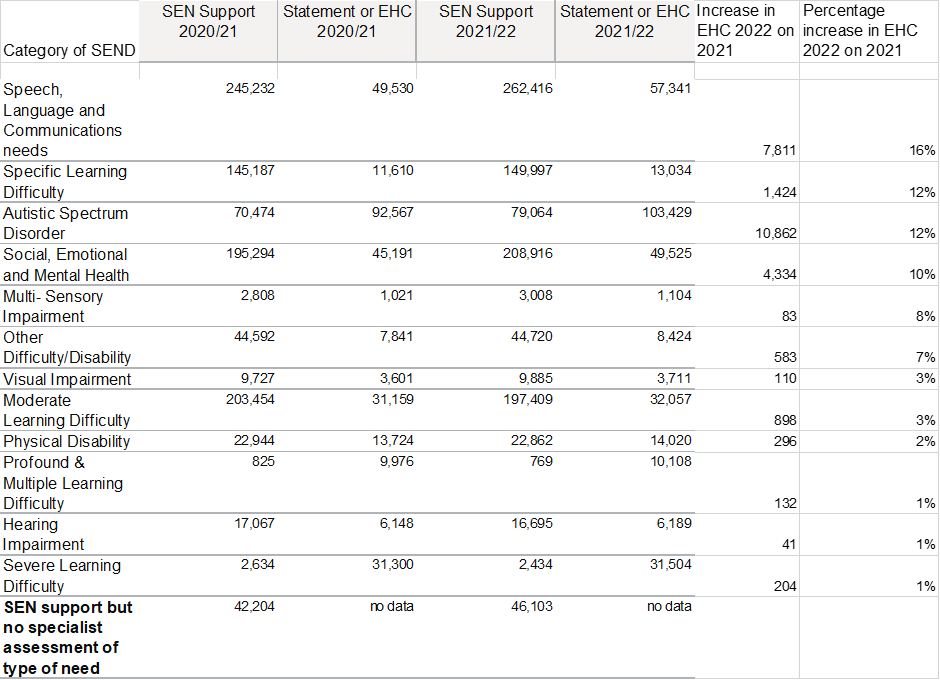
The identification of pupils with Autism or on the Autistic Spectrum at a level where an EHCP (Education and HealthCare plan) is necessary would appear to account for a significant proportion of the unplanned and unfunded growth in spending on SEND, according to the latest DfE data on Special Needs. Special educational needs in England: January 2022 – GOV.UK (www.gov.uk)

The number of EHCPs for young people on the Autistic Spectrum increased from 92,567 in January 2021 to 103,429 in the January 2022 census of pupils. To put this into some context, there are only around 10,000 EHCPs for young people with either a visual or hearing need leading to a requirement for an EHCP. Even, in the category of Social, Emotional and Mental Health, the number of EHCPs in place only increased from 45,191 to 49,525 between 2021 and 2022. However, I suspect this might increase over the coming year if predictions about the mental health of young people following the pandemic come to pass.

Source DfE SEND January 2022 Primary type of need table reordered with additional columns

The growth in EHCPs was even larger for young people with speech, language and communications needs than for those diagnosed as with an autistic spectrum disorder, although this group still only account for half as many EHCPs are for young people on the autistic spectrum disorder group.

Growth in support at this level must mean a radical rethink about how the SEND sector operate. There is no way that this number of young people can be educated in the present Special School sector. Indeed, the staffing of that sector is an issue where a spotlight needs to be shone fairly quickly. There are too many unqualified staff ‘teaching’ these young people, and no visible tracking data for the adequacy of the professional qualifications on top of the basic QTS that such teachers hold. Staying in a mainstream school with an EHCP might be something many parents would need to balance against the journey time to a special school and the more generous staffing of such schools against the qualifications of the staff.

A nine per cent overall increase each year in EHCPs also places a financial burden on more rural local authorities where transport and often that means a driver of a taxi plus another person for each additional EHCP. With fuel costs rising almost by the day, the forward pricing of these contract for next year must already be causing headaches for local authority budget makers.

I don’t have the answers to this issue, but it must be of serious concern that there is sufficient finance for our most vulnerable children to receive as good an education as possible so that they can lead fulfilling lives as adults.  

Special Needs Consultation

What a mess. Underlying the government’s Green Paper SEND Review – right support, right place, right time (publishing.service.gov.uk) published yesterday is a feeling that without a strong middle tier there can be no overall management of a SEND system to help our most vulnerable young people.

The DfE has recognised the need for a regional tier – that’s not up for consultation – but the Green Paper is weak on exactly what the structure below that would look like. With no coherent local government system in place across England, it will be a challenge to create a system that works effectively at the sub regional level, especially where rural ‘donuts’ surround urban unitary authorities. Schools Forum don’t seem to even receive a mention in the Green Paper, despite holding the purse strings for schools in general through the DSG. Will a hard Funding Formula make them little more than a talking shop?

The aspirations to make the NHS play the part designated for it in 2014 with the creation of EHCP is to be welcomed, although it will be interesting to see how general practice and the hospital sector step up to their responsibilities. Still, new data sharing arrangements are long overdue between health and education.

There is little said in the Green Paper about reform of the SEN Tribunals that almost unanimously find, at least in part, in favour of parents. What may be needed is an approach similar to civil court personal injury compensation, where judgements are set down, if necessary, by the high court, and only new conditions or cases need to go to a Tribunal. Saying ‘no’ all the way to the door of the Tribunal, possibly to save a local authority money should be a thing of the past. Such a system won’t be easy to create, but the present system places intolerable burdens on families in terms of both financial and emotional demands.

The Green Paper accepts that alternative provision is a mess, but doesn’t really identify the causes of the mess and which parts work well. If anything, this is an area where my suggestion of multi-purpose practices of teachers might work well and bring fringe activities within a regulatory framework. All pupils should be on a school roll until 18. Off-rolling should be a positive decision that for teenagers needs to be carefully scrutinised as to why ‘now’ and not earlier in a child’s educational journey. The child’s voice must be part of the decision, however uncomfortable that might be for some parties to that child’s education.

Hovering over all the good intentions is the spectre of funding. Perhaps this is why it is a Green and not a White Paper. Unless the Treasury finds the cash for a better system ‘fine words will butter no parsnips’ as the old saying goes.

More young people are been identified as requiring different approaches to learning than the average child and it is interesting that ‘gifted’ children no longer form part of the SEND agenda. However, an education system based upon the needs of every child is expensive and needs good coordination. The aim is there, but it will be well into the autumn before we see the result of this consultation and thus 2025 before any significant outcomes that don’t need legislative change. For changes requiring legislation it seems unlikely anything will happen this side of the next general election.

Attendance Group must address in-year admissions issue

I recently caught up with news about the DfE’s Attendance Group, and the Minutes of its December meeting.  Attendance Action Alliance January meeting notes: 9 December 2021 (publishing.service.gov.uk)

I am delighted to discover the high-profile nature of membership the Group and that the Secretary of State has taken an interest, as owner of the work. However, although the Group discussed the question of a register for home educated children and the concerns over those children just missing school on a regular basis, I didn’t find any emphasis on ensuring that children taken into care are offered a school palace as swiftly as possible and within set time limits. The same standards also need to be put in place for children with special needs whose parents move to a new location during the school year and need a new school placement.

Taking a new job should not be conditional on whether there is a special school place available for your child.

In a previous post on this blog, calling for a ‘Jacob’s Law’, I laid out the case for in-year admissions to academies not to be held up by such schools not wanting to admit such children. The 2016 Education White Paper: Education Excellence Everywhere recognised there was an issue with in-year admissions to academies because local authorities had no powers to over-rule the decision of a school not to admit a pupil. This was why Jacob was out of school when he died. Time for Jacob’s Law | John Howson (wordpress.com)

Sadly, nothing significant has changed since 2016. I hope that the Attendance Group will consider the issue of in-year admissions at a future meeting, and not just focus on the parents that don’t send their children to school. The system must work for the benefit of all and not just those that are easy to educate. The same is the case of children with SEND requiring in-year admission to a school.

These young people must not be ignored, and just offering tutoring is not the same as admission to a school. Home tutoring doesn’t provide the same social interaction that being in a school provides however good the ‘virtual school’ is at its job.

Of course, there are risks where the school community is hostile to incomers and many schools could well look to improve the transfer experience for in-year admissions that can be even worse than that experienced by pupils transferring at the start of the school-year.

Being taken into care as a school-age child is a traumatic experience, and we owe it to these children to make sure that their education is affected as little as possible. So, it is my hope that the Attendance Group will as a minimum endorse the 2016 White Paper suggestions and, if possible, go further and set time limits for school places to be offered to children taken into care and requiring a new school placement. For most, it wasn’t their fault that they have ended up in the care of the local authority where all the secondary schools are academies.

Take Care Seriously

Anne Longfield, the former Children’s Commissioner has published an important report on children in the care of local authorities entitled ‘Out of Harm’s Way. https://thecommissiononyounglives.co.uk/wp-content/uploads/2021/12/OUT-OF-HARMS-WAY-CYL-DEC-29-2021-.pdf?utm_source=HOC+Library+-+Current+awareness+bulletins&utm_campaign=834a4dd143-Current_Awareness_Social_Policy_E_29-12-2021&utm_medium=email&utm_term=0_f325cdbfdc-834a4dd143-103730653&mc_cid=834a4dd143&mc_eid=ae5482b5b9 the report by the Commission on Young Lives should be essential reading for all Councillors, Teachers, Social Workers and Emergency Service personnel, and members of police forces across the country.

The report starts with the case of Jacob, a teenager failed by authorities and who eventually took his own life. I wrong a blog about his case when the Serious Case Review was published back in January Time for Jacob’s Law | John Howson (wordpress.com) But Jacob sadly isn’t the only child let down by a system that is overloaded and under-funded. Not only are children in the care of local authorities suffering but, as seen recently in the outcome of court cases, young children below school age are dying at the hands of those supposed to love and care for them.

But for Jacob and for many children in care one of the key issues is the support they receive from the education system. The pioneering work by the TES more than a decade ago that helped with the creation of virtual schools to oversee the education of children in care on behalf of the ‘corporate parents/guardians’ must not be undermined by an education system that is still too geared to satisfying the needs of able middle-class parents who can make full use of a market-based schooling system.

In my post in January, I called for a Jacob’s law to ensure no child was left without a school place following a move either in care or for any other reason during the school year. Since then, I have heard of too many examples of children, often with complex educational needs, where a family move has meant the child has been denied a school place for far too long. We can debate home schooling when at the behest of the parents, but ‘no schooling’ because of the failure of some part of the state, whether a local authority, a diocese or an Academy Trust, is just not acceptable.

I hope that many Councillors and activists will read this report from The Commission on Young Lives and take action ahead of local authority budgets being set in February to ensure everything possible is done to improve the lot of these young people.

Some children do need to be moved away from their ‘home’ area for safety reasons, but these moves should be exceptional and not routine. No child of secondary age should be moved from a comprehensive system to a selective system where they have no access to selective schools regardless of their perceived ability levels.

We must care for the most vulnerable of our young people in a fit and proper manner and not as an afterthought.

Education and climate change

Today is education day at COP-26. This blog first mentioned climate change in a post on 17th September 2019 and most recently did so in a post about school buildings Zero Carbon Schools | John Howson (wordpress.com) a couple of months ago.

I am delighted to say that the issue of school playgrounds as a possible resource for renewable energy is being taken forward by a multi-national company. Their idea is to inset PV tiles into the surface rather than have extending panels that was my suggestion. Any change to the surface must be safe for children in any weather conditions and must not become contaminated with anything that would reduce the effectiveness of the tiles as a source of energy. The process must also be cost effective.

However, with the roll out of 5G leading to the end of copper phone cables and no guarantee of phone services in a power cut as a result, some local generation and storage capacity in rural areas might well be another reason at looking into the wider role of schools and their buildings in serving local communities.

Today at COP-26 will no doubt be mostly centred around the curriculum as that is where governments can make promises that cost little to implement compared with changes to buildings already in use and setting standards for new construction.

There will also be a new award announced by the Secretary of State to encourage young people to take action against climate change, as if encouragement was needed. As I wrote in an earlier post on this blog, young people can start by conducting an audit of their school’s current actions relating to climate change and suggest some simple steps to start with. In the light of COP-26, will every governing body have an item about climate change on their agenda for this term’s final meeting?

School transport and especially the use of parent’s cars to take children to and from school can be a major source of both pollution and energy consumption. The move towards electric vehicles will help with the former and can encourage better use of the latter if the power to drive the vehicles is created from renewable energy.

So, today is a day for some celebration, much reflection and a desire to move forward. However, actions will speak louder than words in the next few years.

More doctors: fewer teachers?

The news that the government may be raising the cap on places at medical schools for trainee doctors is surely a good outcome for society, but may be a concern for those that are involved with teacher preparation courses.

Both are areas of funding where the government keeps close control over the supply of places. As has been discussed in previous posts on this blog, the recent market review into ITT by the DfE plus a falling birth rate and a reducing school population due to outward migration and an increase in home schooling, has raised the spectre of reductions in the number of primary teacher training places likely to be sanctioned in the short-term by the DfE, and a likely reduction in the number of secondary places once the decade reaches its midway point.

If the DfE has to find more funds for training more doctors, might it be tempted to bring any reduction in teacher preparation numbers forward to start in this autumn’s announcements for 2022 entry? Higher Education might like the reduction to be in postgraduate provision, but the DfE could make more top line savings by reducing undergraduate primary numbers. However, it seems likely that students not offered places on undergraduate course might still decide to attend university and enter teaching through the postgraduate route.

One consideration should be determining which route provides the applicants that best meet the needs of the sector? For instance, how do the ‘A’ level points scores of undergraduates starting primary teacher preparation courses match the scores of their postgraduate colleagues starting such courses.

The regular annual performance profiles might also offer some indications of the type of courses the DfE would possibly favour if there are reductions in places on offer. However, that will also be determined by the DfE’s priorities in terms of quality and other factors, such as employment outcomes and no doubt the contribution to the ‘levelling up’ agenda.

The takeover by the DfE of the postgraduate recruitment process from UCAS adds another uncertainty into the mix. Will the data be available from the DfE, as it has been from UCAS, and before that the GTTR (Graduate Teacher Training Registry), weekly and then monthly data that allowed seasoned ITT watchers to predict the outcome of the recruitment round as early as February or March of each year?

If it isn’t forthcoming, the answer might be regular monthly FOI requests until civil servants understood the message about the need for transparency in data that is best described to the Office for National Statistics as management information rather than statistics.

Teach First trainees have already started their courses, and many other providers will be gearing up for a start early in September. As ever, I wish the staff and the trainees well, and hope that those embarking on a career as a teacher will enjoy the experience of what can be a wonderful, but at times challenging career. Every bit as good as being a doctor, even if not as well paid.

Charity Walk

Just a reminder as to why there are fewer posts than in the past on this blog

Chair dons his walking boots to trek from Oxford to Banbury for charity on Thursday and Friday

Any sponsorship of the 26 mile walk would be very much appreciated. All donations will be split equally between the five charities listed below and can be made via bank transfer to:

O C C CHAIRPERSONS EVENTS DCI

Sort Code: 30-80-12

Account Number: 20391068

Reference: Charity Walk

Walking in midsummer is a pastime many enjoy and the Chair of Oxfordshire County Council will be putting his walking boots on for the charities he supports in mid-July.

Councillor John Howson will walk the 26 miles from Oxford to Banbury along the canal towpath during Thursday, July 15 and Friday, July 16.

He said: “This seemed like something I could do regardless of present COVID restrictions provided I did it myself. Getting out for a walk became people’s big event of the day during the lockdown periods we had and there is little doubt that walking and being outdoors helps people’s physical and mental health.“I am looking forward to doing the walk between Oxfordshire’s largest and second-largest settlements. I hope to be enjoying the scenery of the rolling north Oxfordshire countryside and the tranquility of the villages alongside the canal.“

I have had a special Ordnance Survey map printed for the walk that will be unique and this will certainly be a memorable part of my time as Chair of Oxfordshire County Council.”

Councillor Howson became Chair in May having been Vice-Chair in the two previous years. The Chair is the ceremonial head of the county council and the politically impartial civic leader of Oxfordshire.

The charities he is supporting during 2021/22 are:

• Abingdon Riding for Disabled

• Children Heard and Seen

• Maggie’s (cancer support charity)

• Oxfordshire County Music Service

• Yellow Submarine (learning disability charity)

Oxford Canal Walk

One of my roles as Chair of Oxfordshire County Council is in supporting charities and their need to fund raise, especially as the Covid pandemic has reduced their opportunities to stage events.

This July, I aim to walk the Oxford Canal from Oxford to Banbury – a distance of 26 miles from Isis Lock to Tramway Road bridge along the towpath.

The charities that I am supporting this year are listed below and if any of my regular readers or even just those coming across this blog for the first time wishes to make a donation, then details of how to do so are included below as well.

This morning I walked 5.4 miles in 1 hour and 40 minutes as a start of my making sure that I am in shape. Pictures are on my Cllr Facebook page at https://www.facebook.com/cllrjohnhowson

Sponsorship Any sponsorship of the 26 mile walk would be very much appreciated.

All donations will be split equally between the five charities listed below and can be made via bank transfer to

O C C CHAIRPERSONS EVENTS

DCISort Code: 30-80-12

Account Number: 20391068

Reference: Charity WalkCllr

The walk, scheduled for July 15/16 depending on the weather, will be from Oxford to Banbury along the canal’s tow path.

Charities supported by Cllr John Howson JP Chair of Oxfordshire County Council 2021-22

Oxfordshire County Music Service Oxfordshire has a fine Music Service and following in the tradition of recent Chairs of the County Council, the service is one of my charities.

Children Heard and Seen I was a founding trustee of this charity that works with children that have a parent in prison. The charity started in Oxfordshire, but is now expanding to take in children from a much wider area.

Maggie’s This charity for those with cancer has a centre at the Churchill Hospital in Oxford and I have taken part in several of their previous sponsored walks.

Riding for Disabled – Abingdon branch The horse still plays an important part in the life of Oxfordshire and I am delighted to include this charity that brings horse riding to those that otherwise might miss out on this activity

Yellow Submarine A small charity that offers work to young people and adults with learning challenges and autism. They have a coffee bar in Park End Street less than five minutes from County Hall as well as others across the county.