SEND: we know the issue – but we still won’t say how it will be solved

Buried in the OBR Review in Chapter 5 is the following CP 1439 – Office for Budget Responsibility – Economic and fiscal outlook – November 2025

Correction to Chapter 5, paragraph 5.19, second bullet Text currently reads: If it were fully funded within the Department for Education’s £69 billion RDEL core schools budget in 2028-29, this would imply a 1.7 per cent real fall in mainstream school spending per pupil rather than the 2.4 per cent increase planned by Government.

Text should read: If it were fully funded within the Department for Education’s £69 billion RDEL core schools budget in 2028-29, this would imply a 4.9 per cent real fall in mainstream school spending per pupil rather than the 0.5 per cent real increase planned by Government.

5.19 Special educational needs and disabilities: As set out in more detail in Box 5.1, the Government has announced that from 2028-29 the cost of SEND provision will be fully absorbed within the existing RDEL envelope. The Government has not set out any specific plans on how this pressure, which we estimate at £6 billion in 2028-29, would be accommodated within the existing RDEL envelope. If it were fully funded within the Department for Education’s £69 billion RDEL core schools budget in 2028-29, this would imply a 4.9 per cent real fall in mainstream school spending per pupil rather than the 0.5 per cent real increase planned by Government. The Government has stated that it will set out proposed reforms to SEND provision early in the new year.

So, another function disappears from local authorities, presumably to the DfE as SEND funding will be handled at a national level. Will it include management of transport as well as granting of EHCPs? Who knows, the OBR don’t, but warn that funding per pupil could fall by 4.9%. For many schools, this will be on top of any loss of income from falling rolls. Start planning now for such an outcome.

More to come when the White Paper finally emerges sometime in 2026

Uphill struggle for an all academy system

The DfE has now published the data on governance of schools in England as part of the background to both the recent White Paper and the Schools bill currently before the House of Lords. Opportunity for all: strong schools with great teachers for your child – GOV.UK (www.gov.uk) and Excel spreadsheet the fourth item on the page.

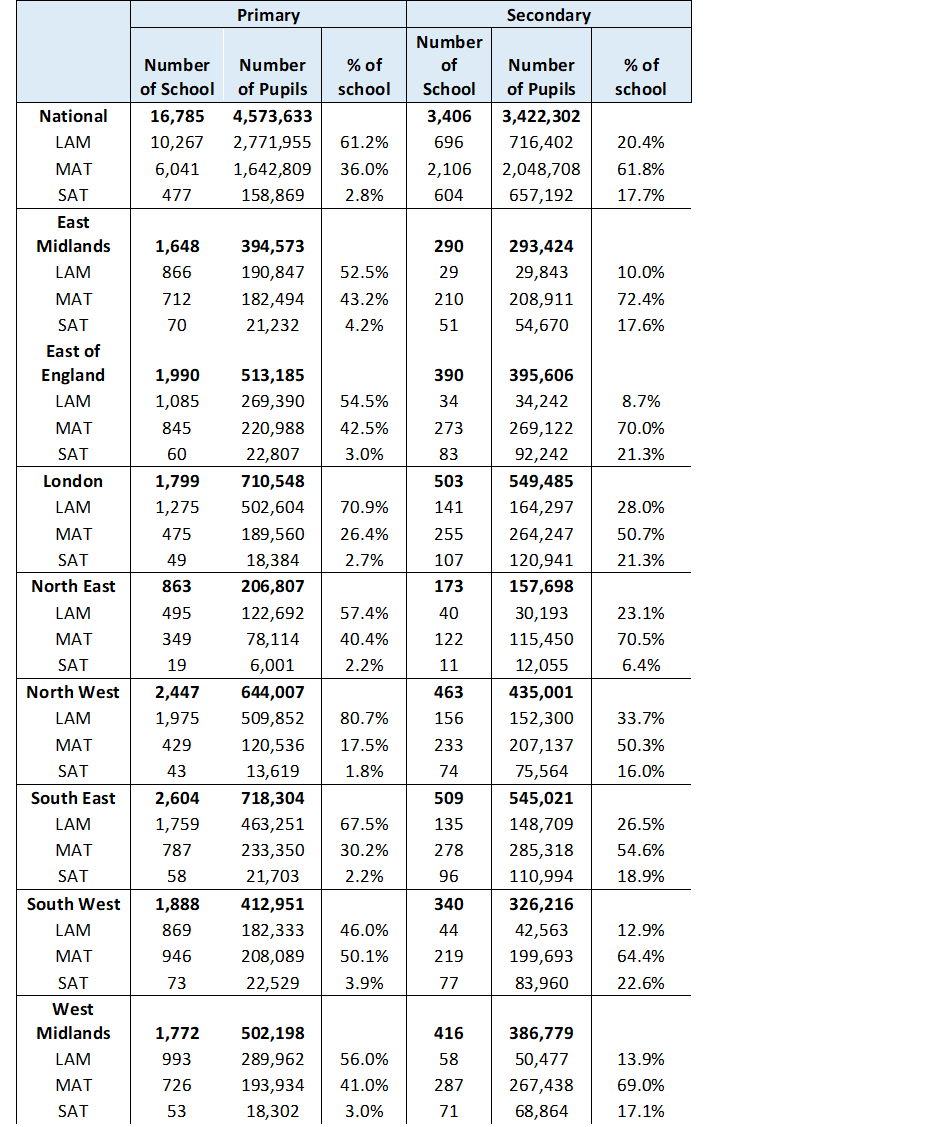
While academisation, whether Stand Alone academies (SAT) or schools in multi-academy trusts or committee (MATs) has taken hold in the secondary sector, the majority of primary schools are still not academies.

GovernancePrimarySecondary
Primary schools% of primary schoolsSecondary schools% of secondary schools
All schools (state-funded)LA maintained10,61563%74722%
MAT5,67534%2,05059%
SAT5013%66119%
Of which faith schoolsLA maintained4,21568%21835%
MAT1,77729%29347%
SAT1923%11719%
Source: DfE

According to the DfE figures, 63% of primary schools are still LA maintained schools and that increases to 68% of faith schools despite some diocese having created local MAT/MACs. However, the vast majority of secondary schools are now academies of one sort or another.

However, a third of faith schools in the secondary sector are not yet academies. It would seem that it is the diocese rather than the local authorities that the DfE should be talking to about how to reach an all-academy school system.

There are also clearly regional differences, with primary schools in the North West still largely LA Maintained schools whereas only eight per cent of secondary schools in the East of England are not academies.

These differences are important in relation to issue such as in-year admissions, a topic this blog has pursued for several years now. I hope the difference arrangements between maintained and academies will be addressed in the Bill before parliament.

Forget the White paper: the crisis is now

There must be a lot of nervous secondary school headteachers at the start of this Easter break. Over the past two weeks TeachVac has recorded 7,800 new vacancies for teachers. These vacancies have been posted by schools across England, but especially by schools in the South East Region. Nationally, the total is a record for any two-week period during the past eight years that TeachVac has been collecting data on vacancies from state and private schools across England.

I can confidently predict that not all these vacancies will be filled, and that some will be filled by teachers with ‘less than ideal’ subject knowledge. So bad is the situation nationally that one major international recruitment agency is offering a rereferral bonus of £250, presumably to attract new teachers to its books to help fill vacancies. With the size of TeachVac’s list of candidates that are matched each day with vacancies that puts an interesting valuation on the company.

Seriously though, TeachVac has an index that compares recorded vacancies with the reported number of trainees from the DfE’s census. This system has used a consistent methodology for eight years and is now also showing signs of how much stress the system is under. Not for twenty years, during what was the severe recruitment challenge around the millennium, have secondary schools, especially in parts of the south of England, but not exclusively in that area of the country, faced recruitment challenges on the present scale.

As readers of previous posts will know, the intake into training for September 2022 isn’t looking healthy either at present as was confirmed in the chat during the recent APPG webinar on the White Paper.

With fewer partners of EU citizens probably coming to work here as teachers while their partners used to work elsewhere in the economy, and the international school scene not yet affected by the geo-politics of the moment, it is probably correct to talk of an emerging crisis now reaching most parts of the curriculum outside of schools recruiting primary school teachers and physical education, history and art teachers in secondary schools.

The predictions about any crisis and its depth compared to previous years will be confirmed if there are a large number of re-advertisements in early May, especially if they come with added incentives such as TLRs and Recruitment and Retention bonuses as schools seek to ensure timetables are fully staffed for September 2022.

One casualty of the present situation may well be the levelling up agenda in a market-based labour market. All else being equal, where would a teacher choose to work, a school that is challenging or one that is less demanding?  Last spring, I wrote a blog about the challenges schools in the West Midlands with high levels of free school meals faced in recruiting teachers when compared with other schools in the same area. TeachVac is again collecting this data for schools across England.  However, with this level of vacancies we won’t have the funds to analyse the data this year.

Opportunity for All?

The government published it Education White Paper today. They didn’t make it easy to find the whole document, but it can be accessed at Opportunity for all – Strong schools with great teachers for your child (publishing.service.gov.uk) For younger readers, it is called a White Paper because when such documents first appeared they had white covers. Later when documents with suggestions and not proposals appeared they were called Green Papers as they had a green cover.

Enough of the history, although it is worth looking back to the last education White Paper. It promised to look at returning in-year admissions to local authorities, but nothing happened. This time on page 53 there is a graphic that just says LAs will ‘manage’ in-year admissions. It is not clear where the management role will have sanctions to back it up. I hope so.  If local authorities are provided with ‘backstop’ powers to direct in-year admissions that will be a step forward and should be put into place as soon as possible. The intention is summarised in paragraph 163. As a final safety net to cover rare circumstances where collaborative working breaks down, we will consult on a new backstop power for local authorities to direct trusts to admit children. Trusts would have the right to appeal this to the Schools Adjudicator. Please start the consultation as soon as possible – Time for Jacob’s Law | John Howson (wordpress.com)

The news in the White Paper that local authorities can run academy trusts is to be welcomed as correcting one of the wrongs of Mr Gove’s original 2010 Academies Act. However, in the spirit of strong schools, will schools in existing academy chains be able to make a transfer either to another chain or to a local authority trust, and will local authorities be able to include schools outside their boundaries in a Trust, such as Swindon schools in a Wiltshire trust or Blackpool schools in a Lancashire Trust? Will there need to be Chinese walls between an LA Trust officers and other officers with powers to direct Trust, as over admissions?

The White Paper downgrades Regional School Commissioners to Regional Directors, a less threatening title to local democracy. However, the amount of power local authorities can wield will depend upon funding. At least local trusts should have the same financial powers as the present trusts to manage central costs.

Perhaps the biggest change in policy terms in the White Paper is the ending of the freedom of parents to control the education of their children as paragraph 77 make clear, the government will also introduce legislation to establish a register for children not in school, exploring how this data should be used by local authorities and multi-agency teams to undertake their duties and support children’s education. The 1870 Act required parents to educate their children. The 2022 White Paper now also requires them to tell the authorities how they are doing that education. Will the next step be to ensure that all children receive high quality education of id the white Paper’s real time ‘Opportunity for all in state funded schools?

Overall, the White Paper is not as dramatic as it was thought it might be.

Bizarre

The DfE’s helpful note issued ahead of tomorrow’s White Paper contains the following:

“In these new ‘Education Investment Areas’, the Department for Education will offer retention payments to help schools keep the best teachers in the highest priority subjects.”

My first reaction was a sense of ‘Deja Vue’ as this was an idea tried in the 1970s under the label of payments for teachers working in schools of exceptional difficulty. There was an initial salary uplift of £201 for all teachers and after three years of service this increased to, I think, £279.

Then I thought, what about the permission that already exists within the Pay and Conditions document for recruitment and retention payments. This permission appears in Section 27 of Part 4.

27. Recruitment and retention incentives and benefits

27.1 Subject to paragraph 27.2, the relevant body or, where it is the employer in the case of an unattached teacher, the authority, may make such payments or provide such other financial assistance, support or benefits to a teacher as it considers to be necessary as an incentive for the recruitment of new teachers and the retention in their service of existing teachers. A salary advance scheme for a rental deposit may be one of a number of tools that schools may wish to consider using to support recruitment or retention.

27.2 Where the relevant body or, where it is the employer in the case of an unattached teacher, the authority, is making one or more such payments, or providing such financial assistance, support or benefits in one or more cases, the relevant body or authority must conduct a regular formal review of all such awards. The relevant body or authority should make clear at the outset the expected duration of any such incentives and benefits, and the review date after which they may be withdrawn.

Teachers Pay and Conditions document England 2021-22

So, the powers are there. This will only mean anything if it creates a hypothecated grant to schools singled out for support. Such an action would be a move away from the idea of the National Funding Formula. Since, I expect, many of the schools are in areas where the Pupil Premium is already being paid at relatively high levels, this will be an interesting measure to examine in detail once the White Paper appears.

Will it be paid to all classroom teachers or just some subjects in secondary schools but all primary school teachers or perhaps no primary teachers at all?

Then there is the issue of how any such payments will be funded if there is no extra grant? Will schools be directed to pay the additional salary and left to sort out the budget implications? It is difficult to see how such a move helps levelling up if some other useful programme is to be cut to fund salary increases for teachers but not for other staff.

White flag or shifting the blame

There is a saying that one should beware of unexpected guests. For reasons obvious to those that know the saying, it is clear why I prefer to compare it with the other saying of ‘not looking a gift horse in the mouth’ – should that be looking an electric car in the battery these days – but without using the actual expression. No matter, what does matter is whether or not local authorities will be able to form and run Multi Academy Trusts/Committees?

Ever since Mr Gove raced the 2010 Academies Act through parliament in the period before the summer break that year, and less than three months after the 2010 General Election, the Conservatives have wanted all schools to become academies. At that time, local authorities were beyond the pale, and a model with no local democratic involvement, similar to that of the NHS, seemed on the cards for education. Peter Downes a former Cambridgeshire Lib Dem councillor and long time secondary head led the Lib Dem charge at their 2010 September Conference, an event where delegates made their support for local democratic involvement in education very clear to Nick Clegg and David Laws.

Over the ensuing decade, most secondary schools have either opted or been forced to become an academy. All new schools are required to become an academy. However, except in a few parts of the country, academisation of the primary sector schools has been slow and patchy. Many primary schools only became academies are a visit from ofsted resulted in compulsory academisation.

The picture that has emerged around the county is of an expensive mess that could make the reputation of a Secretary of State if change is handled properly with a view to the longer-term effectiveness of the school sector.

There are now noises in the press suggesting that the next White Paper from the DfE might allow local authorities to establish and run Multi Academy Trusts or Committees or some new structure such as a Multi Academy Board might be created. Such a suggestion would effectively be a change of direction on the part of central government. Is it either a white flag or preparing the ground to shift the blame for a period of challenge that will face the primary sector where most maintained schools are still to be found?

There is a third possibility. This is that civil servants have been so impressed by how some local authorities have handled the covid crisis that they now recognise their value as part of the middle tier, especially in handling the large number of small primary schools spread across rural England. Certainly, the work by the local authority team in Oxfordshire, where I am a county councillor, has resulted in an email from a headteacher of a private school expressing thanks for the work of local authority staff. Not something you receive every day.

Allowing or even forcing local authorities to take all schools not already academies into a LAB or Local Academy Board would allow the government to tell the public that all schools were now academies. It would allow local authorities to feel that they might be back in the game of education politics and it would allow for more coherent planning for the primary sector less hampered by the legislation on closing rural schools. This may be important should the National Funding Formula create the need to rationalise the school estate.

Try TeachVac: don’t waste money reinventing the wheel

For me, the most interesting paragraph in the White Paper issued today by the Secretary of State at

https://www.gov.uk/government/uploads/system/uploads/attachment_data/file/508501/430653_WL_GOVT_Educational_Excellence_Everywhere_-_print_ready.PDF

is paragraph 1.36 that I have reproduced below

Recruitment: we will reform the National College for Teaching and Leadership, ensuring that in addition to delivering our leadership remit, we are better able to design and deliver well-targeted incentives, teacher recruitment campaigns and opportunities that attract sufficient, high quality new entrants to the profession, including those who are looking to return to the classroom. To reduce the costs of recruitment for schools in a more challenging labour market, we will create simple web tools that enable schools to advertise vacancies for free and a new national teacher vacancy website so that aspiring and current teachers can find posts quickly and easily

The text in bold has been highlighted by me. This is because, as many readers know, I helped establish TeachVac last year to do this very thing.

Indeed, on the 7th March, during a visit to the DfE, I handed a civil servant a letter for the Secretary of State drawing her attention to TeachVac and asking that it be passed to Mrs Morgan’s via her Private Office. I have heard nothing since, presumably because to have replied might have compromised the White Paper. However, the fact that previous letters on this subject also went unanswered suggests the DfE wants to develop its own scheme. It is worth remembering that the last time they tried, it didn’t last very long.

As Chairman of TeachVac, I am happy to discuss saving the government money by demonstrating TeachVac to the DfE, NCTL, College of Teachers or indeed any other body that is to be charged with meeting the DfE’s aim in the White Paper. There really is no need to re-invent the wheel or waste money on something that already exists.

TeachVac has been growing rapidly this year and secondary schools using the system already receive information on the state of the market; this can be expanded to cover all schools very easily.

Our latest assessment of the trainee pool depletion rates for 2016 are reproduced below.

ITT pool numbers as of 17/03/16

Group ITT Number left % left
Art 503 404 80.32
Science 2604 1158 44.49
English 1940 913 47.09
Mathematics 2197 1205 54.87
Languages 1226 826 67.41
IT 498 316 63.45
Design & Technology 518 273 52.80
Business 174 61 35.34
RE 386 217 56.35
PE 1230 1004 81.63
Music 358 224 62.71
Geography 580 309 53.36
History 847 580 68.48

Now is the time for the remaining schools to sign up to TeachVac for nothing and show the government that this isn’t something that they need to re-invent from scratch.

As I have been monitoring trends in vacancies in schools at all levels since I started counting headships in 1983, I would be delighted to see schools able to save substantial sums of money on recruitment. After all, that was the aim of TeachVac and why is was free to use from Day 1.