Taking up the reigns again

Nineteen months ago, I paused this blog when I was appointed as the cabinet member for children, education and families on Oxfordshire County Council. Tomorrow, I officially relinquish that role after failing to win one of the newly created seats in the county council election: one of the few Liberal Democrats to be in such a position.

As a result of no longer being a councillor, and cabinet member, it does mean that I am able to start this blog again. However, even when I was a cabinet member, I have continued to post my views about recruitment into teacher training on LinkedIn. I am grateful to those that have commented on those monthly updates.

Much has changed in the education scene during the time that my blog has been paused. We now have a Labour government, but two-party politics has disappeared from the scene.

What is it, I wonder, about the third decade of each century that results in massive changes in the political landscape. A century ago, the Labour Party displaced the Liberal Party of Asquith and Lloyd George as the opposition to the Conservative Party in a two-party system. Two centuries ago, the start of the urbanisation resulted in a rapid growth in the electorate; a change that in 1832 was to lead to the Reform Act and the start of a road to universal suffrage.

In this context of political change, it is interesting that the DfE’s Interim Curriculum Review had little to say about citizenship as a subject. Perhaps the results of last Thursday might persuade the government to reconsider the importance of protecting democracy by reintroducing the subject into the curriculum.

However, to do so might mean changes in funding, not least for ITT subject targets. I am pessimistic about future funding for education. More funding for defence and the NHS will put pressure on government funding for department such as Education.

Nevertheless, I do believe that rationalisation within the academy sector could reduce spending on back-office salaries. I am also firmly of the belief that with a National Funding Formula being pupil driven, the practice of pooling schools’ balances within a MAT is unhelpful.

When such pooling involves cash balances being pooled across different local authority areas, then I am totally opposed to such a practice. But, then, I believe schooling has a very strong ‘place’ component. I also believe that the local community should have a democratic involvement.  I do not want a schooling system with the same level of local accountability as the NHS.

The nightmare that is SEND was simmering in the background 18 months ago, and it was a poor ofsted judgement that parachuted me into Oxfordshire’s Cabinet, after the Labour Party walked away from the administration. With the National Audit Office, The Education Select Committee and others revealing the scale of the task ahead, there remains much work to be done to support the education of our most physically and mentally challenged young people. As with adult social care, where the Select Committee has reported today, relationships between education and the health service are an important part of the resourcing debate about the best use of funds for the SEND sector.

I take my hat off to the officers managing the remaining local government functions within schooling, many of which, as with home to school transport, often bring parents and officers into disagreement. Although no fan of the undemocratic MATs, I also acknowledge the great work many of their leaders are doing for the education of the nation’s children. I just wish they had more local democratic oversight and support.

One law for parents …

‘School sends children home because of a lack of staff’. The BBC have been running a story about a special school, part of a multi-academy trust that has been sending children home on certain days because of a lack of staff. Oxford pupils miss school amid special needs staff shortage – BBC News

The shortage of staff in the special school sector is nothing new. Indeed, I commented upon the use of unqualified teachers in that sector in a previous post. However, should any school be allowed to send pupils home because of staff shortages?

In 2017, (how time flies) the Supreme Court discussed the responsibilities of parents that contract with the State to provide schooling for their children for free. The case was Isle of Wight Council v Platt and the judgement can be read at Isle of Wight Council (Appellant) v Platt (Respondent) (supremecourt.uk)

The highest court in the land imposed a heavy burden on parents with regard to school attendance – paragraphs 31 onwards set out their reasons for doing so. In reaching their judgement, the court went further than the previous decision made in the 1930s, and placed even more restrictive reasons for parents being allowed not to send a child to school.

The court did not consider the opposite scenario of the responsibility of the State to parents that trust their child to the State to educate.  Lord Denning did discuss this in Meade v Haringey in 1979 at the end of the Winter of Discontent, but that case never came to trial as the strike ended and schools re-opened.  

Lord Denning’s comments in the case can be read at Meade v Haringey London Borough Council – Case Law – VLEX 793965949 The paragraph relevant to the present situation is in paragraph 3.

As I read the statute, it was and is the duty of the Borough Council – not only to provide the school buildings – but also to provide the teachers and other staff to run the schools – and furthermore to keep the schools open at all proper times for the education of the children. If the Borough Council were to order the schools to close for a term – or for a half-term – or even for one week, without just cause or excuse, it would be a breach of their statutory duty. If any of the teachers should refuse to do their work, the Borough Council ought to get others to replace them – and not pay the defaulters. Likewise if the caretakers refuse to open the schools – and keep the keys – the Borough Council ought to demand the return of the keys and open up the schools themselves if need be. For this simple reason: It is the statutory duty of the Borough Council to keep the schools open. If they should fail to do so, without just cause or excuse, it is a breach of their statutory duty.

These days, one must assume that either mutli-academy trust trustees have assumed the responsibilities formerly with local authorities in 1979 or that Regional School Commissioners acting on behalf of the DfE have responsibility for academies under their remit. Whoever is responsible, unless either a court rules otherwise or the law has been changed since 1979, it would seem that there is a statutory duty to open schools, and by implication to staff them during a school term. Of course, fire, plague or pestilence might cause temporary closure, but, as during the covid pandemic, schools were required to stay open for certain children.  

I guess that a parent will need to bring either a judicial review or a case against a school that sent children home. Judicial Review is an expensive process, so perhaps a Council, acting as a corporate parent, could bring the case on behalf of all parents.

It would be interesting to see how the Supreme Court balanced the rights and responsibilities of parents with the duties of the State in providing education. I am reminded that in the late 1940s the then Minister of Education summoned a Council because a school lacking a hall after bomb damage was not offering a daily act of corporate worship. What might that Labour Minister have made of schools sending children home due to staff shortages?

SEND in the spotlight

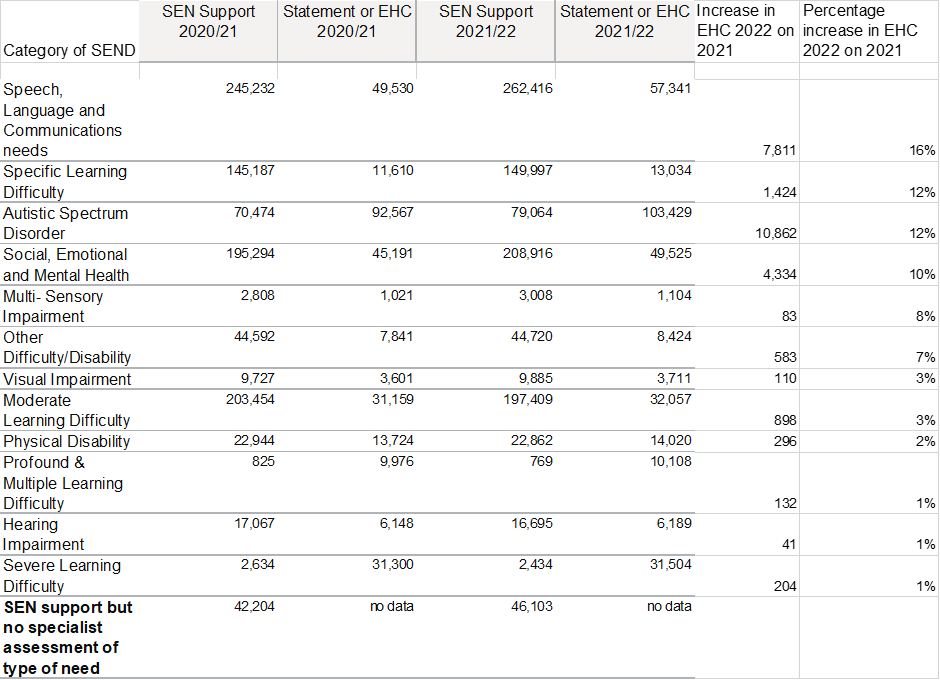
The identification of pupils with Autism or on the Autistic Spectrum at a level where an EHCP (Education and HealthCare plan) is necessary would appear to account for a significant proportion of the unplanned and unfunded growth in spending on SEND, according to the latest DfE data on Special Needs. Special educational needs in England: January 2022 – GOV.UK (www.gov.uk)

The number of EHCPs for young people on the Autistic Spectrum increased from 92,567 in January 2021 to 103,429 in the January 2022 census of pupils. To put this into some context, there are only around 10,000 EHCPs for young people with either a visual or hearing need leading to a requirement for an EHCP. Even, in the category of Social, Emotional and Mental Health, the number of EHCPs in place only increased from 45,191 to 49,525 between 2021 and 2022. However, I suspect this might increase over the coming year if predictions about the mental health of young people following the pandemic come to pass.

Source DfE SEND January 2022 Primary type of need table reordered with additional columns

The growth in EHCPs was even larger for young people with speech, language and communications needs than for those diagnosed as with an autistic spectrum disorder, although this group still only account for half as many EHCPs are for young people on the autistic spectrum disorder group.

Growth in support at this level must mean a radical rethink about how the SEND sector operate. There is no way that this number of young people can be educated in the present Special School sector. Indeed, the staffing of that sector is an issue where a spotlight needs to be shone fairly quickly. There are too many unqualified staff ‘teaching’ these young people, and no visible tracking data for the adequacy of the professional qualifications on top of the basic QTS that such teachers hold. Staying in a mainstream school with an EHCP might be something many parents would need to balance against the journey time to a special school and the more generous staffing of such schools against the qualifications of the staff.

A nine per cent overall increase each year in EHCPs also places a financial burden on more rural local authorities where transport and often that means a driver of a taxi plus another person for each additional EHCP. With fuel costs rising almost by the day, the forward pricing of these contract for next year must already be causing headaches for local authority budget makers.

I don’t have the answers to this issue, but it must be of serious concern that there is sufficient finance for our most vulnerable children to receive as good an education as possible so that they can lead fulfilling lives as adults.  

What is the role of a school in its community?

For everyone interested in either the role of a middle tier in our school system in England or in how pupil place planning and support for vulnerable children is handled in the current shambles around the arrangements for schools in England, this is an important report to read. Local authority provision for school places and support for vulnerable children – GOV.UK (www.gov.uk) The recent White Paper on Education was the second one to pledge to change in-year Admissions and this Report indicates why Ministers should act swiftly to make the necessary changes to the current system.

At the heart of the debate about the middle tier is the role of local authorities and the role of academies and the Trusts that run them. The following two quotes from the report sum up current situation nicely in relation to these important issues for the management of our schooling system:

‘Nevertheless, our research also suggested that there are two ways in which academisation can affect local education systems. First, because there are different processes for making decisions and resolving disputes about place-planning and placements of vulnerable pupils for academies and maintained schools, where an “isolationist” school is an academy, it can be more difficult, complex, and time-consuming to resolve issues. Second, while not generalising, school, trust and LA leaders and parents/carers reported that, among the minority of schools that took an “isolationist” approach, these were more likely to be schools that were part of larger regional or national academy trusts.’

‘Furthermore, there was broad agreement among school, trust and LA leaders and parents/carers that LAs were uniquely placed to play this role [place planning]. (In relation to place-planning, a minority of trust leaders and national stakeholders argued that the RSC should be wholly or partially responsible for delivering place-planning.) Whichever way roles and responsibilities are configured, there was consensus about the need for clarity, alignment of responsibilities and decision-making authority, for reciprocal expectations of schools, trusts and LAs around participating in local partnership-based approaches to place-planning and support for vulnerable pupils, and a renewed, more collaborative relationship between local and central government.’

The situation is summed up by a quote from a local authority officer:

‘Nobody wants to roll back the clock. But if we have MATs not working for the best interests of young people in the community, we don’t have any direct levers. We would have to go through the RSC, and not sure they have many levers. A lot of accountability sits with the LA, but the responsibility of delivery sits with schools. Doesn’t feel appropriate. We need some accountabilities placed on academy trusts and schools to deliver expectations [for vulnerable children].’ (LA officer page 106)

We need a system that works for the children seeking an education, and not primarily for those that provide that schooling. This is especially true for our most vulnerable young people and I hope that Ministers will spend time over easter reading this report and then acting upon its findings. State schooling is a public service and must be managed as such.

Special Needs Consultation

What a mess. Underlying the government’s Green Paper SEND Review – right support, right place, right time (publishing.service.gov.uk) published yesterday is a feeling that without a strong middle tier there can be no overall management of a SEND system to help our most vulnerable young people.

The DfE has recognised the need for a regional tier – that’s not up for consultation – but the Green Paper is weak on exactly what the structure below that would look like. With no coherent local government system in place across England, it will be a challenge to create a system that works effectively at the sub regional level, especially where rural ‘donuts’ surround urban unitary authorities. Schools Forum don’t seem to even receive a mention in the Green Paper, despite holding the purse strings for schools in general through the DSG. Will a hard Funding Formula make them little more than a talking shop?

The aspirations to make the NHS play the part designated for it in 2014 with the creation of EHCP is to be welcomed, although it will be interesting to see how general practice and the hospital sector step up to their responsibilities. Still, new data sharing arrangements are long overdue between health and education.

There is little said in the Green Paper about reform of the SEN Tribunals that almost unanimously find, at least in part, in favour of parents. What may be needed is an approach similar to civil court personal injury compensation, where judgements are set down, if necessary, by the high court, and only new conditions or cases need to go to a Tribunal. Saying ‘no’ all the way to the door of the Tribunal, possibly to save a local authority money should be a thing of the past. Such a system won’t be easy to create, but the present system places intolerable burdens on families in terms of both financial and emotional demands.

The Green Paper accepts that alternative provision is a mess, but doesn’t really identify the causes of the mess and which parts work well. If anything, this is an area where my suggestion of multi-purpose practices of teachers might work well and bring fringe activities within a regulatory framework. All pupils should be on a school roll until 18. Off-rolling should be a positive decision that for teenagers needs to be carefully scrutinised as to why ‘now’ and not earlier in a child’s educational journey. The child’s voice must be part of the decision, however uncomfortable that might be for some parties to that child’s education.

Hovering over all the good intentions is the spectre of funding. Perhaps this is why it is a Green and not a White Paper. Unless the Treasury finds the cash for a better system ‘fine words will butter no parsnips’ as the old saying goes.

More young people are been identified as requiring different approaches to learning than the average child and it is interesting that ‘gifted’ children no longer form part of the SEND agenda. However, an education system based upon the needs of every child is expensive and needs good coordination. The aim is there, but it will be well into the autumn before we see the result of this consultation and thus 2025 before any significant outcomes that don’t need legislative change. For changes requiring legislation it seems unlikely anything will happen this side of the next general election.

Phoenix rising

The DfE has today published a Policy Paper putting more bones on the body of the idea of a career development framework for teachers Delivering world class teacher development policy paper (publishing.service.gov.uk) To those of us with long memories it reads a bit like the early 1990s justification for the creation of the Teacher Training Agency. At that time QUANGOs were fashionable, nowadays government departments like to keep a tighter hold on policy, and don’t let the overall control of this sort of structure outside of the Department’s oversight.

Today’s document is a bit of a curate’s egg. The clickthrough for the Institute of Education on page 8 goes to the document New Institute of Teaching set to be established – GOV.UK (www.gov.uk) not updated since January 2021, and containing quotes from (Sir) Gavin Williamson, the then Secretary of State and Nick Gibb, the former Minister.

Strangely, for a Policy Paper, readers are told to contact their local Teaching Hub to find out more than is in this relatively slight document. I hope that there is a coordinated response for those that do take the trouble to make contact.

The different strands linking together career development paths are ambitious, but necessary. However, it all looks a bit artificial and lacking in both sticks and carrots. Should teachers be required to recertify every few years or would such a move reveal the inability of the system to properly train those asked to teach our young people.

The lack of any mention of special needs, the sector with the highest percentage of unqualified teachers is disappointing, and the numeracy lobby will wonder why literacy is singled out for a specialist NPQ, but they do rate a mention?

In the end, the success of the project will come down to the cash on offer, and how career development will be paid for. The offering in today’s document is still a long way from Mrs Thatcher’s sabbatical term idea based upon the James Committee Report that was scuppered by the 1970s oil crisis. Indeed, it might be worth having a look in the library for a copy of that White Paper; Education – a Framework for Expansion that appear half a century ago.

Teaching Hubs and Regional School Commissioners are no real substitute for a coherent middle tier that can manage the local career development offering for teachers across a local area.

I would like to think that a career framework for all teachers wanting to make the profession their career for the whole of their working life will counter the notion of everyone having several different careers in a lifetime, but it is difficult on the basis of past outcomes to be anything other than sceptical about the needs of individuals rather than the wishes for a system. Will Phoenix make it out of the ashes of past attempts at career development for teachers? I am not sure based upon this Policy Document.

Children in Care

The reports from the Children’s’ Commissioner on Children in Care published today are alarming. https://www.childrenscommissioner.gov.uk/ The number of young people taken into care has been increasing over the past few years for a number of different reasons. Some local authorities tend to take children into care at a younger age than others. Some have more than can be placed with families, albeit sometimes even those placed with families are not located close to where they have been growing up.

A lack of foster families – not just parents since other children in the family need to be part of the decision to foster – especially for more challenging teenagers and groups of siblings can be a real problem. My own family ancestry includes a family group split up in the 1920s. They were fortunate that they were able to keep in touch and retain their familial bonds, even after one was adopted.

The challenge of being moved around, often at short notice and involving a change of school, must be a terrible burden.

A child in care once wrote:

I moved again toady

Discoloured, ripped bin bags struggled to hold my things.”

We cannot countenance the pain felt by such a young person. Their need to hit out becomes more understandable. Less so, the failure of the State to recognise their needs and to allow any undue profits to be made from their situations by the private sector.

The Children’s Commission Stability Index 2020 identifies that

Just over 1 in 10 children in care (8,000 children) experienced multiple placement moves in 2018/19. This rate has remained largely unchanged since 2016. Looking over the longer term, 1 in 4 children in care in both 2018 and 2019 (13,000 children) have experienced 2+ placement moves over 2 years.

More than half of children in care in both 2017 and 2019 have experienced at least one placement change over this 3 year period. These rates have remained broadly constant since 2016.

Older children are more likely to experience multiple placement moves in a year than other children in care. 14% of children in care aged 16+ and 11.5% of children aged 12-15 have had two or more placement moves in 2018/19. Rates are highest amongst 12-15 year olds who also entered care aged 12-15, where nearly 1 in 5 of these children experienced multiple placement moves in 2018/19.

Along with Special education Needs, where demand has also risen significantly, children and young people in care is also an area that need additional funding to address the current shortcomings in the system.

We must also ensure that the young people have a voice that can be heard through groups such as local Children in Care Councils and that local councillors take an active interest in those for whom that have corporate parenting responsibility. Do civil leaders or even ward councillors often visit their local children’s homes and acknowledge the work that foster families are doing? I know that the best do.

These reports need to be read and acted upon at all levels.

Out of the shadows

Last evening I went to a truly wonderful concert at Blenheim Palace in Woodstock. Probably best known as the birthplace of Sir Winston Churchill, the Blenheim estate has developed a range of different activities over the past few years including many musical events. Last night’s concert was not staged by some mega-star, in fact none of the musicians, singers and dancers were professionals at all.

In the splendid setting of the Palace’s library, the Oxfordshire County Music Service performed their Buddies at Blenheim concert. Last night’s concert brought a flavour of their show stopping performance delivered in the Royal Albert Hall last November as part of the Schools Prom season.

What make Buddies unique as a concert is the fact that the Buddies Ensemble and heart of the concert features a collaboration between pupils from the special schools across the county and pupils from a range of other schools.

Performing as one choir, the Buddy Ensemble sang three pieces, including one of their own composition. At the Royal Albert Hall there were nearly 600 young singers from Oxfordshire, last night the library could only accommodate some 50 or so to provide a taste of what the experience in London must have been for those lucky enough to witness it.

At the end of the evening the Buddy Ensemble joined many of the other young players, singers and dancers in a finale entitled ‘Love can build a bridge’. Not only was this sung, but it was also signed by the whole choir, and the chorus by the audience as well. A fitting end to a great evening.

Music has been an important part of the cultural life of our education system since at least the end of the Second World War. There have been times when it has been under threat; the early 1990s and during the recent period of austerity and the transfer of funding to schools from local government are just two such periods when it has faced great challenges. Oxfordshire has found a way to navigate these crises, and still flourish as a service under inspiring leadership, as the collaboration between pupils with SEND and others in the Buddy Ensemble so clearly demonstrated.

Apart from the wonderful and ground breaking work of the Buddy Ensemble, there was an excellent rendition of Corelli’s Concerto Grosso op 6 No 2 in F Major that was exactly suited to the setting of the library, especially for those of us fortunate enough to be placed directly in front of the musicians. The Oxfordshire Youth Flute Choir also provided a superb performance of the Overture to the Barber of Seville by Rossini, played on a range of different flutes. But it is invidious to select these examples from a night of wonderful music and ground-breaking originality that show cased the best of the youth of Britain.

On Friday evening, in another wonderful setting of Dorchester Abbey, there will be an end of term concert. But both before then and for long after the bringing of the pupils in our special schools out of the shadows and into the light must be the abiding memory of what education can achieve.


Too little: too late?

First it was Boris; then Mrs May and finally some of the other leadership contenders. What were they talking about? Not Brexit, although of course all the contenders for the Conservative Party leadership have been trying themselves up in knots of various tightness on that issue, but rather funding for schools.

Reading the runes of what was being outlined, it seems cuts to tuition fees might be some way down the track. If funding for schools and further education is back on the Tory Party agenda, it is difficult to see how the Treasury would be willing to spend more on higher education funding in the immediate future, especially once other Ministers put out their begging bowls. Sure, funding for International Development might be cut to below the level currently agreed to make some savings. This might be justified by citing Donald Trump and the USA level of aid. There might also be some cash to allow higher spending because of better tax revenues, but the police and Ministry of Justice have a real claim on extra cash to fight the rise in certain types of crime, including knife crime and the NHS can always do with more cash.

How much of the suggested increase in funding for education is real, and how much merely determined by the fact that pupil numbers will continue to increase over the next few years, is difficult to determine from the level of the pronouncements made so far, except for Boris’s statement on secondary schools. Not recognising the needs of further education and 16-18 funding might make Boris’s statement about £5,000 per pupil in the secondary sector look like vote catching idea, rather than a serious analysis of where the Tory Party’s current school funding policy has made a mistake. At least in the TV debate, FE, apprenticeships, and skills did receive a mention and, unless I missed, it selective education didn’t.

Any talk about increasing education funding by Conservative may be a case of too little and too late. The warning signs have been there for some time, and the fact that school funding didn’t play much of a part in either of the last two general elections was a bit of a surprise, although the effects on the ground were less obvious than the reductions in school reserves and the consequences of changes to come that are obvious to those that manage budgets, but were not then visible to parents.

For me the funding priorities are: 16-18 funding; early years and children’s centres; SEND funding and protecting rural schools facing falling rolls as the birth rate declines and the housing market stalls. There are other priorities, including metal health, although some cash has been allocated for this, and teacher preparation and career development. All staff will need competitive pay increases if the wider labour market remains as it currently is, but that will be true for the whole of the public sector and might reduce the amount specifically available for education; hence my earlier comment about the challenge in trying to reduce tuition fees.

Unless there is an emergency budget, any changes are not likely to reach schools before April or September 2021 at the earliest.

Congratulations to the Education Select Committee

Alongside the unfolding shambles that is Brexit much of the work of parliament at Westminster goes on almost as normal. Next week the All Party Parliamentary Group on the Teaching Profession s its spring meeting, and I have provided them with an update on teacher recruitment along the lines of yesterday’s post on this blog.

However, of more significant to the work of parliament was the meeting yesterday of the Education Select Committee. Details at https://www.parliament.uk/business/committees/committees-a-z/commons-select/education-committee/news-parliament-2017/send-evidence-17-193/ The minutes haven’t been published yet, but will be well worth reading when the do appear.

When I first started following the work of Select Committees in the 1980s, and then submitting written evidence, and in 1996 being called for the first time to provide oral evidence, these Committees met in rooms at Westminster. They mostly just questioned experts in the field they were discussing. There was no TV channel or live streaming, and I recall astonishing a clerk by requesting that a graph accompanying my evidence needed to be reproduced in colour in the minutes if it was to be understood by readers. Incidentally, guidelines in many organisations for reproducing graphs and charts in both colour and monochrome are still often very lax, making some documents very difficult to understand.

Issues such as concerns about the presentation of data will have been fully understood by those providing evidence to the Education Select Committee yesterday. In three groups, of either two or three, young people with special needs or disabilities provided evidence of their own experience of the education system to the MPs on the Committee. I think this is the first time that the Committee has actually heard at first hand from students with SEND of their experience of our education system.

Schools should not be just exam factories, but pupils with SEND should not lose out in achieving their full potential just because they face additional challenges.  Relegating these pupils to a separate room at lunchtime might be both convenient and help to ensure their safety, but it doesn’t help in making friendship with other pupils. Simple actions such as the wearing of a ‘high vis’ Gillet in the playground can warn other pupils to take care, and reduce the need for isolation and significantly increase opportunities to associate with other classmates.

All new schools should be built with doors and circulation spaces wide enough to take motorised wheelchairs, for even if there are no pupils when the school is being built, who is to say that there won’t be parents, staff, governors or even HMIs making use of such aids to their mobility? For the same reason, lifts must provide access to all upper floors where teaching takes place.

Funding for SEND, and the High Needs Block in general, needs more attention and I hope the Select Committee will consider that issue along with the part the NHS can play in early identification of those that need EHCPs rather than waiting for children to start their education. I hope that yesterday was the start of more conversation between Select Committees and those whose voices are often not heard enough.