
That was The Week That was…

This was an interesting week to have been away from one’s desk. Three Secretaries of State in a week! That’s one for the record books, along with so much else that has happened in Westminster politics during the past seven days.

How much will education feature in the debate over the selection of the next Prime Minister? Will some education journalist ask the obvious questions such as:

If you are going to cut taxes, what will happen to funding for schools, especially in the period before inflation is brought under control?

What are you going to do about the present teacher shortage?

Will you review the way that the apprenticeship Levy operates so that it isn’t a tax on small primary schools?

How important is helping young people recover from the effects of the covid pandemic and what would you do to help boost their mental health?

Do you believe in local democratic control of schooling?

What are you plans for levelling up as it affects the Roma and Traveller communities across England?

Was the EBacc a mistake?

How important do you see the youth Service and other out of school activities?

Will you offer Free School Meals to all primary school children for free?

I am sure that readers can add to this list with this with their own priorities. I am also pretty certain that most of these questions won’t be asked of the candidates.

Education, and schooling in particular doesn’t often feature in either leadership or general election campaigns. It is possible that there could be a debate about selective education, started by one of the candidates, as it is a topic that appeals to the older generation of Tory voters even if most younger Tories have never experienced it, unless they come from parts of the Home Counties. Faced with rising private school fees, some Tories might also see selective state education as a tax cut for parents no longer needing to pay school fees.

And on fees, where will the candidates stand on higher education, university fees and student numbers? It will be especially interesting to see what the Chancellor says as a former Education Secretary. 

Talking of former Education Secretary’s, I wonder whether there was time to take the Ministerial photograph of Michelle Donelan to hang on the wall at Sanctuary Buildings or whether they will use one taken in her previous Ministerial role in the department.

Finally, there is the future of the Schools Bill to consider. This mess of a piece of draft legislation was mauled in the House of Lords and is being reconsidered. The oversight and regulation of academy trusts is an important addition to the legislation on schooling, but I hope that the new team will also listen to their councillors about the importance of both place in the governance of schooling and the need for democratic local accountability.  Local Authorities will not accept the need for responsibility without involvement in decision-making and that matters for admissions, pupil place planning and SEND.
End ITT deserts

Whatever else the re-accreditation process being undertaken by the DfE across the ITT sector achieves, it must end the ITT deserts so that schools across England can rely upon a flow of new entrants into teaching across the whole gamut of secondary curriculum subjects and the differential needs of the primary sector. Attention should also be paid to the needs of the special school sector and pupils with SEND in mainstream schools. The lack of a genuine plan for the training of teachers for pupils with special needs is a scandal than needs highlighting.

However, the needs of the secondary school sector are just as pressing. TeachVac, as well as the DfE and even the tes have built up extensive databases of teacher vacancies that should inform the discussions about where provision needs to be located.

Ever since the cull of providers in the late 1970s and early 1980s there has been a policy of rewarding quality of provision regardless of where that provision was located. The thinking presumably was that ‘trainees will move to the jobs’, so location of the preparation is less important than quality of the preparation. There may also have been a thought that providers of training could partner with schools in localities where there was no training provider.

With the coming of school-based training and employment-based routes, there might also have been an assumption that schools finding recruitment challenging could enter the market and train their own teachers. This produced a confused approach that tried to marry up a top-down model of place allocations based on quality with a ‘bottom-up’ approach on need for teachers that led to a disorganised picture.

In 2013, Chris Waterman joined me in producing a book of maps showing the locations of the various providers, and the routes into teaching that they offered. I have always been surprised that the DfE website on teaching as a career doesn’t offer such a map alongside its rudimentary search facility that only indicates whether a provider has places for a specific course in a manner unhelpful to applicants. The DfE did better in 2013 with its original School Direct application process.

The re-accreditation process provides an opportunity to look in detail at the national picture based upon actual needs for teachers that has been lost since the decision in the 1960s to take teacher preparation away from the employing local authorities and faith communities and transfer preparation into higher education. Wise though that move was in many respects, once the DfE started to let a thousand flowers bloom in the teacher preparation market this ended any national coherence around the provision in relation to the needs of schools.

The situation has become worse in areas where state schools are competing with private schools for the same pool of teachers and trainees. Turning a blind eye to that fact doesn’t help state schools, especially when there is a shortage of new entrants into the profession.

Whatever else the re-accreditation process achieves, if it doesn’t take into account the needs of schools across the whole of England for a reliable flow of new entrants across all subjects and phases it will have failed in what should be one if its major purposes.

Their Lordships 1: DfE 0

If the Schools Bill brought before parliaments soon after the state Opening this spring was a football match that might be the current score line. Today the Minister, Baroness Barron, The Under-Secretary of State for Education has written to all members of the House of Lords announcing major changes to the Bill as first presented to parliament. as a copy has bene placed in the House of Lords library, I feel able to comment on its contents.

 The government still wants an all-academy system, but more of that later. The Minister has said that

The Government has carefully considered the views of the House and as such intends to remove Clauses 1-4 and Schedule 1 from the Bill. Noting that amendments have been tabled to oppose that Clauses 1,3 and 4 stand part of the Bill, the Government intends to support the removal of these Clauses, and table further amendments to remove Clause 2 and Schedule 1, which also form part of the measure.

There have also been concerns on the Academy Trust Termination and Intervention powers (Clauses 5-18 and Schedule 2). This concern is reflected in the amendments that have been tabled to oppose that these Clauses and Schedule 2 stand part of the Bill. I can confirm that is also the Government’s intention to support these amendments.

The Government will support these amendments at this stage and bring forward revised proposals in the House of Commons.  Extract from letter to Members of The House of Lords

I am not sure when I can last recall such a comprehensive review by a government on a Bill of this nature.

The survival of the Bill now depends upon the wider political scene. If there were to be an autumn general election, called by the Prime Minister as a result of a combination of changes in the Labour Party and the Prime Minister taking the view that a general election was less of a problem than a Standards Committee Inquiry, and any consequences resulting from such an inquiry, then the return of the Bill might depend upon whether there was sufficient parliamentary time in what is known as the ‘wash-up’ to see the Bill through all its stages before parliament was prorogued.

Of course, if there isn’t a general election there will be plenty of time to create an all-academy school system with no local democratic scrutiny of schooling.  Presumably, so long as the faith communities can be dealt with to their satisfaction, no other groups will matter.

However, it is to be hoped that the importance of ‘place’ in the delivery of an education system will be recognised. Whether local authorities will want to put the same effort into managing admissions and transport under the new arrangements will be an interesting set of questions.

More teachers take maternity leave

TeachVac records the reason for vacancies as part of its intelligence gathering about the labour market for teachers in England. Each vacancy is classified and placed into one of three categories: permanent position; temporary post or maternity leave vacancy. Where the school doesn’t provide a reason for their vacancy, the default is that the vacancy is for a permanent position.

Regular readers, and those that study the labour market for teachers in any detail, will know that 2022 has been an exceptional year for vacancies, with record numbers being recorded so far this year and approaching 100,000 vacancies across the whole of the 2021-2022 school year.

The lack of any unique job identification number means that it is impossible to know the percentage of re-advertisements in the overall total of recorded vacancies. However, so great has been the increase, even over pre-covid vacancy levels that it must be inferred that there are more vacancies than normal.

To what extent has any growth in teachers taking maternity leave played a part in the increase in vacancies? There has been an increase, as the data in the table below reveals. Between January and June 2021 TeachVac recorded 4,386 vacancies where the cause of the vacancy was as a result of a teacher taking maternity leave. In the same period in 2022, the number had increased to 5,627 by 28th June. Now, cognisant of my comment above, it is entirely possible that some of the growth in maternity leave vacancies is the result of re-advertisements, but it seems unlikely that re-advertisements account for the whole of the growth in such vacancies.

Maternity leave vacancies recorded by TeachVac

Primary SectorSecondary SectorTotalDate range
Maternity256430635627Jan-June 2022
Maternity202423624386Jan-June 2021
Maternity353941567695All Year 2021
Source TeachVac

Now it is also possible that more schools are citing the fact that their vacancy is due to a teacher taking maternity leave. The alternative might be to advertise for a temporary post not citing the reason why the vacancy was temporary.

January to June 2022
 Primary SectorSecondary SectorTotal
Maternity256430635627
Permanent159254878764712
Temporary437122496620
Total228605409976959
Maternity11%6%7%
January to June 2021
Primary SectorSecondary SectorTotal
Maternity202423624386
Permanent100942412834222
Temporary378718385625
Total159052832844233
Maternity13%8%10%
2021 – All year
Primary SectorSecondary Sectortotal
Maternity353941567695
Permanent140793337047449
Temporary593232079139
Total235504073364283
Maternity15%10%12%
Source: TeachVac data

However, there has been a significant growth in the number of permanent vacancies recorded this year, up from 34,222 to 64,712 for the January to June period between those months in 2021 and those moths this year in 2022. Again, it isn’t possible to know the extent that re-advertisements are included in the increase. There will almost certainly be more re-advertisement than in a year when the supply of new teachers entering the market was greater than it has been this year, but I doubt re-advertisements are the main cause of the increase.

Keeping in touch with teachers taking maternity leave to encourage them to return, either part-time or to tutoring or in other type of work within the school would be a cost-effective means of not losing touch with a vital resource. The National Audit Office some years ago now commented that retention was much ore cost-effective than recruitment. Perhaps it is time the DfE dusted off a national ‘keep in tough’ scheme?

More bad news on ITT

Yesterday, The DfE published the ITT applications and acceptances data for the period up to the 20th June thus year. In this post I look at the acceptances for June 2020 compared with those in June 2019, the last year before the pandemic struck. By 2019, there was already concern about the decline in interest in teaching as a career. The pandemic to some extent reversed that trend and provided teaching with a recruitment boost. But, was it a false dawn?

The following table compares the June 2019 UCAS data on ‘offer’ with that from the DfE data issued yesterday.

Subjects2018/192021/22Difference in offers
Biology1430524-906
Science24301531-899
English22901418-872
Geography1010519-491
History11801000-180
Computing410290-120
Religious Education400304-96
Design and technology450355-95
Mathematics15901511-79
Music240228-12
Chemistry600597-3
Physics4004000
Business studies15019747
Art and design41046858
Physical education12901469179
Dramana334na
Classicsna64na
Otherna429na
Sources: UCAS and DfE

On this basis, as I warned in my previous post, 2023 will be another challenging labour market for schools. Only in the same three subjects where there is least concern in 2022: history, art and physical education, is there likely to be anywhere near sufficient supply of new entrants unless there is a sudden rush over the next two months that frankly looks unlikely at this point in time.

The science number is based on an aggregation of totals from the three sciences and doesn’t represent whole new category of potential trainees. The most significant declines in the number of offers since 2019 are English, geography and computing. However, at these levels most subjects won’t reach their Teacher Supply Model number unless there is a significant input from other sources such as Teach First. I am not sure how likely that will be as they don’t publish their data in the same way to the general public whatever they share with the DfE. There are currently more ‘offers’ in mathematics than there are in English and at this level, English departments may struggle with recruitment in 2023.

Overall, there have been 32,609 applicants by 20th June. This compares with 37,790 applicants domiciled in England that had applied through UCAS by June 21st 2021. There are 2,229 ‘recruited’ applicants in 2022, when there were ,5830 ‘placed’ according to the UCAS data in June 2021. The conditional placed or conditions pending groups are 18,363 this year compared with 23,620 in June 2021. Many of these will be awaiting degree results, and this number will reduce next month just as the ‘recruited’ number’ will show an increase. Interestingly, the number that have declined an offer this year is shown as 760 compared with 370 in June last year. Another straw in the wind of how challenging recruitment has become.  However, withdrawn applications are down from 1,520 to just 1,002.

There must be a concern that applications – as opposed to applicants – in the South East provider region are down from 14,390 to 10,795. This is the region with the largest proportion of vacancies each year, and where the private sector vies most strongly with state schools of all types for teachers. An analysis of acceptances by subject by provider region would help schools identify the seriousness of this decline, and whether it is in both the primary and secondary sectors?

Applications overall are down for both sectors, with primary down from 48,520 last June to 39,712 this June, and secondary down from 61,480 to 48,047, a very worrying reduction. School Direct salaried continues to be replaced by the PG apprenticeship route that has had 3,864 applications this year compared to 5,315 for the School Direct Salaried route. However, similar numbers have been placed on both routes, at around 500 trainees on each route.

With some schools ceasing recruitment as term comes towards its end, it will be up to higher education to recruit most of the additional applicants over the summer. Will those providers threatened with not being re-accredited show the same appetite to recruit as they would if their future was secure in teacher education? The DfE must surely how so as every extra trainee is a welcome bonus for schools in 2023 struggling to recruit teachers.

Start worrying about September 2023

While I have been waiting for the DfE to produce the June data about admissions and acceptances to ITT postgraduate courses, I thought that I would have another look at the percentage of courses no longer showing as offering vacancies as listed on the DfE website.

In passing, UCAS used to publish a calendar of dates when the monthly data would be published and generally stuck to that regime. There seems to me to be little logic to the reporting by the DfE this year.  

Anyway, what are the portents for September, and thus for the recruitment round that will provide staff for schools in the 2023/24 school year? Sadly, they don’t seem great.

The data I used matches ‘courses with vacancies’ against the ‘all courses’ number. Now, of course, a course may only have one vacancy or many, and the data doesn’t show that information, useful although it might be to applicants trying to decide where to apply to at this point in the cycle. I assume that those advising applicants are privy in order to use the data to help maximise successful outcomes.

Below in the table is the percentage of courses with vacancies ranked from least to most.

Subject24th June vacanciesall courses% with vacancies
Psychology2810626%
Latin51631%
Social Sciences3611531%
Classics71839%
Heath & Soc Care163644%
Comms & Media Studies183946%
Physical education26256347%
Dance357050%
Business studies17027263%
History40664263%
Drama22735065%
Economics253866%
Computing37356166%
Art and design32547968%
Music26638769%
Primary1200171670%
Citizenship142070%
Design and technology35049471%
English57580871%
Modern Foreign Languages69196672%
Religious Education34748072%
Mathematics63087172%
Chemistry56176673%
Geography50167175%
Biology55173375%
Physics60779676%
Science212584%
Source: DfE website

Only ten subjects have more than a third of courses currently ‘closed’ with no vacancies. The assumption must be that these courses are ‘full’ although there might be other reasons for the course not shown as currently offering vacancies.

Leaving out the small number of ‘science’ courses, there are three subjects, biology, physics and geography with more than three quarters of courses still returned as with vacancies. Even the primary sector has 70% of courses with at least one vacancy.

Such high levels of courses can be seen as a ‘good thing’ if there happens to be a flood of late applications. However, it is possible some school-based providers will no longer recruit after the end of term, and are thus not taking applications after the end of next week.

If the ability and willingness to recruit throughout the summer is not a criterion for re-accreditation then it ought to be, otherwise the government risks shooting itself in the foot by missing out on late applicants. There are those that don’t decide to become a teacher until August, and want to start in September.

As Teach First has started recruiting again, for this summer, it looks fair to say that that data are pointing to 2023/24 being another challenging year for schools needing to recruit staff. Currently, the average number of vacancies for schools in London and the South East stands at 10 per school.

TeachVac’s Premium Service helps schools connect with potential applicants for a fixed annual price of a maximum of £1,000 or £20 per week. With TeachVac’s growing list of teachers and trainees the service offers excellent value for money.

Academies dominate teacher recruitment market

TeachVac, the National Vacancy Service for Teachers, has estimated from an analysis of its data that 65% of teacher vacancies in 2022 have been placed by either MATs or stand-alone academies. Maintained schools, more common in the primary sector, where nationally advertised vacancies tend to be fewer in number, have accounted for only 35% of vacancies.

Multi-Academy Trusts (MATs) with more than 100 vacancies so far in 2022 accounted for 19% of the overall total of vacancies, and a higher proportion of the vacancies for secondary teachers.

One large MAT has posted more than 1,000 vacancies so far in 2022. There is an interesting question for the sector arising from this, as that MAT is one of those selected by the government to lead the new Institute of Teaching. Will there be a barrier between one side of the business and the other or will the MAT be in a more favourable position to recruit trainees than other MATs and maintained schools?

Recruitment has never been level playing field. Indeed, in 1995, I made just this point on page 213 of a book by Bines and Welton entitled ‘Managing partnership in teacher training and development’. Interestingly, I also pointed out in that chapter the need to integrate professional development into a programme that stretched beyond the then probationary year. Some things never change.

In order to meet the demands for teachers that have seen record levels of demand by schools this year, TeachVac, the on-line job board where I am Chair has just launched a new Premium Service that places subscribers’ vacancies at the top of the list of matches sent out each year.

TeachVac’s basic service remains free to schools, but the Premium Service that lists vacancies at the top of the daily match list sent to users costs £1 per match up to a maximum charge per school of £1,000 +VAT per annum for secondary schools and less for primary schools. As more schools sign up to the Premium Service the cap could be reduced to £500 per annum. With approaching 80,000 vacancies handled in 2022 to date and more than 1.8 million matches the premium service offers outstanding value for money and as more teachers sign up to the platform will over even better value. Schools can find out more at enquiries@oxteachserv.com or by messaging me directly.

Recruitment for unexpected January 2023 vacancies and for September 2023 will be challenging and as MATs and academies are currently putting their finishing touches to their 2022/23 budgets, now is an excellent time to adopt TeachVac’s No Match: No fee Premium Service with its cap on annual expenditure that can be built into the budget.

TeachVac doesn’t waste money on the hard sell. Sufficient schools have signed up to produce 1,100 matches through the Premium Service in June alone, after the May deadline for resignations. We believe that results are the best form of marketing. 

Pay primary school teachers less?

A common pay scale for all teachers has been a feature of pay policy in England since at least the 1950s. It is a surprise to read in a study published today by the NfER; a study supported by The Gatsby Foundation, the following paragraph.

Separating the primary and secondary teacher pay scales could be effective at targeting resource where it can have greater gains in terms of overall teacher supply, in a way that is cost neutral within an existing spending envelope.The impact of pay and financial incentives on teacher supply – NFER

Adopting this solution would breach this long-standing arrangement of a common pay  scale for all qualified teachers subject to regional differences. Of course, there has never been pay parity between the two sectors because, as NfER comment, and readers of this blog with know, it is easier to recruit teachers to the primary sector than to some subjects in the secondary sector. Up to now, incentives have been targeted at specific subjects where there are shortages. So, on teacher preparation courses, some trainees receive greater encouragement than others through the use of bursaries on the largest route into teaching. However, on other routes, such as Teach First, this differential doesn’t seem to apply. Both history and physics trainees receive a salary.

Before schools were provided with budgets, and a National Funding Formula based on average salaries was introduced, the allocation of the number of promoted posts differed between primary and secondary schools, to the advantage of the latter. This was, I am sure an indirect way of creating pay differentials for classroom teachers between the two sectors that was acceptable to the then Trade Unions that recognised the differences in recruitment challenges between the two sectors.

The NfER make the point that paying teachers in different sectors at different rates is already to be found in some other countries. The cite the fact that starting salaries for secondary teachers in Finland are 15 per cent higher than their primary counterparts, and secondary starting salaries are 6 per cent higher in Sweden, as evidence of the case for introducing differential salary rates. It is an interesting argument, but I am not persuaded. Evidence about recruitment to the primary sector largely only available at the macro level as anyone with QTS can be recruited to any post, and it isn’t clear if there are specific challenges in some subject specialisms and age-related posts.

The NfER report that is well worth reading despite this recommendation does make the point that I have made regularly relating to the relationship between the wider economic situation and recruitment into teaching. This was last apparent at the start of the pandemic when a fear of mass job losses before the furlough scheme was introduced caused a short-term serge of interest in teaching as a career. The NfER study makes the point that at present the graduate labour market is stronger than the government seems to appreciate.

Perhaps the most depressing feature of the report is the fact that neither physics nor IT will ever meet the target number of trainee teachers required on any of their scenarios. The government really does need to address the issue of teacher supply, not only in these subjects but also across the board.

SEND in the spotlight

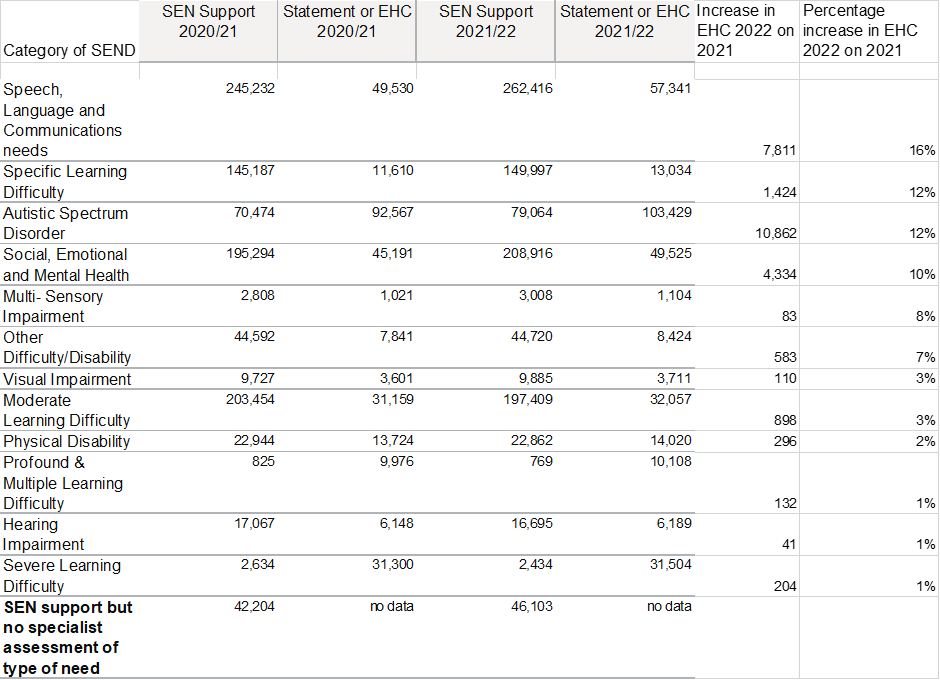
The identification of pupils with Autism or on the Autistic Spectrum at a level where an EHCP (Education and HealthCare plan) is necessary would appear to account for a significant proportion of the unplanned and unfunded growth in spending on SEND, according to the latest DfE data on Special Needs. Special educational needs in England: January 2022 – GOV.UK (www.gov.uk)

The number of EHCPs for young people on the Autistic Spectrum increased from 92,567 in January 2021 to 103,429 in the January 2022 census of pupils. To put this into some context, there are only around 10,000 EHCPs for young people with either a visual or hearing need leading to a requirement for an EHCP. Even, in the category of Social, Emotional and Mental Health, the number of EHCPs in place only increased from 45,191 to 49,525 between 2021 and 2022. However, I suspect this might increase over the coming year if predictions about the mental health of young people following the pandemic come to pass.

Source DfE SEND January 2022 Primary type of need table reordered with additional columns

The growth in EHCPs was even larger for young people with speech, language and communications needs than for those diagnosed as with an autistic spectrum disorder, although this group still only account for half as many EHCPs are for young people on the autistic spectrum disorder group.

Growth in support at this level must mean a radical rethink about how the SEND sector operate. There is no way that this number of young people can be educated in the present Special School sector. Indeed, the staffing of that sector is an issue where a spotlight needs to be shone fairly quickly. There are too many unqualified staff ‘teaching’ these young people, and no visible tracking data for the adequacy of the professional qualifications on top of the basic QTS that such teachers hold. Staying in a mainstream school with an EHCP might be something many parents would need to balance against the journey time to a special school and the more generous staffing of such schools against the qualifications of the staff.

A nine per cent overall increase each year in EHCPs also places a financial burden on more rural local authorities where transport and often that means a driver of a taxi plus another person for each additional EHCP. With fuel costs rising almost by the day, the forward pricing of these contract for next year must already be causing headaches for local authority budget makers.

I don’t have the answers to this issue, but it must be of serious concern that there is sufficient finance for our most vulnerable children to receive as good an education as possible so that they can lead fulfilling lives as adults.  

The new NPQs

The DfE has published a one-off document about participation in the National Professional Qualifications. Participation in the reformed NPQs in the academic year 2021 to 2022 – GOV.UK (www.gov.uk) The report identifies the number of confirmed starts for all NPQs funded by the DfE by region. The data covers two starting points, Autumn 2021 and Spring 2022. The DfE make the point that starts don’t equate to actual numbers of people, as it is possible to start more than one NPQ.

The total starts over the two cohorts were 29,153. I though it would be interesting to see how that compared with the number of advertised vacancies in 2021 for promoted posts with a TLR and also for leadership posts across the primary and secondary sectors.

The data from TeachVac www.teachvac.co.uk suggests that there were around 13,000 vacancies recorded during the whole of 2021 where an NPQ might be a useful part of a teacher’s application.

Promoted postAssistant HeadDeputy HeadHeadteacherTotal for 2021
Primary126165196515364413
Secondary702310346283108995
828416851593184613408
Source: DfE

So, that might suggest that if registrations continue at this level with another intake in Autumn 2022 there is potentially a healthy supply of teachers able to seek promotion with recent experience of an NPQ assuming not too many multiple registrations by each participant.

The number of starts differed by regions according to the DfE statistics

Number of confirmed NPQ starts by region
RegionConfirmed starts (DfE-Funded)TeachVac vacancies 2021TeachVac vacancies as % of the total
North-east1,56139025%
North-west4,267156037%
West Midlands3,439128237%
East Midlands2,528102941%
Yorkshire and the Humber2,853128645%
South-west2,582124948%
London5,065253050%
South-east4,162243859%
East of England2,693164461%
Not available30%
Total29,1531340846%
Source DfE and TeachVac data

In the North East, there a much larger number of NPQ starters across the two cohorts compared with promotion opportunities identified by TeachVac than in London and the Home Counties. This raises interesting questions about the allocation of resources across the regions that might encompass the ‘levelling up’ agenda and the extent to which NPQs are useful in providing a pool of teachers equipped for promotion or whether the NPQs are to help the school where the teacher is currently employed?

It would be interesting to see a further breakdown by the local authority where the teacher’s school was located to further match provision against need. For instance, was there any difference between the estuarine part of the East of England along the north bank of the Thames Estuary and the two counties of Norfolk and Suffolk. The same might be asked between Oxfordshire and Kent in the South East?

The data relates to ‘starters’. I hope the DfE will eventually publish data about completers. I remain in awe of teachers that take on professional development on top of a working week in the classroom. The fact that nearly 30,000 did so in a year when covid was rampant speaks volumes for the teaching profession.