New Service for schools

TeachVac

The National Vacancy Service for Schools

Advanced matching service

Schools pay for matches with interested teachers to be highlighted

No match made; no charge

£1,000 per annum maximum for all matches

on all vacancies by a secondary school in 2022

£100 sign-on fee, with 100 free matches, then £1 per match

TeachVac has already made 800,000 matches in 2022:

1.2 million matches in 2021

A cheap, but cost-effective service for schools

from the free job board covering state and private schools across England

email enquiries@oxteachserv.com for full details

What is the role of a school in its community?

For everyone interested in either the role of a middle tier in our school system in England or in how pupil place planning and support for vulnerable children is handled in the current shambles around the arrangements for schools in England, this is an important report to read. Local authority provision for school places and support for vulnerable children – GOV.UK (www.gov.uk) The recent White Paper on Education was the second one to pledge to change in-year Admissions and this Report indicates why Ministers should act swiftly to make the necessary changes to the current system.

At the heart of the debate about the middle tier is the role of local authorities and the role of academies and the Trusts that run them. The following two quotes from the report sum up current situation nicely in relation to these important issues for the management of our schooling system:

‘Nevertheless, our research also suggested that there are two ways in which academisation can affect local education systems. First, because there are different processes for making decisions and resolving disputes about place-planning and placements of vulnerable pupils for academies and maintained schools, where an “isolationist” school is an academy, it can be more difficult, complex, and time-consuming to resolve issues. Second, while not generalising, school, trust and LA leaders and parents/carers reported that, among the minority of schools that took an “isolationist” approach, these were more likely to be schools that were part of larger regional or national academy trusts.’

‘Furthermore, there was broad agreement among school, trust and LA leaders and parents/carers that LAs were uniquely placed to play this role [place planning]. (In relation to place-planning, a minority of trust leaders and national stakeholders argued that the RSC should be wholly or partially responsible for delivering place-planning.) Whichever way roles and responsibilities are configured, there was consensus about the need for clarity, alignment of responsibilities and decision-making authority, for reciprocal expectations of schools, trusts and LAs around participating in local partnership-based approaches to place-planning and support for vulnerable pupils, and a renewed, more collaborative relationship between local and central government.’

The situation is summed up by a quote from a local authority officer:

‘Nobody wants to roll back the clock. But if we have MATs not working for the best interests of young people in the community, we don’t have any direct levers. We would have to go through the RSC, and not sure they have many levers. A lot of accountability sits with the LA, but the responsibility of delivery sits with schools. Doesn’t feel appropriate. We need some accountabilities placed on academy trusts and schools to deliver expectations [for vulnerable children].’ (LA officer page 106)

We need a system that works for the children seeking an education, and not primarily for those that provide that schooling. This is especially true for our most vulnerable young people and I hope that Ministers will spend time over easter reading this report and then acting upon its findings. State schooling is a public service and must be managed as such.

33,000 in three months

How are we to interpret the record number of teacher vacancies logged during the first three months of 2022 by TeachVac?

Subject20202022Percentage +/- (The nearest whole %)
Design & Technology1089164351%
Leadership2278335347%
Business701101845%
Computing828119144%
Primary5059714041%
RE61583536%
Music49864830%
Total259393358029%
Geography816104628%
Creative Arts33442327%
History58974827%
PE72790625%
Languages1397173724%
Science3427395615%
Art49355212%
English2427268110%
Mathematics311533287%
Source www.teachvac.co.uk

There is little point comparing 2022 with 2021, as the covid pandemic resulted in very little activity in the teacher job market during the first three months of 2021.

So, how to explain this year’s surge in vacancies, and what might be the consequences?

Is the surge down to schools catching up vacancies not advertised last year; is it – at least in the secondary sector – down to increased pupil numbers; might private schools be recruiting more pupils from overseas and, hence need more teachers; could TeachVac be better are recording or even over-recording vacancies than in the past? I asked the team to check on the last point, and since most of them have been entering vacancies for several years, and we haven’t changed their way of working, it seems unlikely as a reason for the large increase in vacancies.  

On the other side of the equation, could the increase in recorded vacancies be down to more teachers quitting schools in England, either to take up tutoring; to teach overseas or to either reduce their hours or even retire completely? Since we don’t have exit interviews, we will have to wait for the DfE to match teacher identify numbers for those moving within the state system and retiring with a pension and then conjecture what has happened to the remainder of leavers?

As to the consequences, regular readers of this blog will know what will come next because various posts since the ITT Census appeared in December have already been discussing the nature of the recruitment round for September 2022 and January 2023.

The table earlier in this post shows English and mathematics with relatively low increases. Perhaps schools feel that with the change in Ministerial team last autumn the focus on the EBacc subjects might have reduced. If so, might the White Paper provisions see an increase in vacancies in these subjects after Easter?

The increase in leadership vacancies needs further investigation in order to see which sector, and which of the leadership posts; head, deputy or assistant head are most affected by the increase or whether it is a general increase.

Design and technology, business, and to some extent computing are subjects that the government has under-played in its various attempts to increase interest in teaching as a career. Schools still want teachers in these subjects, and the government must help them fill the vacancies.

With many subjects not even meeting the DfE’s indicative target for the need for teachers on teacher preparation routes in 2022, the remainder of the recruitment round may well be a real challenge for many schools.

There is one other possibility, and that is the notion of schools bringing forward recruitment this year, so the peak will have been in March rather than in late April, as has been the normal practice in past years. If so, April will be a lean month for those that put off job hunting until then, unless schools have been unable to fill some of the 33,000 vacancies, and there is a string of re-advertisements this month and next.

TeachVac has a number of different reports to allow schools, local authorities, recruitment agencies and anyone else interested in trends in the labour market in real-time to track the behaviour of the market in anything for real-time to monthly. Email the staff using enquiries@oxteachserv.com for details.

Public Accounts Committee concerns over the academy system

The Public Accounts Committee (PAC) has today published its latest annual report into the academies sector. Academies Sector Annual Report and Accounts 2019-20 (parliament.uk)

The Committee accepts that the government wants all schools to become academies, but doesn’t yet see a clear path for some types of schools to be able to do so. Such a move to full academisation would remove local democracy from the school system and make it much more like the NHS, with limited accountability, and no guarantee of local accountability. This does not strike me as a good move for democracy. Hopefully, the government’s plans will be set out in the forthcoming White Paper.

Also, of interests, was the PAC’s views on the financial management of academy trusts. Unlike local authorities and maintained schools, Trusts can aggregate funds and do not have to publish accounts for each school separately. Trusts could move funds between schools and create capital for new buildings at one school by levying other schools in the Trust.

The PAC said:

 ‘Academy trusts have been set up as charitable companies, with more freedoms and responsibilities than maintained schools, including being responsible for managing their own finances. There is a tension between this autonomy and the oversight role by the centre via the Education & Skills Funding Agency which is required to provide assurance to the Department who hold ultimate responsibility for the delivery of education in England. The Department provided additional financial support of £31 million to 81 academy trusts in 2019/20 to support financial recovery, build capacity, facilitate a transfer of academy schools triggered by financial or educational factors, or as a short-term advance. Of this, £21 million has been provided as non-repayable funding. The Education & Skills Funding Agency has reported that £10 million of debts held by academy trusts have been written off in 2020–21, including £5 million for one trust. We are concerned that there is a risk that a trust becomes too big to fail and could therefore see large sums of public funds being pumped into it to keep it afloat.’ (Page 7)

Writing off £10 million of debts in one year means cash that could have been spent on children’s education probably disappeared in a manner not possible with local authorities.

Of more concern is the lack of control over senior staff salaries in Trusts. To quote the PAC again;

‘17. The number of academy trusts paying at least one individual above £150,000 increased to 473 trusts (17% of trusts) in 2019/20, from 340 trusts (12%) in 2018/19. Almost two thirds of trusts (1,772; 64%) in 2019/20 reported paying at least one individual between £100,000 and £150,000, compared with just over half (1,535; 53%) in the prior year.’ (Page 14)

This is not a new issue, as my blog from 2018 highlights: CEOs pay: what’s happening? | John Howson (wordpress.com) If there were just 160 local authorities with Directors of Education, how much more cash might be available to schools that is currently disappearing due to the diseconomies of scale inherent in the model of academisation established by Michael Gove in the hurry to pass the 2010 Education Act.

So, no democratic control, high salaries for some, but pay freezes for workers. Not a good structure for our school system when we cannot even recruit enough teachers.

TeachVac launches new service for schools

The DfE Vacancy site for teachers is still a muddled mess. Eight years ago, well before the DfE woke up to the idea that the internet could be used for low cost but effective job matching, I helped create TeachVac http://www.teachvac.co.uk and made it a free service for schools and teachers.

The basic rationale was simple – modern technology can cut the cost of finding a job and schools could save money as a result. After the Public Accounts Committee complained that the DfE didn’t have a grip on the labour market for teachers, the DfE set about creating a job board of their own.

At the start of the pandemic, I offered to share vacancies that the DfE didn’t upload with them to help to create a single free platform for teachers. Go away, I was told.

So, TeachVac still offers a free service, but is now launching its premium service whereby a school can ensure its vacancies are at the top of the list of matches a teacher receives each day. The service also provides a reminder after a few days so that teachers see the job more than once. Schools also receive labour market updates each month. All this for £500 per year for secondary schools and even less for primary schools across both state and private sectors schools.

Contact enquiries@oxteachserv.com for more information or to sign up and receive an early bird discount.

But, back the DfE site. Where, of course, teachers can only search for jobs in state schools. So, the site isn’t useful to those that don’t mind whether they work in state or private schools.

The front page of the DfE site is a real muddle. There are lists of ‘towns/cities and ‘counties’ although Chester West and Chester East aren’t counties, but unitary authorities. Towns within shire counties such as Oxford, Exeter, Chelmsford and many others don’t have a listing on the front page.  London has a single listing, not even split into the different pay area: not helpful if there are lots of vacancies in the Capital’s schools.

Milton Keynes receives a mention, but the rest of Buckinghamshire doesn’t. Still, there is a search buttons for key words and locations. A search on ‘secondary’ and ‘Oxford’ brings up 12 results. Four are non-teaching posts; two are in special schools or PRUs and only six are in secondary schools.

There is an alert function, but if it sends non-teaching posts as well as teaching vacancies it doesn’t do the job for which it is intended, unless the civil servants at the DfE think teachers that cannot find a teaching post will consider non-teaching roles and have the appropriate qualifications for such positions.

TeachVac is breaking records each month with 500,000+ matches so far in 2022, and over one million in this school year to date.

The earlier a school signs up for the premium service, the higher up the daily list of matches it will be placed. Don’t delay: sign up today by emailing enquiries@oxteachserv.com to express interest.

Teachers need CPD in using technology: nothing new there

The DfE has published an interesting survey about the use of Educational Technology in schools. These days, unlike when I first started teaching, EdTech usually means IT related equipment. The survey can be found at Education Technology (EdTech) Survey 2020-21 (publishing.service.gov.uk) It is worth noting that the Review is based upon a survey of a limited number of schools and teachers and that classroom teachers views may less visible than views from IT specialists and school leaders.

Many years ago, in the days of the Labour government, the early use of IT equipment in schools was chronicled in a number of surveys. I recall writing about some of the results, for instance, in the TES on 4th January 2002 when government data suggested that the average secondary school already had more than 120 computers, and the average primary school more than 20.

In those days, the internet was still new and smart phones were only for enthusiasts. I also recall commissioning a Java app for the 2005 General Election based upon the cost of the War in Iraq: but that’s another whole story.

Schools these days take IT equipment for granted, but there are still differences between the primary and secondary school sectors. The Review rightly suggests that the need for ‘A review of the digital technology used for supporting pupils with SEND.’ (Page 22).  All too often the need for accessible technology can be overlooked.

Schools clearly need more support, not least in the area of cyber security training and safeguarding pupils and staff. The decision to abolish rather than update the national support for Education Technology in the great bonfire of the QUANGOs instituted by the Conservative Ministers in the coalition government really does look like a short-sighted move, whatever the shortcomings were at the time. This lack of on-going support is recognised in the suggestions for future development contained in the Review.

Schools indicated a range of barriers to future effective use of EdTech including

Financial barriers were by far perceived as the biggest barriers, especially cost and budgetary constraints, although availability of technology in school (which is also likely to be linked to school budgets), was also cited.

Pupil barriers were perceived by teachers to be major barriers and the availability of technology (94%) and internet connectivity (90%) in pupils’ homes were perceived to be the biggest barriers to increased uptake of EdTech after cost and budget. Secondary school teachers (in particular those from local authority ‘maintained’ schools) perceived these factors to be ‘big barriers’. Pupils’ digital skills were also perceived as a barrier, although to a lesser degree.

Staff barriers, including teachers’ skills, confidence and appetite for using EdTech also represented a substantial barrier. Almost nine out of ten headteachers (88%) and three-fifths of teachers (58%) cited teacher skills and confidence as a barrier to the increased uptake of EdTech. Teachers who mentioned this was a barrier for them were less likely to say that EdTech met their needs, saved them time and reduced their workload. These teachers were also less confident in their ability to deliver remote education.

Connectivity barriers in school were also commonly mentioned, although they were more likely to be cited as ‘small’ barriers rather than ‘big’ barriers.

Safeguarding and data concerns were also mentioned, especially by secondary school teachers, however, overall, this represented a ‘small barrier’ to the increased uptake of technology. (Page 20)

Implicit in the comments about barriers may be the different funding regimes between academy chains and local authorities, whereby it is easier for academy chains to manage development and purchasing strategies than it is for local authorities under the present funding arrangements.

The use of devices reflects the difference between class-base teaching in the primary sector and subject-based teaching across most secondary schools. This difference in teaching strategy may explain why fixed units such as PCs have greater exposure in the secondary sector and tablets and other more mobile devices are to be found in great numbers in primary schools where pupils spend the majority of their time in a single teaching base.

The past two years of the pandemic has helped change the landscape for learning in schools and the future must make the best use of the skills only teachers can bring to support the learner and the best use that can be made of technology.

White flag or shifting the blame

There is a saying that one should beware of unexpected guests. For reasons obvious to those that know the saying, it is clear why I prefer to compare it with the other saying of ‘not looking a gift horse in the mouth’ – should that be looking an electric car in the battery these days – but without using the actual expression. No matter, what does matter is whether or not local authorities will be able to form and run Multi Academy Trusts/Committees?

Ever since Mr Gove raced the 2010 Academies Act through parliament in the period before the summer break that year, and less than three months after the 2010 General Election, the Conservatives have wanted all schools to become academies. At that time, local authorities were beyond the pale, and a model with no local democratic involvement, similar to that of the NHS, seemed on the cards for education. Peter Downes a former Cambridgeshire Lib Dem councillor and long time secondary head led the Lib Dem charge at their 2010 September Conference, an event where delegates made their support for local democratic involvement in education very clear to Nick Clegg and David Laws.

Over the ensuing decade, most secondary schools have either opted or been forced to become an academy. All new schools are required to become an academy. However, except in a few parts of the country, academisation of the primary sector schools has been slow and patchy. Many primary schools only became academies are a visit from ofsted resulted in compulsory academisation.

The picture that has emerged around the county is of an expensive mess that could make the reputation of a Secretary of State if change is handled properly with a view to the longer-term effectiveness of the school sector.

There are now noises in the press suggesting that the next White Paper from the DfE might allow local authorities to establish and run Multi Academy Trusts or Committees or some new structure such as a Multi Academy Board might be created. Such a suggestion would effectively be a change of direction on the part of central government. Is it either a white flag or preparing the ground to shift the blame for a period of challenge that will face the primary sector where most maintained schools are still to be found?

There is a third possibility. This is that civil servants have been so impressed by how some local authorities have handled the covid crisis that they now recognise their value as part of the middle tier, especially in handling the large number of small primary schools spread across rural England. Certainly, the work by the local authority team in Oxfordshire, where I am a county councillor, has resulted in an email from a headteacher of a private school expressing thanks for the work of local authority staff. Not something you receive every day.

Allowing or even forcing local authorities to take all schools not already academies into a LAB or Local Academy Board would allow the government to tell the public that all schools were now academies. It would allow local authorities to feel that they might be back in the game of education politics and it would allow for more coherent planning for the primary sector less hampered by the legislation on closing rural schools. This may be important should the National Funding Formula create the need to rationalise the school estate.

Attendance Group must address in-year admissions issue

I recently caught up with news about the DfE’s Attendance Group, and the Minutes of its December meeting.  Attendance Action Alliance January meeting notes: 9 December 2021 (publishing.service.gov.uk)

I am delighted to discover the high-profile nature of membership the Group and that the Secretary of State has taken an interest, as owner of the work. However, although the Group discussed the question of a register for home educated children and the concerns over those children just missing school on a regular basis, I didn’t find any emphasis on ensuring that children taken into care are offered a school palace as swiftly as possible and within set time limits. The same standards also need to be put in place for children with special needs whose parents move to a new location during the school year and need a new school placement.

Taking a new job should not be conditional on whether there is a special school place available for your child.

In a previous post on this blog, calling for a ‘Jacob’s Law’, I laid out the case for in-year admissions to academies not to be held up by such schools not wanting to admit such children. The 2016 Education White Paper: Education Excellence Everywhere recognised there was an issue with in-year admissions to academies because local authorities had no powers to over-rule the decision of a school not to admit a pupil. This was why Jacob was out of school when he died. Time for Jacob’s Law | John Howson (wordpress.com)

Sadly, nothing significant has changed since 2016. I hope that the Attendance Group will consider the issue of in-year admissions at a future meeting, and not just focus on the parents that don’t send their children to school. The system must work for the benefit of all and not just those that are easy to educate. The same is the case of children with SEND requiring in-year admission to a school.

These young people must not be ignored, and just offering tutoring is not the same as admission to a school. Home tutoring doesn’t provide the same social interaction that being in a school provides however good the ‘virtual school’ is at its job.

Of course, there are risks where the school community is hostile to incomers and many schools could well look to improve the transfer experience for in-year admissions that can be even worse than that experienced by pupils transferring at the start of the school-year.

Being taken into care as a school-age child is a traumatic experience, and we owe it to these children to make sure that their education is affected as little as possible. So, it is my hope that the Attendance Group will as a minimum endorse the 2016 White Paper suggestions and, if possible, go further and set time limits for school places to be offered to children taken into care and requiring a new school placement. For most, it wasn’t their fault that they have ended up in the care of the local authority where all the secondary schools are academies.

Academies increase cash balances

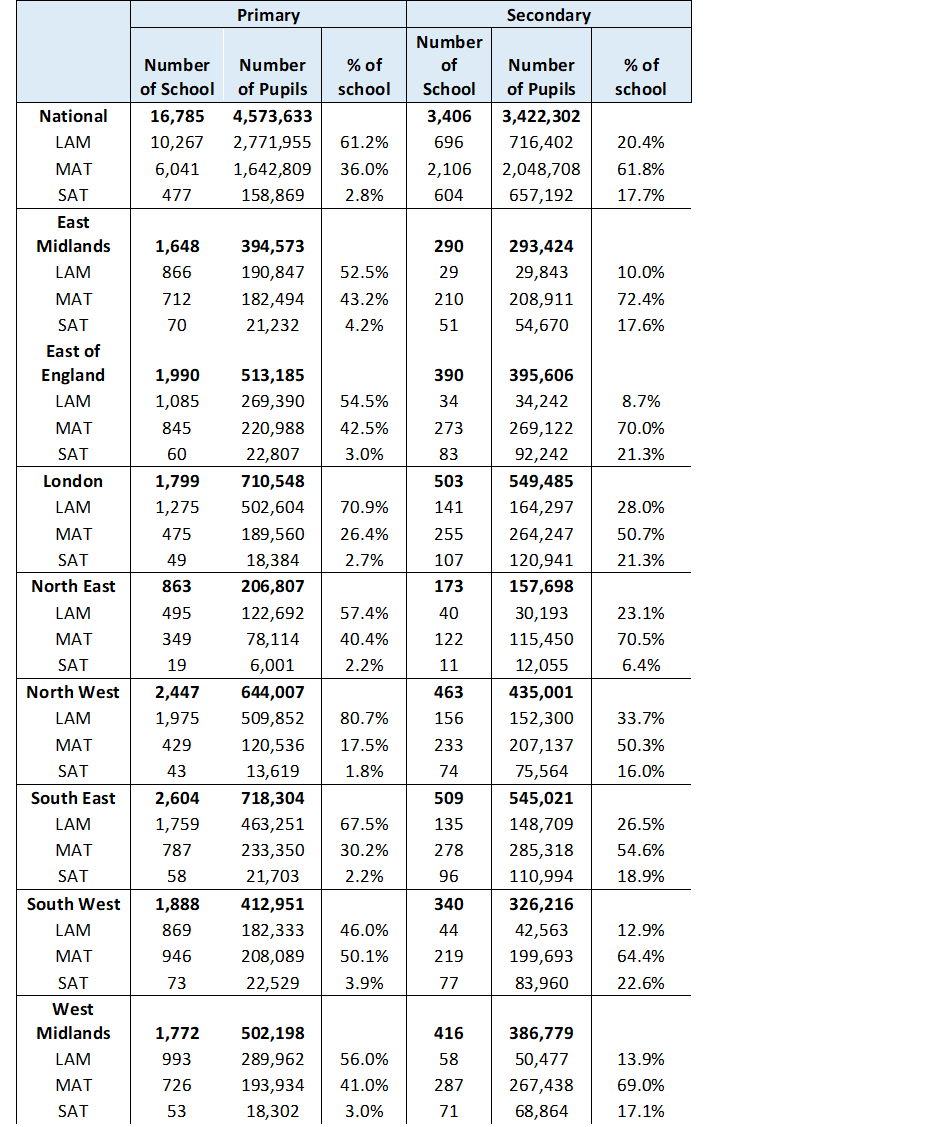
Hard on the heels of the Treasury Select Committee’s Report, with its comments on government funding of education – see previous post on this bog – comes the 10th Annual Academy Benchmark Report from Kreston Global Kreston-Academies-Benchmark-Report-2022-Web.pdf (krestonreeves.com) This detailed report raises a set of interesting questions, and also offers pointers as to why the labour market for teachers in the secondary sector may have been so buoyant during January 2022.

The Kreston Report comments that

Once again, we are seeing record breaking in-year surpluses for MATs, whilst secondaries are showing a small increase and Primaries have fallen to 2019 levels. But this top level statistic hides the complex mix of variables giving rise to the surpluses. This result is likely to be a by-product of Covid-19 factors rather than an intentional result. The good news is that fewer Trusts are now in a cumulative deficit position and only 19% had an in-year deficit (2020: 25%).”

And

The size of the in-year surpluses has gone up to record levels; there are less Trusts making in-year deficits, there are less Trusts with cumulative deficits, free reserves are up, and cash balances are up.” (page 12).

The Kreston Report adds that: “From conversations we have had with our Academy clients many were budgeting for in-year deficits or to break even, and were on track for this to happen. “(page 11).

Now, does this mean that a lot of the cash for catch-up programmes is already sitting in secondary school bank accounts? Why wasn’t the saving on supply teachers and other budget heading immediately transferred into support for pupils?

To allow reserves to increase during the pandemic raises questions abut either a lack of congruence between values and budgets or a less than perfect understanding of financial affairs by school leaders? Surely, neither is the case. However, the increase in balances, even if unexpected, does raise some interesting questions about the relationship between decision-making and educational values.

Way back in the 1990s, when I first worked on Assessment Centres for would-be headteachers, this was an issue of concern. Those in education are good at talking, but do they always possess the skills to put their values into actions? What is the relationship between the values of school business managers and education leaders, especially when faced with challenges for which there is no rulebook?

One reason for high cash balances cited by Kreston in the report is my old bugbear, saving for future capital spending. The Kreston Report says this “Some MATs do have a strategy of accumulating funds within the central fund to meet the costs of future capital projects, so this could explain why there are sizeable balances carried forward in some cases.” (page 20) My view has always been that revenue spending should be for today’s pupils, not those of tomorrow, especially when the non-physical environment is so challenged as it has been during the pandemic.

The Kreston report concludes with some interesting benchmark data, but not, as far as I can see, anything on staff recruitment costs. In view of the amount schools can spend in this area, that seems like a curious admission not to extrapolate it from the measure where it is no doubt currently buried.

Taken together, both the Select Committee Report on future spending and the Kreston Report on past trends make for interesting reading for anyone concerned with the education of the nation’s young people.

Start Recruiting now

This is the stark warning to schools across much of Southern England that may need staff this September and especially to secondary schools. TeachVac www.teachvac.co.uk data has shown that the first three weeks of January have witnessed a continuation of the trend at the end of 2021 with a considerable increase in vacancies recorded.

TeachVac hasn’t changed its vacancy collection methods since 2020 but it has seen vacancies listed in the first 19 days of the month in 2022 increase by 14% over the recorded numbers recorded in early January 2020 pre-pandemic, and by a whopping 135% over the depressed level of last January.

As reported in a previous post, design and technology staff will be especially hard to recruit in 2022. Already in 2022, vacancies recorded are 48% up on the same period in 2020. Vacancies for teachers of music are up by an eyewatering 73% on 2020 vacancies in early January.

All these vacancies mean that the pool of new entrants will be reducing at a faster rate than in previous years. High quality trainees will be offered vacancies by schools that understand these trends and are aware of the state of the pool of trainees, either because they run school-based programmes or because their mentors have told them what higher education providers are saying.

TeachVac’s low-cost service can keep school up to date with trends for as little as £100 and a maximum of £1,000 per year that includes listing and matching all the school’s teaching vacancies with TeachVac’s growing pool of register users.

Registration also provides access to far better data than on the DfE site and also intelligence on the state of the recruitment round for trainees for September 2022 and hence the labour market in 2023.

Signing up today at www.teachvac.co.uk and the tab matching service will also bring a free copy of TeachVac report.  Message me if you want more information or use the comment box.