TeachVac special offer

TeachVac are now offering a FREE subscription, up until February 2023, if you register a school with TeachVac now! From February, TeachVac will invoice a yearly subscription of £1 per match with a ceiling of £500 for secondary schools and £75 for primary schools.

Sign up at   http://www.teachvac.co.uk

TeachVac has made 2,000,000 + MATCHES MADE in 2022

 TeachVac has listed 100,000 + TEACHING JOBS in 2022

2023 vacancies will only be listed for schools signed up to TeachVac.

The average secondary school received more than 500 matches in 2022.

2023 will be another difficult year for teacher recruitment, so can you afford to miss this offer?

School Uniforms: Good idea or extra cost burden?

This September, schools will have had to update their websites to take account of the Education (Guidance about costs of School Uniforms) Act 2021. This was a Private Members Bill, passed last year. The provisions, although requiring more work from schools, are no doubt timely for parents where schools have taken the new Act’s sentiment and coupled it with dealing with the effects of the present cost of living crisis.

In one location I know well, one academy is offering a free blazer to every child entering Year 7. However, another academy that is changing its name this September is requiring all pupils to have the full new uniform. Blazer, tie and PE T-shirt must be purchased from the nominated supplier. For those without access to the internet, the supplier’s shop is probably two bus rides away across town. Although a faith school, the school’s website doesn’t make any obvious reference to assistance, especially for families with more than one child at the school: not much evidence of Christian Charity, although the same school has support for Ukrainian refugees.

The need for charity to start at home is emphasised by the fact that many local authorities have scrapped grants for uniforms that were once commonplace. Authorities can still make grants of up to £300, but few can afford to do so.

As a twin, I well recall the costs of kitting out two boys for secondary school at the same time. That summer, our holiday was with relatives, perhaps to save for the cost of uniforms plus accessories.

One school site I viewed recently even required a calculator priced at £16.99. no doubt it is useful for every pupil to use the same one; but it does erode the concept of ‘free education’, especially when the school’s accounts for 2021 revealed a balance of over £1 million pounds, partly helped by the delay in constructing new facilities. Might this be a case of my old bugbear, transferring revenue into capital and expecting parents to make up the deficit?

Of even more concern than the cost of school unforms to many families in rural areas is the cost of actually reaching school each day, especially if the school is just under the three-mile limit for free transport or the child is aged 16-18. The situation is compounded where there is now no local bus service or convenient rail station.

For any young person wanting to attend a further education college or be faced with a mandatory change of school in an 11-16 plus sixth form set-up, the cost can be serious. Whether it is enough to put-off some young people from studying expensive courses, where students required to purchase expensive equipment to take the course, we just don’t know.

Free school meals have received a lot of publicity, the other costs to families associated with schools, especially in rural area, where wages are often lower than the average, and some workers must live in tied-accommodation, has received less consideration.  Swop shops and second-hand stores may help, but governing bosies should be mindful of the costs of attending their schools, especially for families where several children are attending at the same time. And, then there is the in-year costs to consider, such as school trips.

Their Lordships 1: DfE 0

If the Schools Bill brought before parliaments soon after the state Opening this spring was a football match that might be the current score line. Today the Minister, Baroness Barron, The Under-Secretary of State for Education has written to all members of the House of Lords announcing major changes to the Bill as first presented to parliament. as a copy has bene placed in the House of Lords library, I feel able to comment on its contents.

 The government still wants an all-academy system, but more of that later. The Minister has said that

The Government has carefully considered the views of the House and as such intends to remove Clauses 1-4 and Schedule 1 from the Bill. Noting that amendments have been tabled to oppose that Clauses 1,3 and 4 stand part of the Bill, the Government intends to support the removal of these Clauses, and table further amendments to remove Clause 2 and Schedule 1, which also form part of the measure.

There have also been concerns on the Academy Trust Termination and Intervention powers (Clauses 5-18 and Schedule 2). This concern is reflected in the amendments that have been tabled to oppose that these Clauses and Schedule 2 stand part of the Bill. I can confirm that is also the Government’s intention to support these amendments.

The Government will support these amendments at this stage and bring forward revised proposals in the House of Commons.  Extract from letter to Members of The House of Lords

I am not sure when I can last recall such a comprehensive review by a government on a Bill of this nature.

The survival of the Bill now depends upon the wider political scene. If there were to be an autumn general election, called by the Prime Minister as a result of a combination of changes in the Labour Party and the Prime Minister taking the view that a general election was less of a problem than a Standards Committee Inquiry, and any consequences resulting from such an inquiry, then the return of the Bill might depend upon whether there was sufficient parliamentary time in what is known as the ‘wash-up’ to see the Bill through all its stages before parliament was prorogued.

Of course, if there isn’t a general election there will be plenty of time to create an all-academy school system with no local democratic scrutiny of schooling.  Presumably, so long as the faith communities can be dealt with to their satisfaction, no other groups will matter.

However, it is to be hoped that the importance of ‘place’ in the delivery of an education system will be recognised. Whether local authorities will want to put the same effort into managing admissions and transport under the new arrangements will be an interesting set of questions.

Academies dominate teacher recruitment market

TeachVac, the National Vacancy Service for Teachers, has estimated from an analysis of its data that 65% of teacher vacancies in 2022 have been placed by either MATs or stand-alone academies. Maintained schools, more common in the primary sector, where nationally advertised vacancies tend to be fewer in number, have accounted for only 35% of vacancies.

Multi-Academy Trusts (MATs) with more than 100 vacancies so far in 2022 accounted for 19% of the overall total of vacancies, and a higher proportion of the vacancies for secondary teachers.

One large MAT has posted more than 1,000 vacancies so far in 2022. There is an interesting question for the sector arising from this, as that MAT is one of those selected by the government to lead the new Institute of Teaching. Will there be a barrier between one side of the business and the other or will the MAT be in a more favourable position to recruit trainees than other MATs and maintained schools?

Recruitment has never been level playing field. Indeed, in 1995, I made just this point on page 213 of a book by Bines and Welton entitled ‘Managing partnership in teacher training and development’. Interestingly, I also pointed out in that chapter the need to integrate professional development into a programme that stretched beyond the then probationary year. Some things never change.

In order to meet the demands for teachers that have seen record levels of demand by schools this year, TeachVac, the on-line job board where I am Chair has just launched a new Premium Service that places subscribers’ vacancies at the top of the list of matches sent out each year.

TeachVac’s basic service remains free to schools, but the Premium Service that lists vacancies at the top of the daily match list sent to users costs £1 per match up to a maximum charge per school of £1,000 +VAT per annum for secondary schools and less for primary schools. As more schools sign up to the Premium Service the cap could be reduced to £500 per annum. With approaching 80,000 vacancies handled in 2022 to date and more than 1.8 million matches the premium service offers outstanding value for money and as more teachers sign up to the platform will over even better value. Schools can find out more at enquiries@oxteachserv.com or by messaging me directly.

Recruitment for unexpected January 2023 vacancies and for September 2023 will be challenging and as MATs and academies are currently putting their finishing touches to their 2022/23 budgets, now is an excellent time to adopt TeachVac’s No Match: No fee Premium Service with its cap on annual expenditure that can be built into the budget.

TeachVac doesn’t waste money on the hard sell. Sufficient schools have signed up to produce 1,100 matches through the Premium Service in June alone, after the May deadline for resignations. We believe that results are the best form of marketing. 

Uphill struggle for an all academy system

The DfE has now published the data on governance of schools in England as part of the background to both the recent White Paper and the Schools bill currently before the House of Lords. Opportunity for all: strong schools with great teachers for your child – GOV.UK (www.gov.uk) and Excel spreadsheet the fourth item on the page.

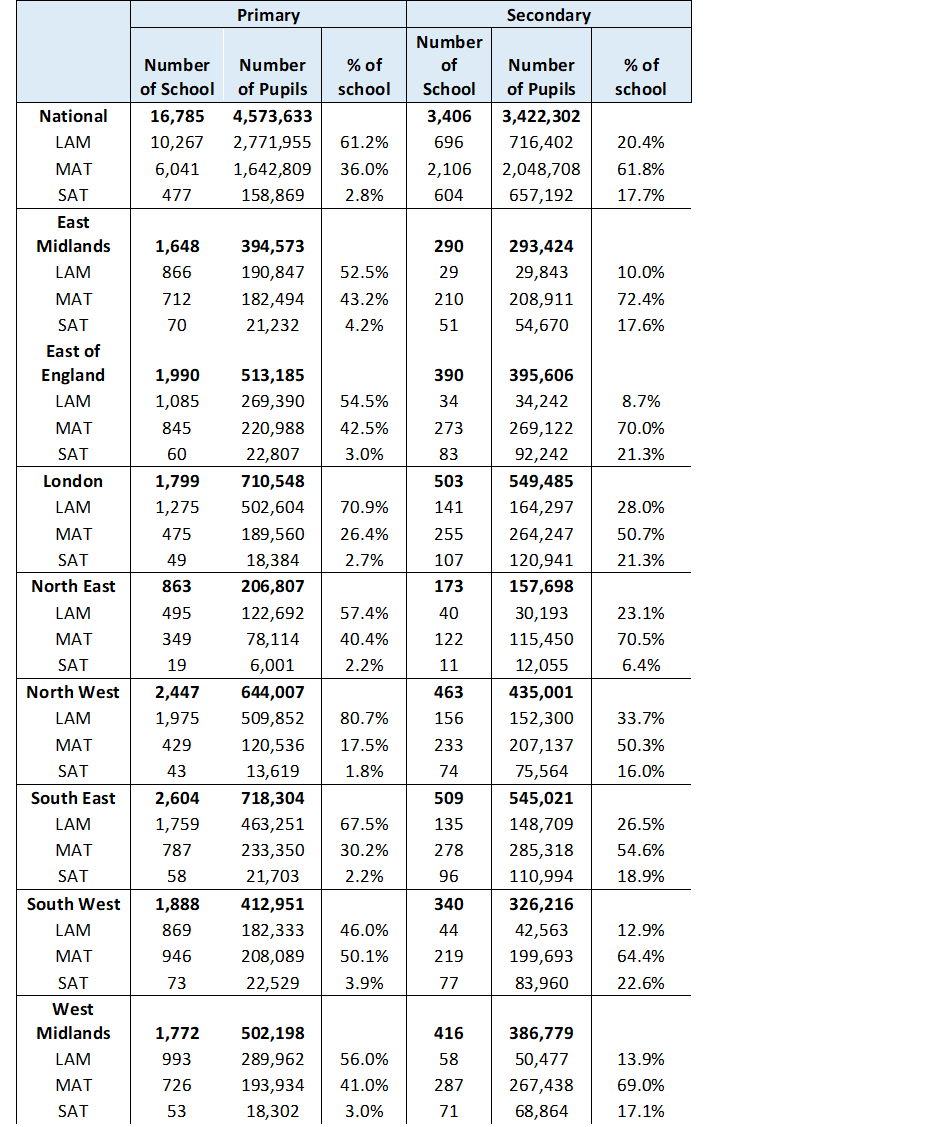
While academisation, whether Stand Alone academies (SAT) or schools in multi-academy trusts or committee (MATs) has taken hold in the secondary sector, the majority of primary schools are still not academies.

GovernancePrimarySecondary
Primary schools% of primary schoolsSecondary schools% of secondary schools
All schools (state-funded)LA maintained10,61563%74722%
MAT5,67534%2,05059%
SAT5013%66119%
Of which faith schoolsLA maintained4,21568%21835%
MAT1,77729%29347%
SAT1923%11719%
Source: DfE

According to the DfE figures, 63% of primary schools are still LA maintained schools and that increases to 68% of faith schools despite some diocese having created local MAT/MACs. However, the vast majority of secondary schools are now academies of one sort or another.

However, a third of faith schools in the secondary sector are not yet academies. It would seem that it is the diocese rather than the local authorities that the DfE should be talking to about how to reach an all-academy school system.

There are also clearly regional differences, with primary schools in the North West still largely LA Maintained schools whereas only eight per cent of secondary schools in the East of England are not academies.

These differences are important in relation to issue such as in-year admissions, a topic this blog has pursued for several years now. I hope the difference arrangements between maintained and academies will be addressed in the Bill before parliament.

New Schools Bill published

The Schools Bill, (no apostrophe) foreshadowed in the Queen’s Speech, has now been published as a House of Lords Bill. This means that the legislation starts in the House of Lords before then progressing to the House of Commons rather than the other way around. This isn’t unusual when there is a heavy legislative schedule. For instance, the 2003 Licensing Act started life as House of Lords Bill Schools Bill [HL] (parliament.uk)

The government has issued a set of notes and policy explanations for each section of the Bill Schools Bill: policy statements – GOV.UK (www.gov.uk) Key sections are on Academies, funding and attendance. The Bill is very technical, and looks in its initial iteration to be sorting out some oversight issues to ensure a national education system with minimal democratic involvement, just like the NHS.

I especially like Clause 3

3 Academies: power to apply or disapply education legislation

(1) The Secretary of State may by regulations provide—

(a) for any relevant provision to apply to an Academy (or to a type or 5 description of Academy) as it applies in England to another educational institution, subject to any prescribed modifications;

(b) for any relevant provision which applies in England both to an Academy and to another educational institution not to apply to, or to apply subject to prescribed modifications to, an Academy (or to a type or description of Academy).

There are some exceptions listed, but this is the sort of sweeping power for the Secretary of State that used to worry parliamentarians.

Part Three of the Bill is about School Attendance, and will no doubt carry much of the discussion at the Second Reading next week. The argument revolves around child safeguarding and children’s rights to education versus the right of a parent to decide the education of their child or children. The Bill doesn’t go so far as to require schooling, but it does seek to tighten up knowing what choices parents have made for their children’s education. The establishment of a register may raise questions for the traveller community.  

Sadly, despite appearing in the past two White Papers, I cannot find anything in the Bill about the return on in-year admissions to local authorities. I hope someone may decide to put down an amendment to Section Three to include this provision, not least for the benefit of children taken into care requiring a new school, and those with an EHCP that move into an area with limited special school places.

Even if the government can argue that there are regulations to cover the change, it would still be better on the face of the Bill.

Following the decision on a National Funding Formula, I am not sure what role Schools Forums will play in the future, and whether headteachers will take them seriously anymore?

The Chief Inspector will now be able to ask a Magistrate for an entry warrant in certain circumstances. Along with the provisions for regulation of independent education establishments this continues the theme of protecting children, but some may see it as heavy-handed from a Conservative government. The debate next week will make for interesting reading in Hansard.

Dead money?

The DfE has published some research into the funds held by Trusts for the year 2020/21. As academies and Trusts report their finances on an academic year basis, these statistics cover the period from September 2020 to August 2021.  Academy trust revenue reserves 2020 to 2021 – GOV.UK (www.gov.uk)

The main findings are summed up in the following two paragraphs from Page 4 of this short report.

Trusts average reserves – In 2020/21 average revenue reserves across academy trusts were £1.48 million, compared to £1.15 million in 2019/20, an increase of 29%. In 2020/21 the average surplus balance was £1.53 million, compared to £1.22 million in 2019/20, an increase of 26%. The average deficit balance in 2020/21 was at £318,000, compared to £376,000 in 2019/20, a decrease of 15.5%

Reserves across the sector – The 2020/21 data shows the total cumulative surplus of trusts with positive reserves was £3.96 billion. Trusts in a cumulative deficit had a total deficit of £22.24 million. In 2019/20 the total cumulative surplus was £3.17 billion against a total cumulative deficit of £42.1 million.

So nearly 4 billion pounds was tied up in reserves sitting in academy trusts waiting to be spent by August 2021. What’s more the pandemic has resulted in more cash in reserves in the average academy trust than in the previous year. Indeed, the average increase is a whopping by 29% in one year.

So, a sector that sometimes loudly complains it is short of cash managed to put quite a bit away in reserves for a rainy day. One wonders what sort of rainy day that would be? One where teachers earn a minimum of £30,000 and where soaring utility costs must be financed from reserves not in-year revenue? Perhaps educating children at home is more cost effective for schools than having them on-site.

Where were the savings made? This ad-hoc set of statistics doesn’t allow for an answer to that question. But, presumably, supply cover and less wear and tear on school premises, plus a slowdown in construction of new build and refurbishment costs anticipated to be spent during the year but for the pandemic, may have accounted for a large amount of the cash going into reserves?

There should have been some savings on recruitment costs, but, as many trusts have subscriptions with the tes and other job sites any reduction in vacancies would not necessarily result in a saving in costs compared to paying for each recruitment round individually.

As we are now half-way through the 2021-2022 academies financial year, it should be possible for the government to have sight of what has been happening since September. Will this be the year reserves start reducing in size or will the £4 billion level be reached or even exceeded?

I always maintain that revenue funding should be spent on the children in the schools at the time when it is received and not stashed away in reserves. However, some provision for depreciation of equipment and eventual replacement is prudent. Delving into these numbers in more detail should allow for consideration of whether there are economies of scale with larger trusts or the opposite. From that perspective, the data here allows for more questions than it provides answers.

New Service for schools

TeachVac

The National Vacancy Service for Schools

Advanced matching service

Schools pay for matches with interested teachers to be highlighted

No match made; no charge

£1,000 per annum maximum for all matches

on all vacancies by a secondary school in 2022

£100 sign-on fee, with 100 free matches, then £1 per match

TeachVac has already made 800,000 matches in 2022:

1.2 million matches in 2021

A cheap, but cost-effective service for schools

from the free job board covering state and private schools across England

email enquiries@oxteachserv.com for full details

What is the role of a school in its community?

For everyone interested in either the role of a middle tier in our school system in England or in how pupil place planning and support for vulnerable children is handled in the current shambles around the arrangements for schools in England, this is an important report to read. Local authority provision for school places and support for vulnerable children – GOV.UK (www.gov.uk) The recent White Paper on Education was the second one to pledge to change in-year Admissions and this Report indicates why Ministers should act swiftly to make the necessary changes to the current system.

At the heart of the debate about the middle tier is the role of local authorities and the role of academies and the Trusts that run them. The following two quotes from the report sum up current situation nicely in relation to these important issues for the management of our schooling system:

‘Nevertheless, our research also suggested that there are two ways in which academisation can affect local education systems. First, because there are different processes for making decisions and resolving disputes about place-planning and placements of vulnerable pupils for academies and maintained schools, where an “isolationist” school is an academy, it can be more difficult, complex, and time-consuming to resolve issues. Second, while not generalising, school, trust and LA leaders and parents/carers reported that, among the minority of schools that took an “isolationist” approach, these were more likely to be schools that were part of larger regional or national academy trusts.’

‘Furthermore, there was broad agreement among school, trust and LA leaders and parents/carers that LAs were uniquely placed to play this role [place planning]. (In relation to place-planning, a minority of trust leaders and national stakeholders argued that the RSC should be wholly or partially responsible for delivering place-planning.) Whichever way roles and responsibilities are configured, there was consensus about the need for clarity, alignment of responsibilities and decision-making authority, for reciprocal expectations of schools, trusts and LAs around participating in local partnership-based approaches to place-planning and support for vulnerable pupils, and a renewed, more collaborative relationship between local and central government.’

The situation is summed up by a quote from a local authority officer:

‘Nobody wants to roll back the clock. But if we have MATs not working for the best interests of young people in the community, we don’t have any direct levers. We would have to go through the RSC, and not sure they have many levers. A lot of accountability sits with the LA, but the responsibility of delivery sits with schools. Doesn’t feel appropriate. We need some accountabilities placed on academy trusts and schools to deliver expectations [for vulnerable children].’ (LA officer page 106)

We need a system that works for the children seeking an education, and not primarily for those that provide that schooling. This is especially true for our most vulnerable young people and I hope that Ministers will spend time over easter reading this report and then acting upon its findings. State schooling is a public service and must be managed as such.

Should middle leaders be qualified for the role?

‘Teachers at schools with an Ofsted rating ‘requires improvement’ were significantly more likely to be greatly concerned about disengagement from learning (29%, compared with 14% of teachers at schools with an Ofsted rating ‘outstanding’)’ School and College Panel: December 2021 wave (publishing.service.gov.uk) Page 55.

This finding from the DfE’s Wave Study from December 2021 will surely surprise nobody. However, it has serious implications for such schools especially as the study also highlights the fact that teachers in schools ‘with the highest proportions of pupils eligible for FSM, 35% (of teachers were) greatly concerned about an increase in behaviour issues and 26% about disengagement from learning (compared with 20% and 9% respectively among those with the lowest proportions of pupils eligible for FSM).’

Schools reported on their workforce concerns in the same survey. Overall, schools were most concerned about not having sufficient numbers of teaching assistants and cover supervisors (two-thirds, or 67% of schools). They were also concerned about not having sufficient numbers of teaching staff (50%), supply staff (42%), non-teaching staff (37%) and leadership staff (36%). (Page 7)

In terms of issues relating to their workforce the majority of schools were concerned about stress/burnout of current staff (82%) and staff absence due to COVID-19 related illness (72%). Just under two[1]thirds (59%) of schools were concerned about funding, while just under half (46%) were concerned about staff absence due to seasonal/flu illness. Roughly a quarter to a third of schools were also concerned about staff absence due to isolation (35%), recruitment of teachers (26%) and retention of teachers (22%).

December is usually one of the low points for recruitment, so school leaders were clearly already worried about recruitment for 2022 in December 2021, and only to a slightly lessor degree about the retention of staff.

As recent blog posts have shown, concerns about recruitment were valid for many schools, and the lack of trainees joining the teaching workforce this September is a matter of considerable concern nationally in many secondary school subjects.

At present, it is too early in the recruitment cycle for September to tell whether the types of school highlighted at the top of this blog are facing more severe recruitment and retention issues if they have anything other than ‘outstanding’ ratings from Ofsted. The levelling up agenda requires schools to be fully staffed with appropriately trained teachers, especially if the ambition is not only to deal with the consequences of the pandemic but also to reduce the gap in achievement between schools by levelling up is to be met.

No doubt, the issue of staffing and outcomes will be in the minds of those that research the consequences of the levelling up ambition of government.  In my mind, the issue of well prepared and supported middle leaders is a key component in the ambition to improve outcomes.

The survey results on understanding of National Professional Qualifications are concerning in the respect of developing middle leaders.

‘Over half of leaders and teachers (55%) said that they had heard of the new National Professional Qualifications (NPQs). Leaders were much more likely than teachers to have heard of the new NPQs (93% vs. 49%).

Nearly a fifth (18%) of those who had heard of NPQs said that they had applied to undertake one since June 2021, with those working in primary schools (20%) more likely to have applied than those in secondary schools (15%).

Among leaders and teachers that had not applied for an NPQ since June 2021, a quarter (25%) intended to apply in the future, with a third (33%) saying they didn’t know, leaving two-fifths (43%) not intending to apply for an NPQ.’ (Page 9)

It was worrying that 64% of teachers said that they ‘didn’t have enough time to complete a qualification’. (Page 42) If this means that many would-be or even will-be middle leaders enter that role unprepared, then little progress has been made in professional development since the 1970s.

Middle leaders in any organisation are key to the success of the organisation and schools are no exception to this rule.