Uphill struggle for an all academy system

The DfE has now published the data on governance of schools in England as part of the background to both the recent White Paper and the Schools bill currently before the House of Lords. Opportunity for all: strong schools with great teachers for your child – GOV.UK (www.gov.uk) and Excel spreadsheet the fourth item on the page.

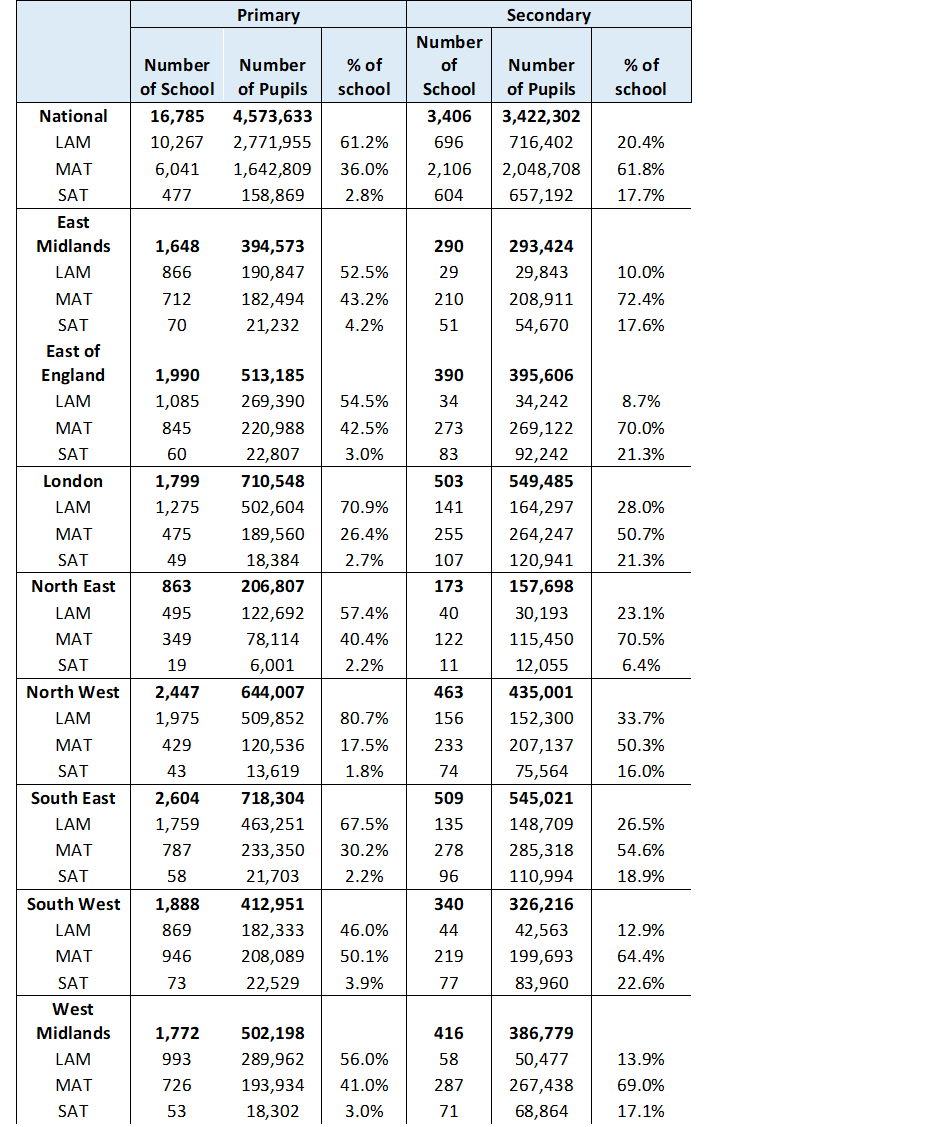
While academisation, whether Stand Alone academies (SAT) or schools in multi-academy trusts or committee (MATs) has taken hold in the secondary sector, the majority of primary schools are still not academies.

GovernancePrimarySecondary
Primary schools% of primary schoolsSecondary schools% of secondary schools
All schools (state-funded)LA maintained10,61563%74722%
MAT5,67534%2,05059%
SAT5013%66119%
Of which faith schoolsLA maintained4,21568%21835%
MAT1,77729%29347%
SAT1923%11719%
Source: DfE

According to the DfE figures, 63% of primary schools are still LA maintained schools and that increases to 68% of faith schools despite some diocese having created local MAT/MACs. However, the vast majority of secondary schools are now academies of one sort or another.

However, a third of faith schools in the secondary sector are not yet academies. It would seem that it is the diocese rather than the local authorities that the DfE should be talking to about how to reach an all-academy school system.

There are also clearly regional differences, with primary schools in the North West still largely LA Maintained schools whereas only eight per cent of secondary schools in the East of England are not academies.

These differences are important in relation to issue such as in-year admissions, a topic this blog has pursued for several years now. I hope the difference arrangements between maintained and academies will be addressed in the Bill before parliament.

New Schools Bill published

The Schools Bill, (no apostrophe) foreshadowed in the Queen’s Speech, has now been published as a House of Lords Bill. This means that the legislation starts in the House of Lords before then progressing to the House of Commons rather than the other way around. This isn’t unusual when there is a heavy legislative schedule. For instance, the 2003 Licensing Act started life as House of Lords Bill Schools Bill [HL] (parliament.uk)

The government has issued a set of notes and policy explanations for each section of the Bill Schools Bill: policy statements – GOV.UK (www.gov.uk) Key sections are on Academies, funding and attendance. The Bill is very technical, and looks in its initial iteration to be sorting out some oversight issues to ensure a national education system with minimal democratic involvement, just like the NHS.

I especially like Clause 3

3 Academies: power to apply or disapply education legislation

(1) The Secretary of State may by regulations provide—

(a) for any relevant provision to apply to an Academy (or to a type or 5 description of Academy) as it applies in England to another educational institution, subject to any prescribed modifications;

(b) for any relevant provision which applies in England both to an Academy and to another educational institution not to apply to, or to apply subject to prescribed modifications to, an Academy (or to a type or description of Academy).

There are some exceptions listed, but this is the sort of sweeping power for the Secretary of State that used to worry parliamentarians.

Part Three of the Bill is about School Attendance, and will no doubt carry much of the discussion at the Second Reading next week. The argument revolves around child safeguarding and children’s rights to education versus the right of a parent to decide the education of their child or children. The Bill doesn’t go so far as to require schooling, but it does seek to tighten up knowing what choices parents have made for their children’s education. The establishment of a register may raise questions for the traveller community.  

Sadly, despite appearing in the past two White Papers, I cannot find anything in the Bill about the return on in-year admissions to local authorities. I hope someone may decide to put down an amendment to Section Three to include this provision, not least for the benefit of children taken into care requiring a new school, and those with an EHCP that move into an area with limited special school places.

Even if the government can argue that there are regulations to cover the change, it would still be better on the face of the Bill.

Following the decision on a National Funding Formula, I am not sure what role Schools Forums will play in the future, and whether headteachers will take them seriously anymore?

The Chief Inspector will now be able to ask a Magistrate for an entry warrant in certain circumstances. Along with the provisions for regulation of independent education establishments this continues the theme of protecting children, but some may see it as heavy-handed from a Conservative government. The debate next week will make for interesting reading in Hansard.

Dead money?

The DfE has published some research into the funds held by Trusts for the year 2020/21. As academies and Trusts report their finances on an academic year basis, these statistics cover the period from September 2020 to August 2021.  Academy trust revenue reserves 2020 to 2021 – GOV.UK (www.gov.uk)

The main findings are summed up in the following two paragraphs from Page 4 of this short report.

Trusts average reserves – In 2020/21 average revenue reserves across academy trusts were £1.48 million, compared to £1.15 million in 2019/20, an increase of 29%. In 2020/21 the average surplus balance was £1.53 million, compared to £1.22 million in 2019/20, an increase of 26%. The average deficit balance in 2020/21 was at £318,000, compared to £376,000 in 2019/20, a decrease of 15.5%

Reserves across the sector – The 2020/21 data shows the total cumulative surplus of trusts with positive reserves was £3.96 billion. Trusts in a cumulative deficit had a total deficit of £22.24 million. In 2019/20 the total cumulative surplus was £3.17 billion against a total cumulative deficit of £42.1 million.

So nearly 4 billion pounds was tied up in reserves sitting in academy trusts waiting to be spent by August 2021. What’s more the pandemic has resulted in more cash in reserves in the average academy trust than in the previous year. Indeed, the average increase is a whopping by 29% in one year.

So, a sector that sometimes loudly complains it is short of cash managed to put quite a bit away in reserves for a rainy day. One wonders what sort of rainy day that would be? One where teachers earn a minimum of £30,000 and where soaring utility costs must be financed from reserves not in-year revenue? Perhaps educating children at home is more cost effective for schools than having them on-site.

Where were the savings made? This ad-hoc set of statistics doesn’t allow for an answer to that question. But, presumably, supply cover and less wear and tear on school premises, plus a slowdown in construction of new build and refurbishment costs anticipated to be spent during the year but for the pandemic, may have accounted for a large amount of the cash going into reserves?

There should have been some savings on recruitment costs, but, as many trusts have subscriptions with the tes and other job sites any reduction in vacancies would not necessarily result in a saving in costs compared to paying for each recruitment round individually.

As we are now half-way through the 2021-2022 academies financial year, it should be possible for the government to have sight of what has been happening since September. Will this be the year reserves start reducing in size or will the £4 billion level be reached or even exceeded?

I always maintain that revenue funding should be spent on the children in the schools at the time when it is received and not stashed away in reserves. However, some provision for depreciation of equipment and eventual replacement is prudent. Delving into these numbers in more detail should allow for consideration of whether there are economies of scale with larger trusts or the opposite. From that perspective, the data here allows for more questions than it provides answers.

New Service for schools

TeachVac

The National Vacancy Service for Schools

Advanced matching service

Schools pay for matches with interested teachers to be highlighted

No match made; no charge

£1,000 per annum maximum for all matches

on all vacancies by a secondary school in 2022

£100 sign-on fee, with 100 free matches, then £1 per match

TeachVac has already made 800,000 matches in 2022:

1.2 million matches in 2021

A cheap, but cost-effective service for schools

from the free job board covering state and private schools across England

email enquiries@oxteachserv.com for full details

What is the role of a school in its community?

For everyone interested in either the role of a middle tier in our school system in England or in how pupil place planning and support for vulnerable children is handled in the current shambles around the arrangements for schools in England, this is an important report to read. Local authority provision for school places and support for vulnerable children – GOV.UK (www.gov.uk) The recent White Paper on Education was the second one to pledge to change in-year Admissions and this Report indicates why Ministers should act swiftly to make the necessary changes to the current system.

At the heart of the debate about the middle tier is the role of local authorities and the role of academies and the Trusts that run them. The following two quotes from the report sum up current situation nicely in relation to these important issues for the management of our schooling system:

‘Nevertheless, our research also suggested that there are two ways in which academisation can affect local education systems. First, because there are different processes for making decisions and resolving disputes about place-planning and placements of vulnerable pupils for academies and maintained schools, where an “isolationist” school is an academy, it can be more difficult, complex, and time-consuming to resolve issues. Second, while not generalising, school, trust and LA leaders and parents/carers reported that, among the minority of schools that took an “isolationist” approach, these were more likely to be schools that were part of larger regional or national academy trusts.’

‘Furthermore, there was broad agreement among school, trust and LA leaders and parents/carers that LAs were uniquely placed to play this role [place planning]. (In relation to place-planning, a minority of trust leaders and national stakeholders argued that the RSC should be wholly or partially responsible for delivering place-planning.) Whichever way roles and responsibilities are configured, there was consensus about the need for clarity, alignment of responsibilities and decision-making authority, for reciprocal expectations of schools, trusts and LAs around participating in local partnership-based approaches to place-planning and support for vulnerable pupils, and a renewed, more collaborative relationship between local and central government.’

The situation is summed up by a quote from a local authority officer:

‘Nobody wants to roll back the clock. But if we have MATs not working for the best interests of young people in the community, we don’t have any direct levers. We would have to go through the RSC, and not sure they have many levers. A lot of accountability sits with the LA, but the responsibility of delivery sits with schools. Doesn’t feel appropriate. We need some accountabilities placed on academy trusts and schools to deliver expectations [for vulnerable children].’ (LA officer page 106)

We need a system that works for the children seeking an education, and not primarily for those that provide that schooling. This is especially true for our most vulnerable young people and I hope that Ministers will spend time over easter reading this report and then acting upon its findings. State schooling is a public service and must be managed as such.

Should middle leaders be qualified for the role?

‘Teachers at schools with an Ofsted rating ‘requires improvement’ were significantly more likely to be greatly concerned about disengagement from learning (29%, compared with 14% of teachers at schools with an Ofsted rating ‘outstanding’)’ School and College Panel: December 2021 wave (publishing.service.gov.uk) Page 55.

This finding from the DfE’s Wave Study from December 2021 will surely surprise nobody. However, it has serious implications for such schools especially as the study also highlights the fact that teachers in schools ‘with the highest proportions of pupils eligible for FSM, 35% (of teachers were) greatly concerned about an increase in behaviour issues and 26% about disengagement from learning (compared with 20% and 9% respectively among those with the lowest proportions of pupils eligible for FSM).’

Schools reported on their workforce concerns in the same survey. Overall, schools were most concerned about not having sufficient numbers of teaching assistants and cover supervisors (two-thirds, or 67% of schools). They were also concerned about not having sufficient numbers of teaching staff (50%), supply staff (42%), non-teaching staff (37%) and leadership staff (36%). (Page 7)

In terms of issues relating to their workforce the majority of schools were concerned about stress/burnout of current staff (82%) and staff absence due to COVID-19 related illness (72%). Just under two[1]thirds (59%) of schools were concerned about funding, while just under half (46%) were concerned about staff absence due to seasonal/flu illness. Roughly a quarter to a third of schools were also concerned about staff absence due to isolation (35%), recruitment of teachers (26%) and retention of teachers (22%).

December is usually one of the low points for recruitment, so school leaders were clearly already worried about recruitment for 2022 in December 2021, and only to a slightly lessor degree about the retention of staff.

As recent blog posts have shown, concerns about recruitment were valid for many schools, and the lack of trainees joining the teaching workforce this September is a matter of considerable concern nationally in many secondary school subjects.

At present, it is too early in the recruitment cycle for September to tell whether the types of school highlighted at the top of this blog are facing more severe recruitment and retention issues if they have anything other than ‘outstanding’ ratings from Ofsted. The levelling up agenda requires schools to be fully staffed with appropriately trained teachers, especially if the ambition is not only to deal with the consequences of the pandemic but also to reduce the gap in achievement between schools by levelling up is to be met.

No doubt, the issue of staffing and outcomes will be in the minds of those that research the consequences of the levelling up ambition of government.  In my mind, the issue of well prepared and supported middle leaders is a key component in the ambition to improve outcomes.

The survey results on understanding of National Professional Qualifications are concerning in the respect of developing middle leaders.

‘Over half of leaders and teachers (55%) said that they had heard of the new National Professional Qualifications (NPQs). Leaders were much more likely than teachers to have heard of the new NPQs (93% vs. 49%).

Nearly a fifth (18%) of those who had heard of NPQs said that they had applied to undertake one since June 2021, with those working in primary schools (20%) more likely to have applied than those in secondary schools (15%).

Among leaders and teachers that had not applied for an NPQ since June 2021, a quarter (25%) intended to apply in the future, with a third (33%) saying they didn’t know, leaving two-fifths (43%) not intending to apply for an NPQ.’ (Page 9)

It was worrying that 64% of teachers said that they ‘didn’t have enough time to complete a qualification’. (Page 42) If this means that many would-be or even will-be middle leaders enter that role unprepared, then little progress has been made in professional development since the 1970s.

Middle leaders in any organisation are key to the success of the organisation and schools are no exception to this rule.

33,000 in three months

How are we to interpret the record number of teacher vacancies logged during the first three months of 2022 by TeachVac?

Subject20202022Percentage +/- (The nearest whole %)
Design & Technology1089164351%
Leadership2278335347%
Business701101845%
Computing828119144%
Primary5059714041%
RE61583536%
Music49864830%
Total259393358029%
Geography816104628%
Creative Arts33442327%
History58974827%
PE72790625%
Languages1397173724%
Science3427395615%
Art49355212%
English2427268110%
Mathematics311533287%
Source www.teachvac.co.uk

There is little point comparing 2022 with 2021, as the covid pandemic resulted in very little activity in the teacher job market during the first three months of 2021.

So, how to explain this year’s surge in vacancies, and what might be the consequences?

Is the surge down to schools catching up vacancies not advertised last year; is it – at least in the secondary sector – down to increased pupil numbers; might private schools be recruiting more pupils from overseas and, hence need more teachers; could TeachVac be better are recording or even over-recording vacancies than in the past? I asked the team to check on the last point, and since most of them have been entering vacancies for several years, and we haven’t changed their way of working, it seems unlikely as a reason for the large increase in vacancies.  

On the other side of the equation, could the increase in recorded vacancies be down to more teachers quitting schools in England, either to take up tutoring; to teach overseas or to either reduce their hours or even retire completely? Since we don’t have exit interviews, we will have to wait for the DfE to match teacher identify numbers for those moving within the state system and retiring with a pension and then conjecture what has happened to the remainder of leavers?

As to the consequences, regular readers of this blog will know what will come next because various posts since the ITT Census appeared in December have already been discussing the nature of the recruitment round for September 2022 and January 2023.

The table earlier in this post shows English and mathematics with relatively low increases. Perhaps schools feel that with the change in Ministerial team last autumn the focus on the EBacc subjects might have reduced. If so, might the White Paper provisions see an increase in vacancies in these subjects after Easter?

The increase in leadership vacancies needs further investigation in order to see which sector, and which of the leadership posts; head, deputy or assistant head are most affected by the increase or whether it is a general increase.

Design and technology, business, and to some extent computing are subjects that the government has under-played in its various attempts to increase interest in teaching as a career. Schools still want teachers in these subjects, and the government must help them fill the vacancies.

With many subjects not even meeting the DfE’s indicative target for the need for teachers on teacher preparation routes in 2022, the remainder of the recruitment round may well be a real challenge for many schools.

There is one other possibility, and that is the notion of schools bringing forward recruitment this year, so the peak will have been in March rather than in late April, as has been the normal practice in past years. If so, April will be a lean month for those that put off job hunting until then, unless schools have been unable to fill some of the 33,000 vacancies, and there is a string of re-advertisements this month and next.

TeachVac has a number of different reports to allow schools, local authorities, recruitment agencies and anyone else interested in trends in the labour market in real-time to track the behaviour of the market in anything for real-time to monthly. Email the staff using enquiries@oxteachserv.com for details.

Public Accounts Committee concerns over the academy system

The Public Accounts Committee (PAC) has today published its latest annual report into the academies sector. Academies Sector Annual Report and Accounts 2019-20 (parliament.uk)

The Committee accepts that the government wants all schools to become academies, but doesn’t yet see a clear path for some types of schools to be able to do so. Such a move to full academisation would remove local democracy from the school system and make it much more like the NHS, with limited accountability, and no guarantee of local accountability. This does not strike me as a good move for democracy. Hopefully, the government’s plans will be set out in the forthcoming White Paper.

Also, of interests, was the PAC’s views on the financial management of academy trusts. Unlike local authorities and maintained schools, Trusts can aggregate funds and do not have to publish accounts for each school separately. Trusts could move funds between schools and create capital for new buildings at one school by levying other schools in the Trust.

The PAC said:

 ‘Academy trusts have been set up as charitable companies, with more freedoms and responsibilities than maintained schools, including being responsible for managing their own finances. There is a tension between this autonomy and the oversight role by the centre via the Education & Skills Funding Agency which is required to provide assurance to the Department who hold ultimate responsibility for the delivery of education in England. The Department provided additional financial support of £31 million to 81 academy trusts in 2019/20 to support financial recovery, build capacity, facilitate a transfer of academy schools triggered by financial or educational factors, or as a short-term advance. Of this, £21 million has been provided as non-repayable funding. The Education & Skills Funding Agency has reported that £10 million of debts held by academy trusts have been written off in 2020–21, including £5 million for one trust. We are concerned that there is a risk that a trust becomes too big to fail and could therefore see large sums of public funds being pumped into it to keep it afloat.’ (Page 7)

Writing off £10 million of debts in one year means cash that could have been spent on children’s education probably disappeared in a manner not possible with local authorities.

Of more concern is the lack of control over senior staff salaries in Trusts. To quote the PAC again;

‘17. The number of academy trusts paying at least one individual above £150,000 increased to 473 trusts (17% of trusts) in 2019/20, from 340 trusts (12%) in 2018/19. Almost two thirds of trusts (1,772; 64%) in 2019/20 reported paying at least one individual between £100,000 and £150,000, compared with just over half (1,535; 53%) in the prior year.’ (Page 14)

This is not a new issue, as my blog from 2018 highlights: CEOs pay: what’s happening? | John Howson (wordpress.com) If there were just 160 local authorities with Directors of Education, how much more cash might be available to schools that is currently disappearing due to the diseconomies of scale inherent in the model of academisation established by Michael Gove in the hurry to pass the 2010 Education Act.

So, no democratic control, high salaries for some, but pay freezes for workers. Not a good structure for our school system when we cannot even recruit enough teachers.

TeachVac launches new service for schools

The DfE Vacancy site for teachers is still a muddled mess. Eight years ago, well before the DfE woke up to the idea that the internet could be used for low cost but effective job matching, I helped create TeachVac http://www.teachvac.co.uk and made it a free service for schools and teachers.

The basic rationale was simple – modern technology can cut the cost of finding a job and schools could save money as a result. After the Public Accounts Committee complained that the DfE didn’t have a grip on the labour market for teachers, the DfE set about creating a job board of their own.

At the start of the pandemic, I offered to share vacancies that the DfE didn’t upload with them to help to create a single free platform for teachers. Go away, I was told.

So, TeachVac still offers a free service, but is now launching its premium service whereby a school can ensure its vacancies are at the top of the list of matches a teacher receives each day. The service also provides a reminder after a few days so that teachers see the job more than once. Schools also receive labour market updates each month. All this for £500 per year for secondary schools and even less for primary schools across both state and private sectors schools.

Contact enquiries@oxteachserv.com for more information or to sign up and receive an early bird discount.

But, back the DfE site. Where, of course, teachers can only search for jobs in state schools. So, the site isn’t useful to those that don’t mind whether they work in state or private schools.

The front page of the DfE site is a real muddle. There are lists of ‘towns/cities and ‘counties’ although Chester West and Chester East aren’t counties, but unitary authorities. Towns within shire counties such as Oxford, Exeter, Chelmsford and many others don’t have a listing on the front page.  London has a single listing, not even split into the different pay area: not helpful if there are lots of vacancies in the Capital’s schools.

Milton Keynes receives a mention, but the rest of Buckinghamshire doesn’t. Still, there is a search buttons for key words and locations. A search on ‘secondary’ and ‘Oxford’ brings up 12 results. Four are non-teaching posts; two are in special schools or PRUs and only six are in secondary schools.

There is an alert function, but if it sends non-teaching posts as well as teaching vacancies it doesn’t do the job for which it is intended, unless the civil servants at the DfE think teachers that cannot find a teaching post will consider non-teaching roles and have the appropriate qualifications for such positions.

TeachVac is breaking records each month with 500,000+ matches so far in 2022, and over one million in this school year to date.

The earlier a school signs up for the premium service, the higher up the daily list of matches it will be placed. Don’t delay: sign up today by emailing enquiries@oxteachserv.com to express interest.

Buddy, can you spare a dime?

Did schools really save money in the five-year period up to 2019-2020? The DfE has published a study showing the aim of ‘saving’ at least one billion pounds during that period was achieved. Progress in schools savings and resource management – GOV.UK (www.gov.uk)

The methodology of the study was to measure savings as the difference between actual non-staff expenditure in 2019-20 and what was estimated non-staff expenditure would have been in 2019-20 if schools had not changed their spending behaviour. This is expressed as the difference between the expenditure line and the counterfactual line as to where expenditure without saving would have been.

It is worth noting that the period covered was one where primary school rolls were generally on the increase, and for many secondary school rolls were either constant or falling. Academies and maintained schools also operate on different financial years, so that could be an additional complicating factor.

A significant proportion of the saving came in the final year 2019-2020. I am not sure whether that meant that the final third of that financial year for academies covered the first four months of the pandemic when, for instance, there would have been a significant drop in expenditure on school meals, as most children were forced to stay at home.

The target of £1 Billion pounds was set after the National Audit Office (NAO) report “Financial sustainability of schools” published in 2016 identified that schools would incur cost pressures of £3bn between then and 2019- 20. The DfE then produced analysis which compared schools with different levels of spending but similar pupil characteristics and levels of attainment.

According to the report,

 ‘the DfE estimated the impact of bringing the spending of the top 25% highest per-pupil non-staff spending schools down to the level of those at the 75th percentile. This analysis indicated that, schools could plausibly save around £1 bn on their non-staff spending and so this became the ambition of the SRM portfolio’ (Page 3)

It is not clear from the report whether that is what happened, or whether the schools better at managing their costs took more out of the system, thus widening the gap between those schools good at achieving savings and the rest of the sector. Since both primary and secondary schools were included, it would have been interesting to know how much of the saving was due to fixed costs that don’t alter with changing pupil numbers – it presumably cost a similar amount to heat and light a school even if pupil numbers fluctuate. The saving would be more impressive and longer-lasting if it was the variable costs that had been reduced. Primary schools often have higher fixed costs as a proportion of income, although many of these are staff costs.  

And, as the DfE note in the definitions on page 5 of the report.

‘“Saving” in this context does not mean a cash saving. We measure savings by comparing actual non-staff spend to where we expected non-staff spending to be had schools not changed spending behaviour – the counterfactual. We would calculate cash savings by taking away actual non-staff spend in 2019-20 from actual non-staff spending in 2015-16.’

And finally, it looks as if the special school sector was excluded if the study was only on primary and secondary schools. It would be interesting to know about cost pressures in that sector and whether similar saving was possible?