
Attendance and Behaviour Hubs: a DfE initiative

One of the government initiatives that I have just caught up with is the one around attendance and behaviour hubs. The DfE announcement in December when the programme was announced said that:

The regional improvement for standards and excellence (RISE) attendance and behaviour hubs programme is a national initiative designed to support schools in improving pupil attendance and behaviour.

Led by schools with strong practice, it aims to:

  • support school leaders to reflect on current systems
  • share effective practice
  • implement changes

It is aimed at senior leaders with responsibility for attendance and behaviour who are seeking to strengthen their school’s leadership, culture and systems. RISE attendance and behaviour hubs programme – GOV.UK

Yesterday, the DfE updated the list of lead schools, so I took a look at these schools in the South East Region.  Today’s list has five primary and five secondary schools as lead hubs.

The secondary schools are located in:

West Sussex

Milton Keynes

Medway

Slough

Portsmouth

Two of these schools are non-selective schools in a location with selective schools; four schools are under-subscribed, with the fifth school having 1150 pupils against a roll of 1058, and it is a faith school.

The five primary schools are located in

Kent – 2

East Sussex

West Sussex

Medway

All have at rolls of at least 400 pupils, although three of the schools are nowhere near their capacity.

How these schools will spread good practice across the region from Milton Keynes to the Isle of Wight and from Oxfordshire to Bracknell Forest will be an interesting challenge.

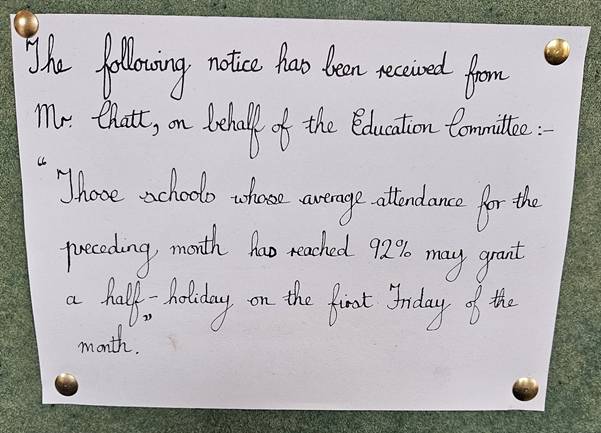
One option not open to them will be the device used in the Durham coalfield in the 19th century and recorded on the noticeboard of the school now housed in the Beamish Living Museum.

The notice reads

The following notice has been received from Mr Chatt, on behalf of the Education Committee: –

“Those schools whose average attendance for the preceding month has reached 92% may grant a half-holiday on the first Friday of the month.”
Looking at the DfE’s data for Oxfordshire, the average attendance from September 2025 to start of February 2026 was 95.1% for primary schools; 91.5% for secondary schools and 88.8% for special schools.

On the basis of that data some primary schools would have qualified for the half-day in at least one month. Possibly some secondary schools might have done so as well.

However, it is worth remembering that the schools receiving the notice were Elementary Schools, taking pupils from 5 to 13 or 14, depending upon the school leaving age at the time of undated message. Attendance by the older pupils was probably as much of a challenge in the 19th century as it is today; albeit for different reasons.

Youth Custody: an update

Following on from my last blog post about an incidence of knife crime in a school in Wales, I thought that I would look again at the latest statistics regarding youth custody for uder18s in England and Wales.  Youth justice statistics: 2024 to 2025 – GOV.UK

The table below is abstracted from Table 7.2: Youth custody population, year on year monthly trends (under 18s only), years ending March 2001 to 2025 omitting the data for the years before 2014/15

Financial YearAprJulOctJanFebMarAverage monthly population
2014/15         1,078         1,111         1,033            976            988         1,002         1,031
2015/16            999         1,003            997            921            877            881            946
2016/17            906            857            872            862            863            858            870
2017/18            910            914            898            874            865            922            897
2018/19            938            882            853            806            827            832            856
2019/20            795            811            791            751            770            737            776
2020/21            664            563            535            532            536            516            558
2021/22            493            479            449            426            414            422            447
2022/23            432            457            434            437            467            452            447
2023/24            457            443            429            397            411            410            425
2024/25            427            437            400            406            398            402            412

The decline in custody numbers even during the period between 2-014/15 and 2024/25 is significant, especially taking into account the growth in the number of young people in the older age groups 11-18 during the period under review.

In April 2014, there were 1,078 under-18s in custody. In March 2024 that number had reduced to 402. This was just five above the lowest number in recent history, recorded in January 2024.

For girls, the average number in custody in 2025 was just 10, compared with 42 in 2015. So, the girl convicted of stabbing teachers in Wales really does join a very small number of other girls in custody.  

The most worrying number within the 402 is the number on remand. This number stood at 183 in March 2025, some 44% of the total. This compared with just 23% in March 2015. The backlog of trails post-Covid is well known. There is surely a case for fast tracking cases for those under-18s on remand. No child of school-age should be locked up a day longer than necessary. A backlog of trials is not a good enough reason to leave a young person languishing in custody.

Violence against the person offences, offences that would include attempted murder – the offence the girl in Wales was sentenced to custody for – now account for 68% of the primary offences for young people under-18 in custody, compared to just 31% of those in custody in 2015. One should always be wary of using percentages, since the absolute numbers have declined from 317 in March 2014 to 284 in March 2025. It is just that custody for other offences, especially for both domestic burglary and robbery producing custodial sentences have declined even faster than custody for offences of violence against the person.

One concern about the decline in custody is that under-18s in Young Offenders Institutions may now be serving sentences or on remand further from home than in the past, as the number of institutions in use reduces with the reduction in the custody population. This is an issue that policymakers may wish to address. When Cabinet Member in Oxfordshire, I did my best to keep young offenders out of Feltham YOI, but acknowledged that the alternative YOIs were further away., should there have been no alternative to that form of custody.

The use of custody for undr-18s has come a long way since the bleak days of the Blair government and police targets, when August 2006 saw more than 3,000 under-18s in custody. Even with this massive reduction, I think we are less violent society, despite some headlines in the press and on social media. 

Do better funded schools exclude fewer pupils?

The DfE published the annual data for exclusions and suspensions from schools during the 2023/24 school-year this week. Suspensions and permanent exclusions in England: 2023 to 2024 – GOV.UK Sadly, there are more pupils being excluded than in recent years, and my post from July 2018 Bad news on exclusions | John Howson reflects much , at least at the national level, of what is contained in the latest report on 2023/24. Boys on free school meals, and with SEND, and from a minority group are at highest risk of being excluded, especially when they are in Year 9, and, as ever, the reasons is most likely to have been ‘persistent disruptive behaviour’.

With the worsening recruitment crisis in schools, allied to a challenging financial environment, an increase in exclusions and suspensions was to be expected. What the data doesn’t tell us is whether schools with high exclusion rates are linked to specific academy trusts, and also to high levels of teacher turnover.

I wrote a blog about policies for reducing exclusions in May Reducing exclusions from schools | John Howson and I would hope that if the staffing situation does settle down, so might the number of pupils being banished from school.

As ever, I am struck by the funding issue. London, the best funded part of England has some of the lowest rates for exclusion and suspensions. There are 17 London boroughs in the list of the 25 local authorities with the lowest rate of suspensions in 2023/24, and 19 in the similar list for secondary exclusions. In the list of ten local authorities with the highest rates of exclusion are five authorities in the North East. I think that there may be something in this data that needs further exploration, especially as I would expect teacher recruitment to be easier in the North East than in London.

Interestingly, in view of the debate about mobile phones in schools, the number of suspensions for ‘inappropriate use of social media or online technology’ only increased from 11,419 to 11,614, an insignificant change between 2022/23 and 2023/24 especially compared with the increase in exclusions for ‘persistent disruptive behaviour’ from 446,676 to 569,921 over the same period. Of course, much comes down t how a decision on which box to tick when the exclusion is being reported and the latter category may hide suspensions that actually belong in one of the other categories. This is the risk when there are too many choices for a school to make.

The increase of around 25,000 in assaults leading to suspensions must be very worrying, although I wonder whether most are ‘common assault’ rather than ‘assault leading to actually bodily harm’ or ’GBH’ to use the criminal code levels of violence against another.

Some numbers are so small it is a wonder that they are still collected. Were only 69 pupils – up from 50 the previous year- permanently excluded for theft. Perhaps schools have nothing worth nicking these days.

I hope that next year, we might read of at least a levelling out of the rates of exclusions and suspensions and perhaps a return to a downward trend, especially if there is a relationship between funding and how schools can cope with disruptive pupils.