
Over the next few years, schools across England will be forced to come to terms with falling pupil numbers. As I indicated in an earlier set of posts on this blog, falling rolls can either be managed by the market, through parental choice and selective school’s decisions on their capacity levels without recourse to other local schools, or falling rolls can the reduction in numbers can be managed through some form of innervation, either by the DfE or by some local body, such as a local authority or an elected Mayor.
How pressing is the problem for secondary schools at present? I have looked at a random selection of schools, almost all secondary schools, that have advertised so far in this autumn term of 2026 for a teacher with expertise in music. The usefulness of looking at music is it is a subject where any vacancy is unlikely to be covered by someone else already on the staff. This is because of the subject knowledge needed.
The data for the schools with vacancies has been compared with the DfE public database that contains columns for a school’s ‘number on roll’ and ‘school capacity’. It is not clear how often this data are updated, or when it refers to, but there don’t seem to have been any changes between the beginning of September and this week, so it may be reasonably recent.
The following table for the different regions of England reveals an interesting picture
| LOCAL AUTHORITY REGION | 20%+ SPARE PLACES | 19%- 10% SPARE PLACES | 9% TO 5% SPARE PLACES | 5% SPARE PLACES TO 4% OVER CAPACITY | 5%+ OVER CAPACITY | TOTAL |
| EAST ENGLAND | 1 | 0 | 2 | 1 | 0 | 4 |
| EAST MIDLANDS | 2 | 2 | 3 | 3 | 1 | 11 |
| LONDON | 1 | 4 | 2 | 11 | 4 | 22 |
| NORTH EAST | 0 | 1 | 0 | 1 | 0 | 2 |
| NORTH WEST | 0 | 2 | 1 | 3 | 1 | 7 |
| SOUTH EAST | 1 | 1 | 1 | 0 | 3 | 6 |
| SOUTH WEST | 2 | 1 | 8 | 0 | 0 | 11 |
| WESTMIDLANDS | 1 | 2 | 1 | 1 | 5 | |
| YORKS & HUMBER | 0 | 1 | 2 | 0 | 2 | 5 |
| ALL REGIONS | 8 | 14 | 19 | 20 | 12 | 73 |
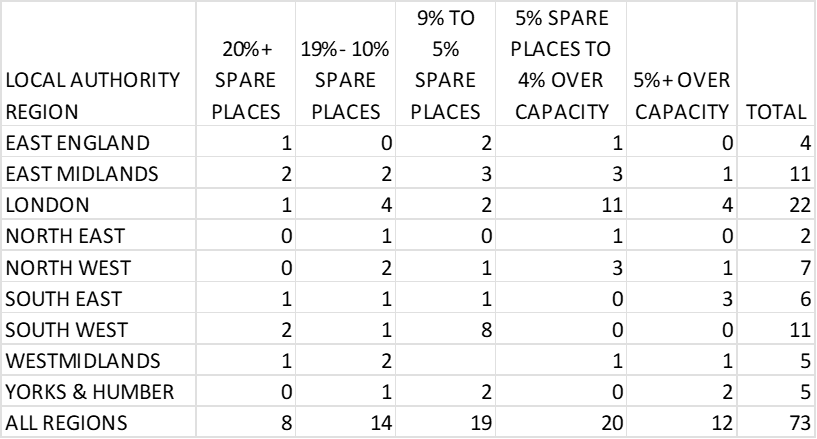
Of the 73 schools with a vacancy record – about just under 2% of secondary schools, so a reasonable opportunity sample – 41 already had more than 10% spare capacity; 20 had between 5% spare capacity and 5% over capacity, and might be regarded as working at capacity; 12 schools were more than 5% over capacity. Of this last grouping, three were selective schools, and another a highly regarded specialist school. Seven of the 12 schools were either in London or the South East.
Of the schools with the most spare capacity, only one was in London, and the other seven were spread across five of the other regions, suggesting that parental choice might already be playing a significant part in how full to capacity certain school are even today.
Only two of the 22 schools with the most spare capacity are church schools: both are Catholic schools. One Church of England school features in the list of most over-subscribed schools. That school is in London, and may have benefitted from a closeness to the Elizabeth Line, and TfL’s generous transport policy for travel to and from school.
The real issues to come will be both protecting schools in rural areas that serve an area where closure would mean an excessively long journey for some pupils and ensuring all schools can offer what is regarded as the whole curriculum up to age 16. What minority subjects is it allowable for a school not to offer at Key Stage 4?
One thing is certain, many schools with falling rolls will not be recruiting because of their budgets already being under pressure. Might some schools already have dropped music, so not be included in this sample?
I hope that local politicians across England are now asking Scrutiny Committees to be looking into the position locally, and whether any action will be needed, and, if so, by whom?

