
NEETS: Why is London so different to the rest of England?

London seems to be a different world to much of the rest of England when it comes to looking at a range of different indicators about education. The latest one where the statistics raise an interesting question is the percentage of 16- and 17-year-olds that are NEETs (Not in Education, Employment or Training).

With the raising of the suggested ‘learning leaving age’ to eighteen (the official age is still sixteen) it is expected that almost all students in what is Years 12 and 13 should be in some form of certified education or training. The DfE asks local authorities for data each year bout the percentage participating in education or training and produces scorecards on-line. I wonder how many local authority scrutiny committees ever see this data? Participation in education, training and NEET age 16 to 17 by local authority, Academic year 2024/25 – Explore education statistics – GOV.UK

The scorecard for Oxfordshire can be found at Oxfordshire_neet_comparator_scorecard.pdf

Looking through the data for all local authorities for both 2019 and 2025 what struck we was there was a definite London effect. 28 London boroughs had higher participation rates in 2025 than in 2019. For the rest of England there were only 37 other local authorities with higher participation rates in 2025 than in 2019.

One explanation is the inclusion of ‘no data’ in the NEETs percentage. As the DfE noted;

 ‘NEET/not known rates at the end of 2024/start of 2025 ranged from 0.0% City of London to 21.5% in Dudley. Dudley’s rate includes 2.4% NEET and 19.1% activity not known.’

So, either London boroughs are better at collecting the data – quite possible, given their relatively small size and close geographical cohesion, or there is something else going on.

On the other hand, only seven ‘shire counties’ had higher participation rates in 2025 than in 2019.  Might the decimation of rural bus services and the effect of a punitive motor tax on those without a no claims bonus be something to do with this change? Could it be that in large counties there are no longer the staff to badger multi-academy trusts (MATs) to provide accurate data about the destination of Year 11 leavers?

I think the DfE data should make clear both the known percentage of NEETs and the percentage of the age group where these is no data available. Perhaps, there might be a scorecard of MATs to identify those that provide high quality data, and those where hard pressed local authorities have to waste time and money chasing the data.

With the job market looking increasingly challenging over the next few years, and fewer incentives for employers to offer jobs with training to school leavers, the percentage of NEETs is an issue that needs more visibility, especially with the rapid growth in EHCPs. Will the significant increase in young people with mental health issues result in more NEETs, and if so, will London be different?
SEND in the spotlight

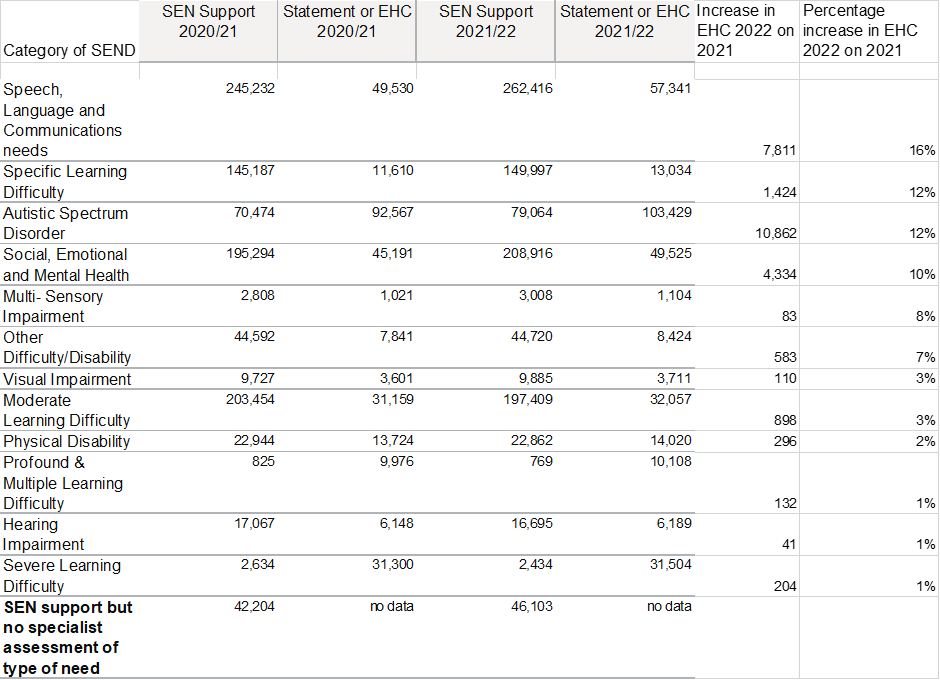
The identification of pupils with Autism or on the Autistic Spectrum at a level where an EHCP (Education and HealthCare plan) is necessary would appear to account for a significant proportion of the unplanned and unfunded growth in spending on SEND, according to the latest DfE data on Special Needs. Special educational needs in England: January 2022 – GOV.UK (www.gov.uk)

The number of EHCPs for young people on the Autistic Spectrum increased from 92,567 in January 2021 to 103,429 in the January 2022 census of pupils. To put this into some context, there are only around 10,000 EHCPs for young people with either a visual or hearing need leading to a requirement for an EHCP. Even, in the category of Social, Emotional and Mental Health, the number of EHCPs in place only increased from 45,191 to 49,525 between 2021 and 2022. However, I suspect this might increase over the coming year if predictions about the mental health of young people following the pandemic come to pass.

Source DfE SEND January 2022 Primary type of need table reordered with additional columns

The growth in EHCPs was even larger for young people with speech, language and communications needs than for those diagnosed as with an autistic spectrum disorder, although this group still only account for half as many EHCPs are for young people on the autistic spectrum disorder group.

Growth in support at this level must mean a radical rethink about how the SEND sector operate. There is no way that this number of young people can be educated in the present Special School sector. Indeed, the staffing of that sector is an issue where a spotlight needs to be shone fairly quickly. There are too many unqualified staff ‘teaching’ these young people, and no visible tracking data for the adequacy of the professional qualifications on top of the basic QTS that such teachers hold. Staying in a mainstream school with an EHCP might be something many parents would need to balance against the journey time to a special school and the more generous staffing of such schools against the qualifications of the staff.

A nine per cent overall increase each year in EHCPs also places a financial burden on more rural local authorities where transport and often that means a driver of a taxi plus another person for each additional EHCP. With fuel costs rising almost by the day, the forward pricing of these contract for next year must already be causing headaches for local authority budget makers.

I don’t have the answers to this issue, but it must be of serious concern that there is sufficient finance for our most vulnerable children to receive as good an education as possible so that they can lead fulfilling lives as adults.  

In-year admissions matter

Each year thousands of children move to a different school. In some cases, it is because either a parent has a new job or has been relocated by an employer to a new location. Information in many parts of the country about schools with places available is still as sketchy as when I first started advising relocation firms some forty years ago.

Finding a house is easy, plug in a price band and see what comes up on the search engines. But, what’s the point of buying a house where there are no school places? Children may face either a long period out of school or a long journey to the nearest school with an available place.

So, here’s an idea. A traffic light system to tell parents about the state of schools on local authority web sites and linked to a page on the DfE site.

Here’s how it might work.

Green – places available in-year for all or most year groups

Amber – some places in some year groups

Red – few places or even no places and not worth joining the ‘waiting list’ unless you live very near the school.

Of course, it leaves the system open to gaming – as if the present system was free of such tactics – by naming a full school and expecting transport to be paid for if the nearest school with a place is more than three miles away. But, the risk of that approach is that you get the school nobody else wants to go to.

The situation is especially acute for children with an EHCP and needing a place in a special school. Managing those moves for often severely challenged young people can be especially difficult mid-year. I would encourage employers to take that into account when arranging start dates for the parent.

The issue of in-year admissions is especially challenging in some areas at present because of the influx of children and their mothers from the Ukraine. Often host families live in areas of over-subscribed schools and that can put pressure for local authorities, especially where most of the secondary schools are academies. Hence my traffic light idea. After all, parents don’t understand that local authorities cannot just tell an academy to admit a child.

As the current Schools Bill is wending its way through parliament it might be worth the government either bringing forth the secondary legislation to return control of in-year admissions to local authorities that was mentioned in the last two White Papers or adding a clause to the Bill agreeing to do so within six months of the commencement date of the Act.

As regular readers of this blog know, another group that could benefit from this change are children taken into care and moved away from their local area, usually for very good reasons. This almost always means a change of school. If you want to know why I feel so strongly abut this, search for the post about Jacob on this blog.

Administrative changes need champions, and this is one that I hope many will champion.

No room in the school

Last week the Children’s Commissioner for England published a disturbing report about children placed into care and moved away form their local area. Entitled Pass the parcel: children posted around the care system is resonated with concerns raised by this blog in the past about the education of these children. https://www.childrenscommissioner.gov.uk/wp-content/uploads/2019/12/cco-pass-the-parcel-children-posted-around-the-care-system.pdf

The report highlighted the fact that 30,000 children are placed in care setting ‘out of their area’. Of these, some 11,000 are more than 20 miles from what they term ‘home’, with 2,000 placed more than 100 miles away. There may be good reasons for such a move. These include safeguarding issues such as avoiding former gangs or groups that were sexually exploiting the child.

However, the Children’s Commissioner Report suggests that often this type of move is because there is nowhere locally for these children to live. Pressure on Children’s Social services was always going to intensify as the number of children taken into care increased.   With local government having experienced a period of significant funding cutbacks from government it is not a surprise that services where need is expanding, such as this, are facing particular challenges, especially as the concept of  a ‘just in time’ economy meant resources could not be funded to be on stand-by if needed..

This blog has highlighted the issue of schooling for these children placed ‘out of area’ in several previous posts. Indeed, all Oxfordshire MPs in 2017 wrote to the Minister about the matter. As a result, it is disturbing that the Children’s Commissioner’s Report highlight this issue as still a matter for concern.

We spoke to children during September and October and many of them had no school place for the beginning of the school year. This was a common occurrence for older children, a number of whom were stuck waiting for decisions from professionals. This waiting game could last weeks or months, despite statutory duties to prioritise education, and in the case of emergency placements to secure suitable education within 20 school days.14 Virtual School professionals responsible for managing education plans for looked after children informed us that when children are placed outside of their local area it can contribute to delays because different areas have different application procedures to be understood and navigated. We were advised that children with Education, Health and Care (EHC) plans15 usually suffer further setbacks because their applications must go via Special Education Needs and Disabilities (SEND) teams and because schools take time to assess whether they can meet children’s needs. Page 15 of the Report – my emphasis.

In all, the Report concludes that ‘5% (140 children) of this out of area group missed a term of school or more, compared to 2% of those staying in their home local authority.’ The Report doesn’t identify the reasons why finding a school place should be so time-consuming for these young people whose lives have already been disrupted. Is the issue especially bad in areas where there are clusters of Children’s homes taking in children placed into care?

The Report concludes with the recommendation that:

‘The DfE ensure that its review of the role of virtual school heads looks at education processes in response to out of area placements. This review, which is already in progress, should consider: how virtual school heads can have a greater role in placement decisions; giving local authorities powers to direct academy schools to admit children placed away from their home areas; how delays in school transfers can be minimised for these children, especially unaccompanied asylum seeking children (UASC) and children with Education, Health and Care (EHC) plans, including how admissions processes can be simplified; how children can be kept in mainstream schools as far as possible.’   Page 17 of the Report

I would add and also look at what happens when children used to a comprehensive style of schooling are placed in secondary modern schools. These young people deserve better from Society.