
SEND in the spotlight

The identification of pupils with Autism or on the Autistic Spectrum at a level where an EHCP (Education and HealthCare plan) is necessary would appear to account for a significant proportion of the unplanned and unfunded growth in spending on SEND, according to the latest DfE data on Special Needs. Special educational needs in England: January 2022 – GOV.UK (www.gov.uk)

The number of EHCPs for young people on the Autistic Spectrum increased from 92,567 in January 2021 to 103,429 in the January 2022 census of pupils. To put this into some context, there are only around 10,000 EHCPs for young people with either a visual or hearing need leading to a requirement for an EHCP. Even, in the category of Social, Emotional and Mental Health, the number of EHCPs in place only increased from 45,191 to 49,525 between 2021 and 2022. However, I suspect this might increase over the coming year if predictions about the mental health of young people following the pandemic come to pass.
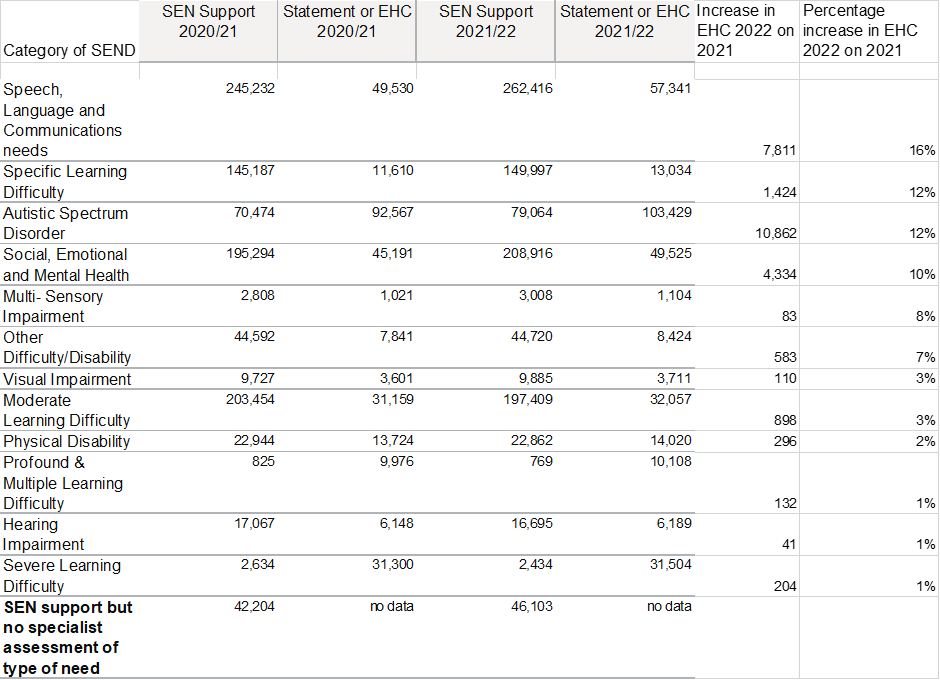
Source DfE SEND January 2022 Primary type of need table reordered with additional columns

The growth in EHCPs was even larger for young people with speech, language and communications needs than for those diagnosed as with an autistic spectrum disorder, although this group still only account for half as many EHCPs are for young people on the autistic spectrum disorder group.

Growth in support at this level must mean a radical rethink about how the SEND sector operate. There is no way that this number of young people can be educated in the present Special School sector. Indeed, the staffing of that sector is an issue where a spotlight needs to be shone fairly quickly. There are too many unqualified staff ‘teaching’ these young people, and no visible tracking data for the adequacy of the professional qualifications on top of the basic QTS that such teachers hold. Staying in a mainstream school with an EHCP might be something many parents would need to balance against the journey time to a special school and the more generous staffing of such schools against the qualifications of the staff.

A nine per cent overall increase each year in EHCPs also places a financial burden on more rural local authorities where transport and often that means a driver of a taxi plus another person for each additional EHCP. With fuel costs rising almost by the day, the forward pricing of these contract for next year must already be causing headaches for local authority budget makers.

I don’t have the answers to this issue, but it must be of serious concern that there is sufficient finance for our most vulnerable children to receive as good an education as possible so that they can lead fulfilling lives as adults.  

Special Needs Consultation

What a mess. Underlying the government’s Green Paper SEND Review – right support, right place, right time (publishing.service.gov.uk) published yesterday is a feeling that without a strong middle tier there can be no overall management of a SEND system to help our most vulnerable young people.

The DfE has recognised the need for a regional tier – that’s not up for consultation – but the Green Paper is weak on exactly what the structure below that would look like. With no coherent local government system in place across England, it will be a challenge to create a system that works effectively at the sub regional level, especially where rural ‘donuts’ surround urban unitary authorities. Schools Forum don’t seem to even receive a mention in the Green Paper, despite holding the purse strings for schools in general through the DSG. Will a hard Funding Formula make them little more than a talking shop?

The aspirations to make the NHS play the part designated for it in 2014 with the creation of EHCP is to be welcomed, although it will be interesting to see how general practice and the hospital sector step up to their responsibilities. Still, new data sharing arrangements are long overdue between health and education.

There is little said in the Green Paper about reform of the SEN Tribunals that almost unanimously find, at least in part, in favour of parents. What may be needed is an approach similar to civil court personal injury compensation, where judgements are set down, if necessary, by the high court, and only new conditions or cases need to go to a Tribunal. Saying ‘no’ all the way to the door of the Tribunal, possibly to save a local authority money should be a thing of the past. Such a system won’t be easy to create, but the present system places intolerable burdens on families in terms of both financial and emotional demands.

The Green Paper accepts that alternative provision is a mess, but doesn’t really identify the causes of the mess and which parts work well. If anything, this is an area where my suggestion of multi-purpose practices of teachers might work well and bring fringe activities within a regulatory framework. All pupils should be on a school roll until 18. Off-rolling should be a positive decision that for teenagers needs to be carefully scrutinised as to why ‘now’ and not earlier in a child’s educational journey. The child’s voice must be part of the decision, however uncomfortable that might be for some parties to that child’s education.

Hovering over all the good intentions is the spectre of funding. Perhaps this is why it is a Green and not a White Paper. Unless the Treasury finds the cash for a better system ‘fine words will butter no parsnips’ as the old saying goes.

More young people are been identified as requiring different approaches to learning than the average child and it is interesting that ‘gifted’ children no longer form part of the SEND agenda. However, an education system based upon the needs of every child is expensive and needs good coordination. The aim is there, but it will be well into the autumn before we see the result of this consultation and thus 2025 before any significant outcomes that don’t need legislative change. For changes requiring legislation it seems unlikely anything will happen this side of the next general election.

Better identification or more pupils with SEN?

The DfE data on pupils with special education needs in schools at the January 2019 census data confirms what everyone has been saying about the absolute number of such pupils being on the increase, as might be expected when pupil numbers overall are increasing. However, the percentage of pupils with both SEN and the need for an Education and Health Care plan (EHCP) has also increased. https://www.gov.uk/government/statistics/special-educational-needs-in-england-january-2019

As the DfE puts it, across all schools, the number of pupils with special educational needs has risen for the third consecutive year, to 1,318,300 (14.9%) in January 2019. This follows a period of year on year decreases from January 2010 to 2016. Over this period, the overall decrease was driven by decrease in the proportion of pupils with SEN support, while the percentage of pupils with a statement or EHC plan remained stable at 2.8%.

The percentage of pupils with SEN Support, those with identified special educational needs, but no EHC plan, followed a similar pattern rising to 1,047,200 (11.9%).

271,200 school pupils had an EHC plan in place in January 2019. This is an increase of 17,500 since January 2018. The percentage of pupils with an EHC plan has risen to 3.1% of the total pupil population in January 2019, after remaining constant at 2.8% from 2007 to 2017.

These figures show why both the high Needs Block of funding is under such pressure and also why local authority SEN transport budgets are also costing local taxpayers more each year. Moe pupils means more schools and it is to be hoped that in parts of England where there are many small local authorities the forward planning by the ESFA is robust enough to deliver these places at the minimum additional travel costs to taxpayers.

Across all pupils with SEN, Speech, Language and Communications Needs is the most common primary type of need at 22% of pupils. This had previously been Moderate Learning Difficulty, which has decreased to 20%.

Among pupils on SEN support, Speech, Language and Communications Needs is also the most common type of need, at 23%. Of those with an EHC plan, Autistic Spectrum Disorder remains the most common primary type of need with 29% of pupils with an EHC plan having this primary type of need. This has increased from 28% in January 2018.

The number of pupils in state-funded special schools has increased by 6% to over 120,000. This represents 9% of all pupils with SEN. The former trend towards integration now seems to be a feature of the past as numbers of SEN pupils in independent schools has also increased. 7% of all SEN pupils are placed in an independent school.

Special educational needs remain more prevalent in boys than girls, 4.4% of boys and 1.7% of girls had an EHC plan, both small year-on-year increases. Similarly boys were almost twice as likely to be on SEN support – 15% compared to 8% of girls.

SEN is most prevalent among boys at age 9 (23% of all boys), and for girls at age 10 (13% of all girls). SEN support is most prevalent among primary age pupils, before decreasing as age increases through secondary ages.

For EHC plans however, as age increases the percentage of pupils with EHC plans also increases, up to age 16, where nearly 4% of pupils have an EHC plan. However, it is not clear how many pupils with identified needs have been flagged by the NHS before they enter into education. This would save schools both time and resources and ensure early help for some children.

With the new focus on mental health, something schools have always been acutely aware of as an issue, I would not be surprised to see the number of pupils with SEN continue to increase over the next few years. The DfE will also need to consider how to help teachers keep as many of those that can manage their learning in mainstream schools to do so.


SEND on the agenda again

Until recently, the difference between the High Needs Block and remainder of the Dedicated Schools Grant that funds schooling in England was known only to a few officers and civil servants and those headteachers and governors serving on School Forum. The advent of a National Funding Formula for schools outside the special school sector and a growing demand for spending on children with additional needs has brought the issues with the High Needs Block into sharp relief.

The Local Government Association has published the outcomes of the research they commissioned earlier this year. A key paragraph sets out the issues and reflects two of the key issues, the ability of local authorities to ensure all schools act in ‘the common good’ instead of ‘their own good’ and the effects on the school funding of an extension of support to young people up to the age of twenty five from the High Needs budget, not originally designed for that age range.   The report can be found at: https://www.local.gov.uk/have-we-reached-tipping-point-trends-spending-children-and-young-people-send-england

Addressing the points raised in paragraph 17 of the Report would go a long way to creating a sustainable and successful system for young people with SEND.

  1. To create a more sustainable funding settlement going forward there may be merit in considering some key questions around how incentives in the system might be better aligned to support inclusion, meet needs within the local community of schools, and corral partners to use the high needs block to support all young people with SEND as a collective endeavour. These might include
  2. setting much clearer national expectations for mainstream schools;
  3. rethinking how high stakes accountability measures reflect the achievements of schools which make good progress with children and young people with SEND or at risk of exclusion;
  4. correcting the perverse funding incentives that mean that it can be cheaper to pass the cost of an EHCP or a permanent exclusion onto the high needs block than making good quality preventative support available in-school;
  5. looking again at the focus and content of EHCPs to afford greater flexibility to schools in how they arrange and deliver the support needed;
  6. providing ring-fenced investment from government designed explicitly to support new and evidence-based approaches to early intervention and prevention at scale;
  7. providing additional capital investment and flexibility about how that can be deployed by local government;
  8. issuing a national call for evidence in what works for educating children and young people with these needs, backed up by sufficient funding to then take successful approaches to scale and a new focus for teacher training and ongoing professional development;
  9. more specific advice for Tribunals, parents and local authorities on how the test on efficient use of resources can be applied fairly when comparing state and non-state special school placements; and
  10. reaffirming the principle around the equitable sharing of costs between health and education where these are driven by the health needs of the child or young person.

At present, there are perverse incentives for schools to look first to their needs and only then to the needs of children with SEND. The extension of the age range to twenty five brought many more young people into scope without necessarily providing the resource.

The announcement of more cash by the Secretary of State will help, but is almost certainly not enough to solve the problems being faced within many local authorities. At the heart of this is broken system for governance of our schools. In the post Brexit world, whatever it looks like, creating a coherent education system with democratic accountability across the board should be a high priority for the Education Department and its Ministers at Westminster.


Time to listen

Why do children with hearing loss, but no other impediment to their learning, fare so much worse than children of a similar ability but with normal hearing patterns? You could ask the same question of children with other disabilities. Later this month the DfE should publish outcome figures for the 2015 GCSE results for these pupils.

Last year, the National Deaf Children’s Society a key campaigner in the field of education for children with hearing impairment, published a chilling report on the state of their education http://www.ndcs.org.uk/for_the_media/press_releases/deaf_children_slip.html only 36% of these children achieved the %A-Cs at GCSE compared with more than 60% of their hearing classmates. Even more concerning was the decline in specialist teachers of hearing impaired children.

It is this latter point that concerns me at this time. Does our fractured governance system which fails to rate professional development of teachers properly now allow for a system to ensure the training of sufficient teachers of hearing impaired pupils or indeed or other pupils that need specialist training. Is there any obligation on multi-academy trusts or single converter academies to ever consider this type of issue? Local authorities certainly won’t these days and, I guess, it hasn’t featured on the agenda of many of the School Forums responsible for setting policy on funding distribution across school in an area. Funding is ever more weighted towards pupils and their immediate needs and rarely takes into account the longer-term strategic needs of the school system.

One implication of more pupils overall is that the number with impaired hearing is also likely to rise in proportion. This means that more teachers should be trained. How will this happen? Could such teachers be incorporated into the National Teaching Service or will we expect enthusiastic teachers to take out one of the new career loans for higher degrees on top of their existing student debt to provide out cadre of qualified teachers of hearing impaired pupils in the future, let alone the leaders in the special schools where some of these children are located. Who is going to employ the advisers to help classroom teachers with a child with mild hearing loss in their class to perform to the best of their ability and help close the performance gap?

These pupils and their compatriots with other special needs deserve a high quality schooling system not to be pushed to the margins of policy-making. I am sure that they aren’t seen as a nuisance, but perhaps they aren’t seen enough or even at all by those that consider these issues. There are only around 20,000 pupils with recognised hearing impairment in our school system, but each and every one deserves the best possible education. As, indeed, do all other pupils with special needs.


Are school leaders happy?

On the day that The Association of School & College Leaders (ASCL) revealed a survey that said two thirds of senior leavers were thinking of quitting the profession, the BBC published details of a survey by the Cabinet Office on job and life satisfaction that cranked some 274 different occupations by their satisfaction ratio alongside the average salary for the occupation. http://www.bbc.co.uk/news/magazine-26671221   Surprisingly, in view of the ASCL Survey, senior professionals of education establishments topped the satisfaction rankings for the eleven education occupations listed, with a score of 7.789 that put them in 11th place overall, just ahead of primary and nursery education professionals in 13th place on 7.786 some 0.003 points behind. Secondary education professionals were placed 34th on 7.637, just ahead of inspectors and advisers in 36th place. Support staff in school generally had a lower satisfaction rating than the professionals, with teaching assistants in 50th place, and midday supervisors and crossing patrol staff in 145 position, with a score of 7.308. School secretaries fared much better, achieving 17th place on 7.711 a score just 0.078 lower than that of their bosses.

SEN teaching professionals had a ranking placing them in 99th place, worse than the 61st place of Higher Education professionals and the 79th place of Further Education professionals. However, a category of ‘Teaching and other education professionals’ that presumably includes supply teachers ranked 106th in the satisfaction stakes, with a score of just 7.413. If you think the civil servants at Westminster are any happier, think again. National Government Administrative Staff has a satisfaction ranking that placed them in 187th place out of the 274 occupations. Clearly, not everyone is happy in the home of democracy.

Whether these two surveys support the jaundiced view that there are lies, damm lies and statistics, I am not sure. After all, I would expect heads to answer in large numbers that there were going to quit in the next five years because many are that close to retirement. I would be more concerned if the ASCL Survey showed younger head teachers as more likely to quit than those nearest to retirement. As to the Cabinet Office survey, I have no idea how many people we questioned in each category, and the methods used, but it is interesting that clergy came top of the 274 occupations with a satisfaction score of 8.291 whereas publicans cam bottom with a score of just 6.38. This really does seem to put God and mammon at opposite ends of the spectrum.

No doubt the scores for teachers will allow the DfE to take a more relaxed attitude to next week’s strikes by teachers, although BiS might need to pay more attention to unrest in FE & HE institutions. But, with the advent of free meals for infant pupils, the relative lack of satisfaction among meal supervisors that placed them in 145th place is probably the score for the group where the greatest attention needs to be focussed. Without the help of this group the introduction of the policy will face a significant challenge in many schools. Even more than the head, they have the capability to derail the policy if their lack of job satisfaction deteriorates even further.

SEN: a trend towards more segregation?

The debate about increasing pupil numbers has generally centred on the need for more primary places. However, it is important that children with special educational needs aren’t overlooked in this focus on the primary sector especially after the recent figures for pupils with SEN published by the DfE. They can be accessed at https://www.gov.uk/government/publications/special-educational-needs-in-england-january-2013

On the face of it the story is an encouraging one, with the number of pupils in the three northern regions of England with statements of SEN actually reducing between 2009 and 2013. However, in the other six regions the number of pupils with statements has risen over this period. At first, I wondered whether this had to do with the larger number of academies in the southern half of England during the review period or whether it was a consequence mainly of the falling rolls in the secondary sector. By reviewing the number of new statements issued during 2012 and comparing them with the number of those first made during 2008 it became clear that the number of new statements has risen across most of the country in 2012, except for the East of England where the number remained the same in the two years, but had dipped and the risen during the intervening period.

So, although the overall numbers of children with SEN and no statement has decreased over the past few years much of this may be due to the decline in the secondary school population rather than a shift in attitudes to SEN. As with all statistics one must be wary of reading too much into some of them. For instance, the table for the percentage of pupils with a Statement educated in a local authority area shows West Berkshire right at the top of the local authority list with 4% of pupils with statements of SEN: anyone with a knowledge of the SEN world will know that the presence of the Mary Hare School for pupils with hearing impairments within this small unitary authority will have significantly affected the outcome for the authority on this measure. Had the table considered home authority and the number of pupils with statements placed ‘out of the authority’ the result would undoubtedly have been quite different. No doubt the concentration of SEN provision in various parts of London is behind the fact that Newham has the lowest percentage of SEN pupils with statements educated in the borough of any authority in England except the City of London.

Young people with SEN remain some of the greatest challenges facing our education system and despite the progress being made those from some ethnic and social groups are more likely to feature in the statistics that those from other backgrounds. It may be 40 years since the Caribbean community in parts of North London challenged the apparent overuse of special schools for pupils from their community but, along with the Traveller and Roma/Gypsy communities, pupils of a Caribbean heritage still have a higher incidence of SEN needs than the school population as a whole.

Finally, the trend towards integration of those with SEN into mainstream provision seems to have been reversed with number of pupils attending special schools increasing by more than 6,000 over the past four years. However, it still represents just 1.2% of the total school population. But for many that will be an unjustifiably high figure.