
What has the growth in EHCPs been like in one local authority area? I used the DfE site to investigate the period between 2020/21 – the covid year – and 2025/26, the latest data available across one authority.
I considered two EHCP classifications: ‘Autistic spectrum disorder’ and ‘Social, emotional and mental health’ across all mainstream primary and secondary schools, and for pupils with Free School Meals and those without access to Free School Meals (FSM). This meant that pupils in special schools and alternative provision, including home schooling with an EHCP were omitted from the data used.
I was interested to see the growth in EHCPs in mainstream schools.
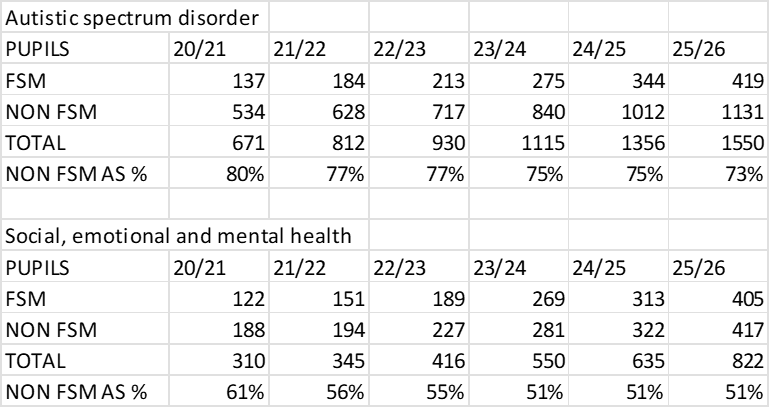
In both of the classification, the percentage of non-FSM pupils in the overall total fell. For EHCPs on the ‘Autistic spectrum disorder’, the non-FSM percentage fell from 80% in the covid year to 73% of the total in 2025/26. For the Social, emotional and mental health’ classification, the reduction was from 61% in 2020/21 to 51% in 2025/26.
Despite the changes in percentages, there was still a significant difference in the actual numbers between the two classifications. The gap between the number of EHCPs for the ‘Social, emotional and mental health’ classification for FSM and non-FSM pupils reduced from 66 in 2020/21 to just 12 in 2025/26.
However, for the ‘Autistic spectrum disorder’ classification over the same time period the difference between FSM and non-FSM pupils grew from 397 in 2020/21 to 712 in 2025/26. The overall number of EHCPs for the ‘Autistic spectrum disorder’ classification increased from 671 to 1550, more than doubling over the five-year period between 2020/21 and 2025/26.
Overall, more than 2,000 EHCPs were in placed in these two classifications in 2025/26. Perhaps, not surprisingly, the increase was more noticeable in the secondary sector, where non-FSM EHCPs for ‘Autistic spectrum disorder’ increased from 274 to 679 compared with an increase from 260 to 452 in the primary sector. For EHCPs for ‘Social, emotional and mental health’, the growth was less marked. In the primary sector from 65 to 168 and in the secondary sector from 72 to 251. This meant across the two classifications in 2025/26 there were more than 900 pupils with an EHCP or more than twenty per school and a likely four in each year group in Key Stages 3 and 4.
The increase in EHCPs in just these two classifications goes some way to explain the significant increase in the spending on SEND that this local authority, along with all others has faced over the past few years.
Significantly, in neither of the two classifications does there seem to be any sign of the rate of increase slowing down. How much further does the diagnosis of these classifications have to go until every child that needs an EHCP has been granted one?
This is the question planners in local authorities will be asking, especially with local government reorganisation underway. How will these 2,000+ EHCPs split between any new and smaller unitary , and will the funding from central government recognise the changes local government reorganisation will bring about?

